
 E-Paper



Is Delhi storm-ready? Deaths, wreckage paint bleak picture
The southwest monsoon is still weeks away. But in just three weeks of May, 12 people have died in rain-linked incidents


A barrage of sudden, violent storms has turned Delhi’s summer into a season of chaos. In a city accustomed to sweltering heat this time of year, winds howling at speeds of up to 80 km/hr have instead ushered in destruction. Trees have been ripped from the earth, tin sheets flung like shrapnel, and roads flooded in minutes. The skies open for barely half an hour, yet the Capital buckles — flights are grounded, homes collapse, and people die.
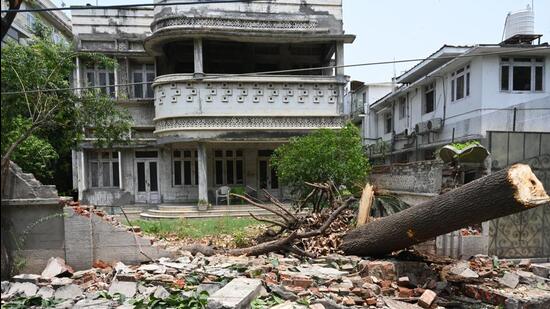
The southwest monsoon is still weeks away. But in just three weeks of May, 12 people have died in rain-linked incidents, many crushed under walls or electrocuted by falling wires.
The city, meanwhile, remains dangerously unprepared. Drains are still clogged, tree roots strangled by concrete, and the so-called quick response teams (QRTs) — announced with much fanfare by the new Delhi government — are nowhere to be seen.
On May 2, Delhi was battered by 77 mm of rainfall in a single day — the second-highest May rainfall ever recorded. The damage was swift and unforgiving. A woman and her three young children were buried alive when their house collapsed in Dwarka. In Green Park, a 25-year-old construction worker died of electrocution. That day alone saw five deaths.
Two weeks later, on May 17, a fresh wave of strong winds and brief but intense showers left four more people dead — three crushed when an under-construction house caved in at Paharganj, and another in Prahladpur, killed by a collapsing wall.
Then on May 21, a sudden storm greeted the city with fury. Wind speeds hit 80 km/hr. Hail lashed down in parts of the city. Three more people were killed — a nine-year-old girl in Dayalpur struck by a falling metal windowpane, a 22-year-old man crushed under a tree in Gokalpuri, and a 49-year-old homeless man electrocuted by a toppled pole in Lodhi Colony.
Count the first storm on April 11, and Delhi has already recorded 15 rain-related deaths this season — a grim echo of the 50 lives lost in last year’s monsoon. Little, it seems, has changed.
Trees, damage and deaths
Each time the wind rises, trees are the first to fall — blocking roads, crushing cars, and sometimes taking lives. On May 21, at least 54 fallen tree complaints were reported within the Municipal Corporation of Delhi’s (MCD) jurisdiction and 21 more within the NDMC area. Many crashed onto vehicles, requiring long hours of removal.
A senior DFS officer said they have attended more than 212 calls since Wednesday evening.
Most of these involved uprooted trees, collapsed structures, and damaged cars. “We can handle 200 calls per storm, but the traffic, weather, and fatigue make it extremely challenging,” the officer said, adding that such emergencies demand tight coordination between the police, MCD, and fire services.
But despite the launch of QRTs by chief minister Rekha Gupta in April — one team for each of Delhi’s 11 districts — their impact remains invisible. No official data has been released on their activities or effectiveness.
Experts said while QRTs and tree ambulances can be utilised, basic measures such as deconcretising trees was not being adhered by any agency.
“The National Green Tribunal in 2013 ordered that all trees be deconcretised within a one-meter radius. Agencies are not complying,” said environmental activist Bhavreen Kandhari. “Most trees that fall have had their root systems weakened by concrete. Even in the May 17 storm, when winds were just 40-50 km/hr, we saw widespread tree falls.”
Desilting targets off
The Public Works Department (PWD) had set a deadline of May 31 to complete desilting along 1,400 km of roads, but officials say only about 25% of the work is done, and the agency is all but set to miss its own target.
On May 5, HT had flagged that MCD’s annual desilting exercise is even behind schedule even more. As of early May, MCD had cleared only 21.32% of the silt from 800 large drains. That figure hasn’t seen a major update since. There’s also been no word on the annual “dangerous buildings” survey, usually conducted before monsoon to identify structures at risk of collapse.
An MCD official however said that the work is being carried out at “expedited pace” and the desilting will be completed before monsoon.
But unless it is done urgently, large parts of Delhi — especially underpasses and low-lying neighbourhoods — will be swamped at the first major downpour.
PWD and Irrigation & Flood Control Department (I&FCD) have been instructed to jointly inspect drains and coordinate water flow. But according to a May 21 PWD order, these inspections had not yet begun.
Delhi’s drainage system is an overlapping web of responsibilities. PWD manages 2,026 km of drains alongside 1,400 km of roads. These connect to larger drains under I&FCD, which ultimately flow into the Yamuna.
In 2023, 308 waterlogging hotspots were identified in Delhi by PWD. In 2025, that number has risen to 445, according to Delhi Traffic Police. Of these, 335 fall under PWD’s purview.
MCD, meanwhile, manages 12,892 smaller drains (under 4 feet wide), stretching over 6,070 km. It had targeted removal of 40,086 metric tonnes (MT) of silt from these drains — but has only managed 9,474.8 MT so far, or about 24%. The 800 larger drains under MCD total 530 km, but the progress there too remains incomplete.
Despite repeated directives from the Delhi government urging departments to work in tandem to avoid flooding, progress on the ground remains sluggish.
Advisory to aide residents
On Thursday, MCD officials issued an advisory to resident welfare associations (RWAs) ahead of more expected thunderstorms. RWAs were asked to warn residents against standing near trees or electric poles during storms, and to secure loose balcony items like flowerpots and tin sheets that could turn into dangerous projectiles. With winds repeatedly hitting 70-80 km/hr this month, the advisory also urged people not to park vehicles under trees or unstable structures and to keep emergency supplies like torches and first-aid kits ready.
But unless Delhi gets serious about its pre-monsoon preparation — deconcretising trees, desilting drains, coordinating departments — its streets will keep turning into hazard zones. And with the real monsoon yet to arrive, worse could still lie ahead.

Stay updated with all top Cities including, Bengaluru, Delhi, Mumbai and more across India. Stay informed on the latest happenings in World News along with Delhi Election 2025 and Delhi Election Result 2025 Live, New Delhi Election Result Live, Kalkaji Election Result Live at Hindustan Times.


