E-Paper



Delhi’s Karol Bagh stretch no longer a pedestrian haven, chaos is back
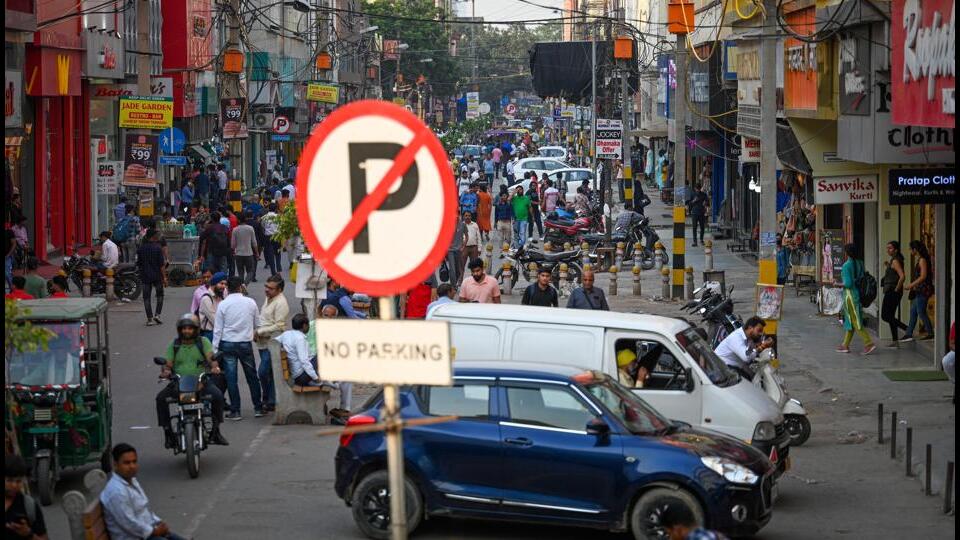
Footpaths have been encroached upon by shops and hawkers, and the little space left is usually where two-wheelers are parked.

 Prefer HTon Google


Karol Bagh’s Ajmal Khan Road is synonymous with readymade garment shops, and is packed with shoppers at all times of the day. In 2016, the Union ministry of housing and urban affairs (MoHUA) proposed that Karol Bagh be made pedestrian-friendly, and as part of the project, the erstwhile North Delhi Municipal Corporation or North MCD suggested that Ajmal Khan road be treated along the lines of an open-air mall, and in April 2019 declared the entire 1.7km stretch a motorised vehicle free zone.
Also read: Delhi govt moves SC over LG-led panels
The curbs on vehicles did wonders — a localised study conducted by Centre for Science and Environment (CSE) on Ajmal Khan Road in May 2019 showed a 27% decrease in PM2.5 concentration in comparison to the nearby Arya Samaj Road. Similarly, noise levels were also found lower at Ajmal Khan Road compared to the roads nearby.
Soon, the North MCD began heralding Ajmal Khan Road as a rare success in civic body efforts to pedestrianise inner roads in the Capital.
Cut to 2023, and the vehicle restrictions have all but disappeared. Both ends of the road have posters that clearly state that the street is off limits for vehicles, with the legend “no entry, no parking” in bright, bold letters, but local residents, merchants and shoppers brazenly enter the street in their vehicles, and park there with impunity.
Footpaths have been encroached upon by shops and hawkers, and the little space left is usually where two-wheelers are parked. Pedestrians have nowhere to walk but on the street itself, where they usually have to dodge cars — both moving and parked — even as two-wheelers drive with reckless abandon in an already crowded space.
The last vestige of the pedestrianisation initiative — planters placed along the road — have been converted into dustbins and spittle pails, while benches on pedestrian pathways have been roughly brushed aside to make space for cars to park.
Devinder Kohli, a trader in the market, said the project was bound to fail. “It is very difficult to change habits. People don’t want to carry expensive goods on foot, and then to an off-street parking site, due to safety issues. Nobody wants to pay ₹100 to park on nearby streets. They should have tried it (the pedestrianisation project) in a new market instead of a well-established one,” he said.
The idea of pedestrianising Karol Bagh dates back to at least 2010, when the Unified Traffic and Transportation Infrastructure (Planning & Engineering) Centre or UTTIPEC, which is the infrastructure planning arm of the DDA, approved a proposal by MCD to make the entire commercial centre vehicle-free, with off-street parking.
However, the plan was ultimately rolled back after stiff resistance from market associations.
Later, in June 2016, the MoHUA identified Karol Bagh for a model decongesting project. As part of this project, the MCD began pedestrianising Ajmal Khan Road — the contract for on-street parking was cancelled, and bollards were installed at all intersections to cordon off vehicular traffic. Potted plants were placed on the road to enhance the aesthetic quality of the stretch, street furniture and benches were provided at strategic locations to facilitate shoppers, and dustbins were installed at regular intervals. Electric shuttles — similar to those at the airport — were also introduced for shoppers to traverse the length of the road, and to take them to-and-fro the off-street parking spaces.
Today, most of these interventions lie in a dilapidated state. During spot checks on May 9 and 19, HT found that the valet parking service, which would park shoppers’ vehicles at off-street sites, has been discontinued. The electric shuttles now only take shoppers to-and-fro the nearby Karol Bagh Metro station. The planters, meanwhile, are filled with trash while the dustbin themselves have all but disappeared.
Murli Mani, who heads the Vyapar Mandal Karol Bagh, placed the blame for the failure of the project squarely on the MCD.
“They (the civic body) demanded that the MCD be paid ₹4.4 lakh per month for off-street parking, which was not part of our original agreement. A proposed multi-storey parking structure at nearby Shastri Park is stuck in legal issues. Traders then started parking their cars outside their shops. The benches, footpaths and other street furniture now need urgent repairs. MCD should also start putting up railings as many of these benches are damaged by vehicles. All the progress has been rolled back,” he said.
Shoppers too bemoaned the failure of the project. Reena Gupta, 42 a resident of Mayur Vihar who frequents the market, said the road felt much more secure during the pedestrianisation initiative. “One can walk in a much more carefree manner when there are no vehicles moving behind you. One also needs to be careful, as many incidents of chain snatching are being reported from the city. Earlier, the market was a much more controlled space,” she said.
Also read: Three problems with the Delhi ordinance
An MCD spokesperson said violations on the pedestrianised stretch will be looked into by the corporation. “We will try to create a more robust system to stop these violations. We will also examine what arrangements can be made with local traders’ associations in terms of parking management, and if something can be done on a revenue sharing basis, similar to that in Lajpat Nagar,” the spokesperson said.
HT reached out to the Delhi Traffic Police, but officers refused to comment on the violation of the pedestrianisation project.
Road safety expert Sarika Panda Bhatt said pedestrianisation projects have the potential to greatly improve the liveability and sustainability of cities, so it is important to evaluate the reasons behind the failure of the Ajmal Khan Road project.
“The initial pedestrianisation of Ajmal Khan Road was a positive step, as it aimed to create a safer and more vibrant space for pedestrians… The return of vehicles to the pedestrianised area and the utilisation of the road width for car parking is concerning. It indicates a lack of sustained commitment to prioritising pedestrians and promoting sustainable modes of transportation. It is crucial to ensure that once pedestrianisation initiatives are implemented, they are consistently enforced and monitored to prevent such relapses,” she said.