E-Paper



Leopard killed in accident at Alipur near Delhi
A leopard was found dead on National Highway 44 in north Delhi. It is believed to have been killed due to a road accident.

 Prefer HTon Google


A leopard was found dead on National Highway (NH) 44, near Khatu Shyam temple in north Delhi’s Alipur, in the early Wednesday – just days after another big cat was sighted in south Delhi’s Sainik Farms. The body of the animal was cremated at the Delhi zoo on Wednesday evening, zoo officials said.
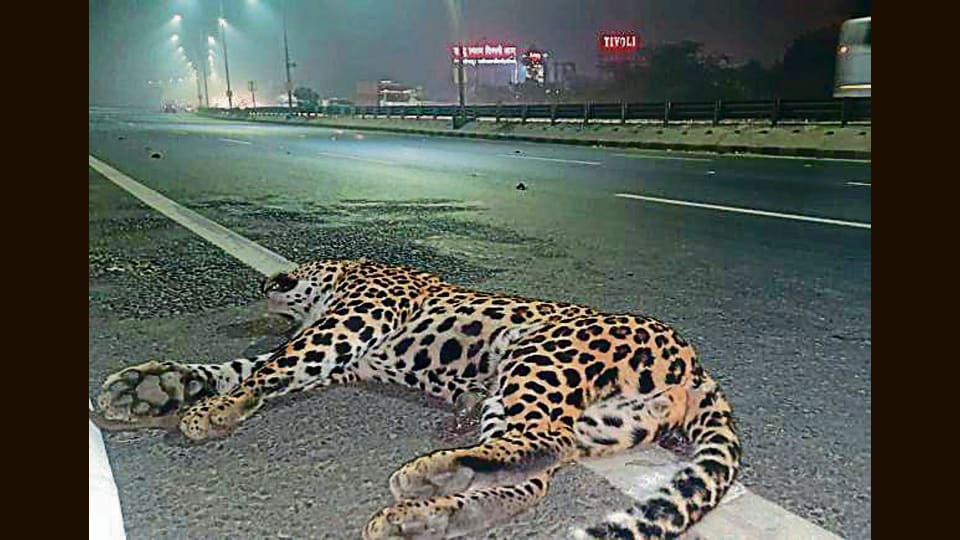
“The leopard was between the juvenile to adult phase, but we are yet to ascertain the precise age. The post-mortem examination confirmed that it was a a male and that it died due to “strong impact”, which is suspected to be a roadkill incident,” said a senior forest official, on condition of anonymity. He added that the leopard is not believed to be the same that was spotted at Sainik Farms.
The Delhi Police control room received a call around 4am on Wednesday. A police team that reached the spot found the animal lying on one side of the road. The animal was later handed over to the state forest and wildlife department, which carried out a post-mortem and confirmed it to be a roadkill death.
The animal is suspected to have travelled along the Yamuna and may have come from as far as the Rajaji National Park in the Shivalik hills, experts say.
“Leopards are generalist feeders (species that can live in many different types of environments, and have a varied diet) and have been known to move along the Yamuna, where there are tall grasses and urban settlements with stray dogs. This leopard may have taken a similar route, possibly coming from as far as the Shivalik,” said Faiyaz Khudsar, scientist in-charge of DDA’s Biodiversity Parks programme.
DCP (outer north) Ravi Kumar Singh said the incident took place under the jurisdiction of the Alipur police station and a team reached the spot on the highway, following a PCR call at 4 am. “Prima facie, it appeared to be a case of traffic accident. The body was handed over to forest department,” Singh said.
The leopard at Sainik Farms was spotted first on the night of December 1, with at least two videos surfacing online of the animal, which since then was spotted multiple times by locals, forest officials and the police. The big cat was last sighted on December 6 and is now suspected to have returned to the Asola Bhatti Wildlife Sanctuary, where at least 8 leopards are said to be living.
The department also said they had received a call from Burari’s Mukhmelpur just a day earlier, but did not find anything there. “A call, claiming that a tiger was sighted was received on Tuesday. Our team went and scanned the area, but could not find anything, including any pugmarks,” the officials said.
Praveen Kumar Rana, 32, a Mukhmelpur resident claimed that the leopard was spotted in his nearly three-acre farm patch there. “A leopard was spotted on Tuesday morning in the tall grass in my farm. We called the forest department, but they could not find it and their teams left by the evening,” he told HT.
Though generally sighted in parts of south Delhi abutting the southern ridge, which is an extension of the Aravallis into Delhi, isolated sightings of leopards in north Delhi have also been made in the recent past.
In December 2015, there were reports of a leopard in north Delhi’s Usmanpur, around 15 kms from this spot. The leopard was never captured though. Next year in December 2016, a leopard was sighted multiple times at the Yamuna Biodiversity Park in north Delhi. The big cat had to ultimately be trapped in a cage and released in the Shiwalik range near Saharanpur, after local residents living around the biodiversity park complained that they perceived the leopard as a threat.