E-Paper



Mapping the Delhi heat: Daily max temperature, and beyond
Experts say heat index is often highest during the month of June and early parts of July, with humidity levels constantly remaining around 40-50%, coupled with temperatures of over 40 degrees, with the body’s ability to not effectively sweat making it more dangerous than spells of dry heat.

 Prefer HTon Google


Can 35 degrees Celsius temperature kill someone? And why does 35°C sometimes feel much hotter than 40°C?.

That’s because there is temperature, and temperature, and finally, temperature.
As parts of India (Delhi and the northwest, for instance) enter their fourth straight month of summer, people are becoming used to three different measures of temperature -- each relevant.
The first is maximum temperature, an easy measure to understand.

The second is the heat index (HI), a function of maximum temperature and humidity, but calculated in the shade.
The third is wet-bulb temperature, a function of maximum temperature, humidity, wind speed, and solar radiation, and calculated in the sun (under direct sunlight).
The first matters to everyone because it is an easy measure of heat; the second tells us why we feel hotter on a day with a 35°C maximum temperature and 70% relative humidity (actual feel: 50°C ) than on a day with 42°C maximum temperature and 30% relative humidity (actual feel: 47°C ).
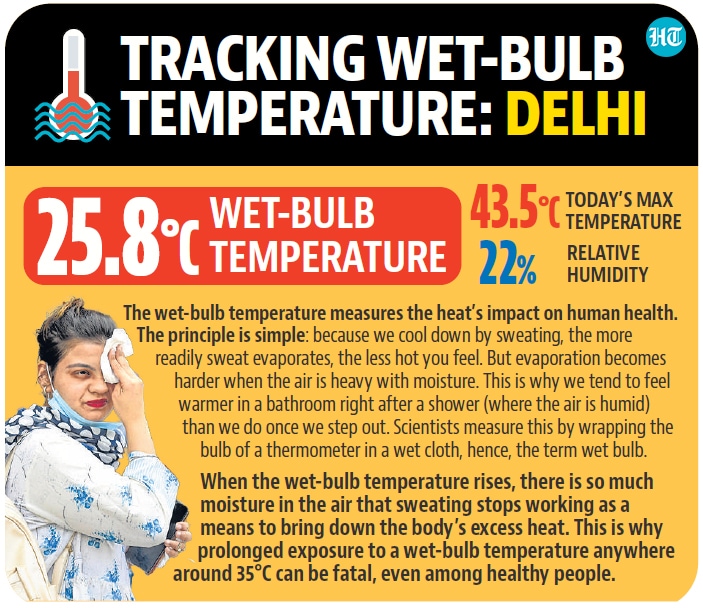
And the third is especially relevant for the occupational health of anyone who is going to be spending a lot of time working outdoors, in the sun, on a hot and humid day.
So, on May 26, Delhi’s temperature was a low 35.8°C at 2:30pm, but the relative humidity of 36% meant it felt more like 38°C . The temperature the very next day at the same time was 38.4°C , but with a humidity of 34%, the Heat Index (HI) was closer to 42 degrees. The next day, a temperature of 38.6°C with a relative humidity of 41% meant the HI was 45°C , substantially hotter than the actual temperature at the time. Though currently not calculated by the India Meteorological Department (IMD), HI is used widely, particularly in tropical countries, to understand the extent of discomfort being felt by an individual by factoring in both humidity and temperature.
Experts say HI is often highest during the month of June and early parts of July, with humidity levels constantly remaining around 40-50%, coupled with temperatures of over 40 degrees, with the body’s ability to not effectively sweat (which is how human bodies cool) making it more dangerous than spells of dry heat .
According to Live Weather, a weather channel, since May 26, there has been a difference of as much as 7 degrees between the actual temperature and the HI in Delhi, with a temperature of 39.4°C and a relative humidity of 40% on May 30, making it feel more like 47°C .
“Heat Index was not a factor earlier as Delhi had dry weather in March and April. This becomes more prominent when the moisture content in the air rises, generally due to a high number of western disturbances, or moisture being fed due to the onset of monsoon,” said an IMD official, adding that June is generally the most uncomfortable month in Delhi, largely because of a high HI.
Naresh Kumar, scientist at IMD, said the weather office is working on a HI model . “HI (data) will also be released in the future, along with the temperature. We are already incorporating the impacts of high humidity and wind speed in the alerts we issued, so if humidity is expected to be high, we generally upgrade the alert from yellow to orange and this is done to ensure people are more cautious on that particular day.”
Experts say that while during the dry heat months of March and April, the body is able to cool off more effectively, owing to low moisture content in the air – that same ability for the body to sweat out reduces when humidity levels are 50% or higher. “This is why humid weather is more dangerous than dry heat,” said Gufran Beig, founder project director at Safar, a forecasting body under the ministry of earth sciences.
And it is the why, for people working outdoors, wet-bulb temperature (which HT publishes everyday) is most important. Exposure to a sustained wet bulb temperature of 35°C or higher can kill even healthy people.
Mahesh Palawat, vice-president of meteorology at the private weather forecaster Skymet, said HI is often shown in most weather apps these days. “If the temperature outside shows 40 degrees, but humidity is high, it may feel closer to 46 or 47 degrees. This phenomenon is generally seen from early to mid-June as the onset of southwest monsoon begins to add moisture to the air and easterly winds start blowing towards Delhi-NCR.”
Interestingly, Delhi’s HI was lower than the actual temperature over the last three days, when mercury was over 42.5 degrees, but humidity levels dropped. On June 5, a temperature of 43.6°C and a relative humidity of just 14% meant the HI was actually 42 degrees. On June 4, a temperature of 43.2°C and a relative humidity of just 13% meant the HI was around 41 degrees, while on June 3, the temperature of 42.6 degrees with a humidity level of 12%, made it feel more like 40°C .
Madhavan Rajeevan, former secretary at the Union ministry of earth sciences said, “It is easy to incorporate relative humidity and high moisture content while measuring temperature” , adding that HI is the “ideal” measure “to ascertain the health impact of high humidity”.
Abinash Mohanty, Programme Lead at the Council on Energy, Environment and Water (CEEW) globally, said the rise in wet-bulb temperature and high heat index -- both used to denote discomfort due to high humidity -- has led to mass mortality in 2022. “In India, such weather patterns could have severe repercussions on human health and productivity, which in turn could cause revenue loss for industries and impact agricultural productivity. The current trends and estimates imply a fivefold increase in wet-bulb days across Delhi by 2100. This is indeed a different and severe heat to worry about, and meteorological agencies need to integrate both wet-bulb temperature and heat index-based impact warnings in their forecast quickly.”