
 E-Paper



New Goa airport to enhance tourism, boost connectivity in India
Developed at the cost of Rs. 2,870 cr, the airport is located at Pernem Taluka in North Goa which is approximately 35 km from the capital city of Panjim. It is accessible from NH66 which runs north-south through Goa and connects along the coastline to Panvel near Mumbai to the north, and Edapalli in Kerala to the south


Prime Minister Narendra Modi in Maharashtra inaugurated the Mopa International Airport in Goa in a massive boost the air connectivity in the country.
The new international airport will soon become functional as IndiGo and GoFirst have already announced plans to launch 168 and 42 flights, respectively, for the airport next months.
“Strengthening domestic connectivity, GoFirst will commence 42 non-stop weekly flights to and from the new Goa airport (Mopa) with the first flight scheduled to take off on January 5, 2023,” a statement by GoFirst read.
Also Read: PM Modi inaugurates greenfield international airport, to be named after Parrikar
IndiGo said that it will operate 12 daily and a total of 168 weekly new flights to and from the Mopa airport. “This will be IndiGo’s largest ever new station launch and will immediately connect new Goa international airport to eight cities across India,” the airline spokesperson said.
The existing airport at Goa which is a civil enclave for which a terminal building is maintained by the Airports Authority of India (AAI), is a defence airport belonging to the Indian Navy.
With an aim to attract clean high-tech technologies and industrial financial services, the new international airport will likely put Goa on the international map for trade commerce and high-tech industry on the pattern of Dubai, Singapore, Hong Kong and Shanghai.
The airport is being developed in four phases starting from 4.4 million passengers per annum (MMPA) and will gradually increase its size to 5.8 MPPA in phase 2. 9.4 in MPPA in phase 3 and finally 13.1 MPPA in the fourth phase. The project has an ultimate potential of 33 MPPA.
The aerodrome was licensed by the aviation regulator, the Directorate General of Civil Aviation (DGCA) on October 26 this year permitting flight operations.
Developed at the cost of Rs. 2,870 cr, the airport is located at Pernem Taluka in North Goa which is approximately 35 km from the capital city of Panjim. It is accessible from NH66 which runs north-south through Goa and connects along the coastline to Panvel near Mumbai to the north, and Edapalli in Kerala to the south.
The new Goa airport is a state-of-the-art 24x7x365 international airport serving all segments of inbound and outbound tourism.
GMR Goa International Airport Limited (GGIAL), by and large, a wholly owned subsidiary of GMR Airports Limited (GAL), is a special purpose vehicle (SPV) created to design, build, finance, operate and transfer (DBFOT) the new Goa airport.
This is the first airport to be built under the aegis of the New Civil Aviation Policy (NCAP), 2016. GGIAL signed the concession agreement with the Goa government on November 8, 2016, for a period of 40 years from the appointed date, with an extension provision of 20 years. The foundation stone of the airport was laid by PM Modi on November 13 of the same year.
The airport is built on 2,132 acres, of which 232 acres are earmarked for city-side development for commercial purposes.
This airport’s primary runway is code E and F compliant (where big aircraft like B747 and A380s can land) which is 3500 m long and 60 m wide.
“The code 4E/F runway is equipped to handle even extra-large wide-bodied jets like an Airbus A380. The airport also has two rapid exit taxiways (RETs) and six cross taxiways for aircraft circulation and to avoid congestion,” a GMR spokesperson said.
The passenger terminal building of the airport is being built on 67,726 sq. meters comprising 18 check-in counters along with four self-baggage drops (SBD), an advanced baggage handling system and other amenities and utilities, which could cater to 33 million passengers at its peak time.
“The PTB is designed in a way that its central processor and pier can be expanded linearly towards east and west in a modular way,” the airport officials said.
Also Read: PM Modi inaugurates 3 National Ayush Institutes at event in Goa
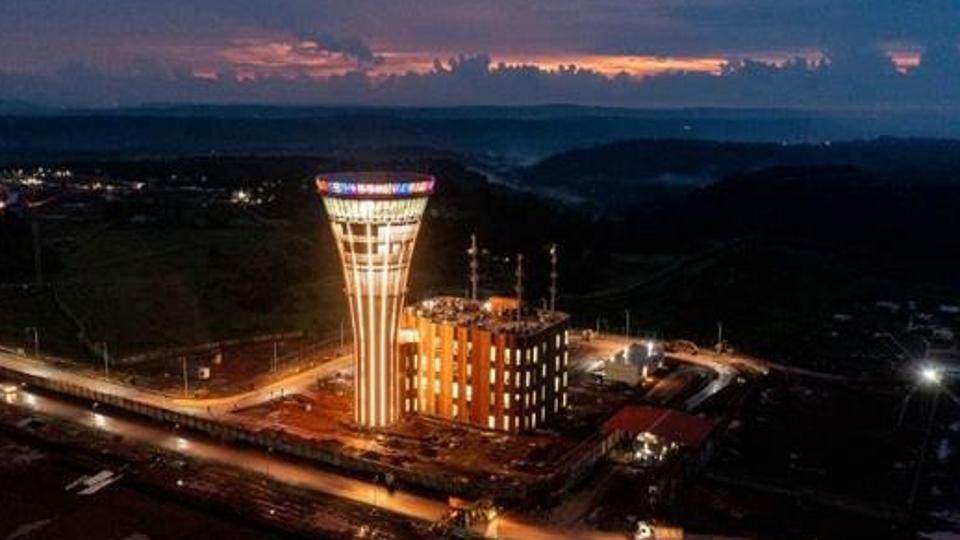
Designed in the form of an Olympic torch the air traffic control tower is 49 meters in height. The Olympic torch design is created to capture the unifying spirit of Goa and project Goa as a torchbearer of tourism in India.
According to the officials, the Mopa airport is connected to the city with planned multi-modal connectivity. A six-lane expressway, NH166S, is being built to connect with the existing NH66, which will provide seamless connectivity to the traffic going in the direction of the highway. The airport is also connected to Karnataka state by NH748A.
Officials said that the new Goa airport is designed keeping in mind the nature, culture, and spirit of Goa.
“5G infrastructure is provided with smart city elements. The exterior building is designed with two separate roof structures resembling the vernacular architecture, one over the processor and the other over the pier building providing flexibility for the building to expand individually,” an airport official said.
“The interior of the building is a blend of contemporary and Goan architecture to portray the exuberant culture, and colourful and eventful lifestyle of Goa also contributing towards a greater passenger experience and memorable moments throughout the passenger journey,” an airport official said adding that its architecture forms the shape of “Shankha” which conveys positive vibrations and atmosphere inside the passenger terminal building.
The airport has adopted best-in-class technologies like 3-D Monolithic pre-cast buildings, StabilRoad, Robomatic Hollow pre-cast walls and 5G compatible IT infrastructure, the official said, adding that passenger facilities like self-baggage drop, analytics tools have also been deployed.
The airport will also promote local artisans by creating a designated area for a flea market under ‘Prakal Initiative’. The use of bright hues of red, blue, green, and yellow with white borders on the walls replicates the look and feel of old Goa. The food court at the PTB recreates the charm of a typical Goan café, with its walls painted in bright colours and the counters made of tin-glazed blue-and-white Azulejos tiles.
The Mushroom design AC ensures optimum utilization of space while providing efficient cooling. The infrastructure is the best-in-class design certified to platinum standard by the Indian Green Building Council of CII (IGBC).
World-class cargo facilities comprising 25,000 metric tonnes of temperature-controlled cargo handling capacity have the potential to become an ideal hub for exports from Goa, Southern Maharashtra and Karnataka, officials said.

Stay updated with all top Cities including, Bengaluru, Delhi, Mumbai and more across India. Stay informed on the latest happenings in World News along with Delhi Election 2025 and Delhi Election Result 2025 Live, New Delhi Election Result Live, Kalkaji Election Result Live at Hindustan Times.


