E-Paper



Pollution-check measures amped up in Delhi as AQI improves marginally
The sub-committee of the Commission for Air Quality Management for Delhi-NCR and adjoining areas met on Monday, and decided to upgrade the Grap measures from the current steps that were being enforced under the ‘very poor’ air category

 Prefer HTon Google


The authorities on Monday upgraded pollution control measures in Delhi on Monday and introduced differential rates for public transport to encourage off-peak travel mandated under the Graded Response Action Plan (Grap) as Capital’s air was recorded in the very poor zone after remaining severe for three consecutive days.
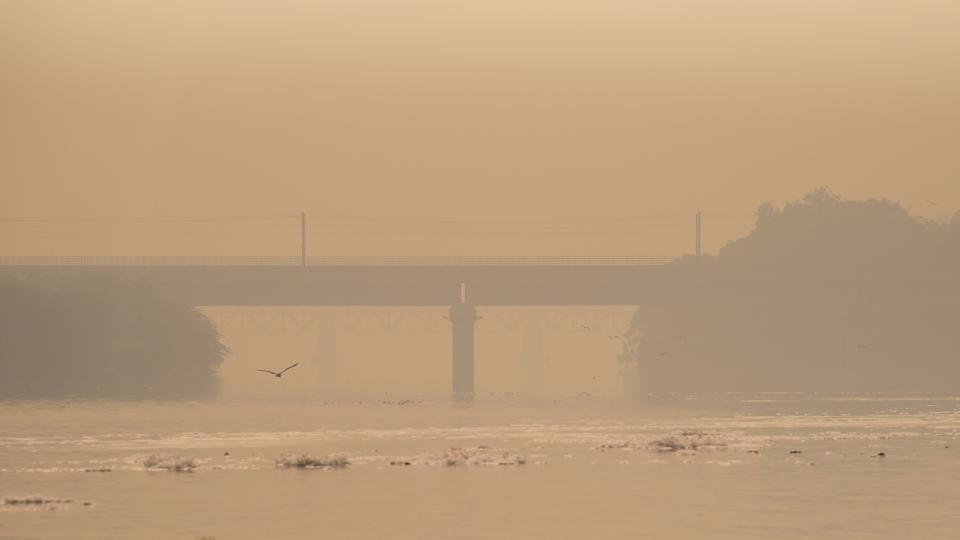
The steps that also include closure of brick kilns and optimising power generation by gas-based plants are mandated under the Grap when air quality turns severe (when AQI value is more than 400 or ambient PM2.5 concentration 250 microgram per cubic metre of air).
The sub-committee of the Commission for Air Quality Management for Delhi-NCR and adjoining areas (CAQM) met on Monday, and decided to upgrade the Grap measures from the current steps that were being enforced under the ‘very poor’ air category.

Delhi’s air quality plunged into the severe category on November 5, a day after Diwali, with an AQI of 462 -- the highest for a day after Diwali since the records of AQI are being maintained. Scientists blamed blatant violations of the ban on bursting of firecrackers and the increase in the number of farm fires for the sudden spike in air pollution. On Saturday, Delhi reported an AQI of 437 and that of 428 on Sunday, when the share of the stubble fires reached the season’s highest at 48%.
On Monday, the air improved a bit at AQI of 390 with wind speeds picking up and the share of stubble fires to Delhi’s PM2.5 pollution dipping to 30%, according to CPCB and Safar data.
VK Soni, part of the sub-committee on Grap, said wind direction is expected to remain northwesterly over the next five days with local wind speed ranging between 6-10 km/hr. But, the share of stubble burning will remain high during this period. “Wind speeds will be between 6-10 km/hr over the next five days, but will become calm at night, causing air quality to decline. The air quality will fluctuate between the higher end of the ‘very poor’ category and the ‘severe’ category over these next five days,” said Soni.

Prashant Gargava, member secretary, CPCB and chairperson of the sub-committee, said frequency of mechanized sweeping and road cleaning needed to be increased during this period. “The directions issued include the need to identify roads with high dust generation. We have also asked the NCR states to disseminate information on air pollution so that citizens can take steps to reduce air pollution,” he said.
The Delhi Metro Rail Corporation (DMRC) and the Delhi Transport Corporation (DTC) did not comment on the latest directions to introduce differential rates.
Forecasting agencies said while wind speed over Delhi remained around 10 km/hr on Monday, there was a drop in the speed of winds blowing from Punjab and Haryana towards Delhi, thereby reducing the contribution of farm fires to 30%. In contrast, the contribution of farm fires was 48% on Sunday, the highest so far this winter season.
According to the System of Air Quality and Weather Forecasting And Research (Safar), a government forecasting body, around 4,189 fires were recorded in the northern plains on Sunday as compared to 5,430 fires on Monday. However, slow ‘transport level’ winds are playing a role in the reduction in AQI, the agency said.
“Parameters have largely remained the same, but wind speed at the higher-elevation – which transports pollutants from Punjab and Haryana towards Delhi, is slow and has reduced the impact of stubble burning. If wind speed is slow, these pollutants are unable to complete the journey to Delhi and disperse during the journey,” said Gufran Beig, founder and project director at Safar.
In its daily forecast, Safar said that the air quality in the national capital may improve slightly in the next 24 hours, but will still remain in the ‘very poor’ category.
R.K Jenamani, scientist at IMD, said visibility ranged from 1000 to 1800 metres at both Palam and Safdarjung, with wind speed remaining around 8-10 km/hr during the day. “Like Sunday, visibility remained similar, but the minimum temperature was just 13.6 degrees Celsius. Local wind speed will remain in a similar range, with north-westerly winds continuing to prevail over the next 48 hours,” he said.
Delhi recorded a minimum temperature of 13.6 degrees Celsius, and the maximum temperature was recorded at 29.2 degrees Celsius.
Dipankar Saha, former head of CPCB’s air laboratory says the problem is not limited to Delhi, but the entire Indo-Gangetic Plain region, which needs to be treated as one large air-shed. “Emissions can travel a long range and distance if wind speed and wind direction are ideal. Satellite data will show a thick haze over not just Delhi NCR, but it spreads across the entire Indo-Gangetic Plain region,” he said.