
 E-Paper



Punjab facing gamut of problems in combating farm fires
At the heart of the problem are two core issues: First, a large part of the state’s agriculture sector sticks to a rice-wheat formula for farming. The second concerns how farmers harvest paddy, using a machine known as the combine harvester.

 Prefer HTon Google


Widespread rain across over the past week has delayed paddy harvesting in Punjab by 10 days, leaving farmers with a smaller window to ready their fields for winter sowing, in what will likely compel them more to burn crop remnants, and, yet again, trigger a pollution crisis.
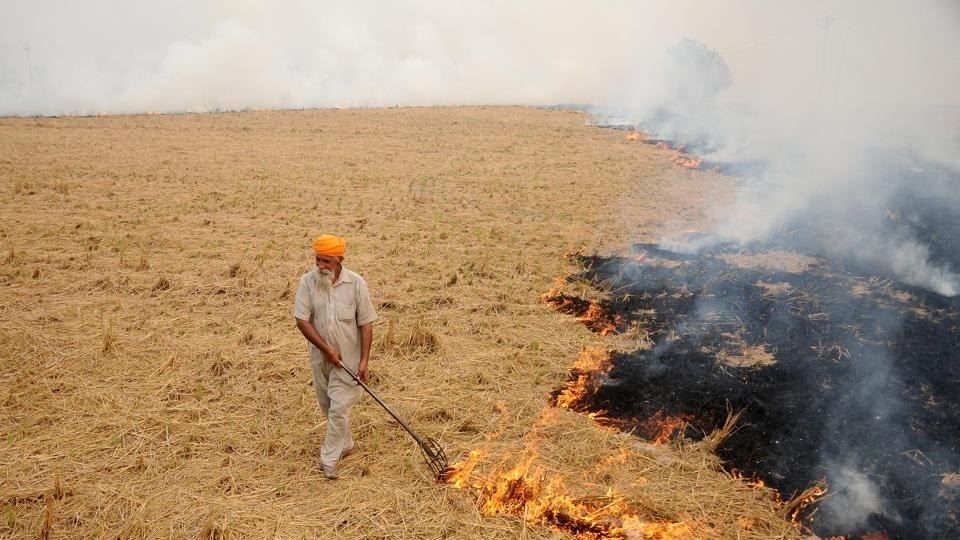
Experts say that a host of unresolved issues going back decades are anyway likely to make farm fires inevitable, despite Punjab now being run by the Aam Aadmi Party (AAP) that is also in power in Delhi, where the winter air pollution crisis is a massive public health issues.
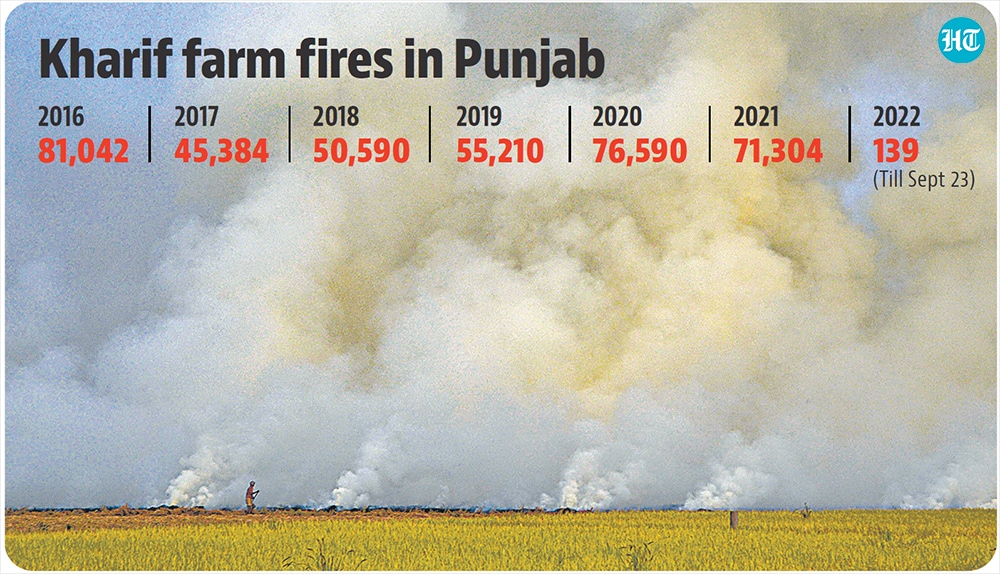
At the heart of the problem are two core issues: First, a large part of the state’s agriculture sector sticks to a rice-wheat formula for farming. Rice, sown in summer season, and wheat, sown in the winter, are covered under the government’s minimum support price (MSP) guarantee. This effectively leads to farmers choosing paddy over other crops in the kharif, or summer, season.
The second concerns how farmers harvest paddy, using a machine known as the combine harvester. This farm machine slices away the part of paddy that contains the rice grains, leaving a roughly 12-inch stalk, or stubble, embedded in the field. Most commonly used seeding machines are then unable to navigate a farm full of stubble to sow the winter (rabi) crop, in most cases wheat, which has to be put in the ground by the second week of November. This leads to the farmers setting the stubble on fire.
Over the years, the Punjab administration has tried to address these issues, especially the second one. But a combination of bad planning and lack of political will have ensured they have not come to fruition. Listed below are some of the measures and why they failed. The question is, will the AAP, with higher stakes than previous regimes because it is also in government in Delhi, do better this year?
1. Stubble-free machines Between 2018 and 2021, a total of ₹1,145 crore has been spent to distribute 90,422 subsidised systems to farmers and to centres from where farmers hire farm equipment. These include machines and attachments that deal with the stubble in-situ, or in the field itself. Some of these, like the paddy straw chopper, shred the stalks, while others, like the happy seeder, help plant seeds even when the ground is covered in paddy stalks.
But in those four years, there was little difference in the number of farm fires. A part of the reason was that many of these machines never made it to the farms -- a survey of such machines carried out by the Punjab government in July and August this year, after being prodded by the Enforcement Directorate, found that 14% of these machines never reached farmers or were disposed off as junk.
Even the machines that were found were likely not used. “There were about 78,000 operable machines but results were not encouraging. It seems these were not used optimally as the farmers who were given the machines restricted the usage to their farms and did not help others,” an official in state agriculture department said, asking not to be named.
An officer at the helm when the in-situ stubble programme was started in 2018 said the approach itself may be flawed. “In my opinion, we are barking up the wrong tree. Managing a whopping 20 million tonnes of stubble in just 20 days is impossible,” he said, asking not to be named.
2. New varieties of seeds
To address the failure of the stubble-free machines, experts said that farmers must be transitioned away from paddy or, at least, from the late-growing varieties such as PUSA-44, which takes 160 days to harvest, to those with a shorter, 120-130-day lifecycle. This could allow for the harvesting to be done sooner, leaving farmers with more time to clear their fields before they need to sow wheat.
Former agriculture secretary KS Pannu said, in particular, nine districts may hold the key. “In my opinion the problem of stubble burning is more pronounced in the nine districts of Patiala, Sangrur, Barnala, Mansa, Bathinda, Muktsar, Ferozepur, Faridkot and Tarn Taran since these districts grow PUSA-44 variety that has higher biomass content and is a late maturing variety,” Pannu, who cited it as among the major reasons why efforts to curb farm fires have failed so far. “Farmers are left with no option but to burn it to ready their fields for the next crop,” Pannu added.
PAU vice-chancellor Dr Satbir Singh Gosal said that work on such varieties are underway. “We are doing research and have launched short duration varieties such as 125 days-PR 126.’ But, Gosal added, “simultaneously, efforts for in-situ (mixing in soil) management of stubble should continue as it improves soil fertility and saves water”.
Gosal suggested innovation to bring simpler and cost-effective happy-seeders for sowing wheat directly after harvesting paddy without tilling and setting crop residue on fire.
3. Off-farm solutions
Off-farm, or ex-situ, measures -- a scenario in which the stubble is removed and sold for other uses -- was among the solutions suggested, especially by directions of the National Green Tribunal (NGT) and the Commission for Air Quality Management (CAQM).
Latest data by Punjab Pollution Control Board (PPCB), analysed by HT, shows that there are 11 privately owned biomass-based power generating plants in the state, which are the only ones that will process the crop remnants. Their capacity of 0.8 million tonne is enough to process only 6% of the total stubble generated in the state.
Gosal told HT last week that the state needs an infrastructural push to improve ex-situ methods. “It’s a cheaper proposition but needs infrastructure for which big budget is required,” he said, adding that the state needs more biomass-based power generating plants, pellets making industry, bio-CNG plants, fast transportation to evacuate stubble from the farms and storage godowns.
4. Incentive schemes
The Amarinder Singh-led Congress government too sought to give cash incentives of ₹100 per quintal of stubble from the Centre to nudge farmers into giving away the crop remnants for a profit. Those funds too, however, did not come through.
The Union government pointed to the funds it provides for the subsidies of the farm equipment to defend its decision to not offer any of the other incentives as sought by the states.
This year, The AAP government attempted to offer farmers ₹2,500 per acre, of which ₹1,500 was to come from the central government, as cash incentive for farmers to turn over their paddy stubble. But the proposal was turned down by the Union government over cost factors. The plan has now been abandoned altogether.
5. Punitive action
Efforts by the erstwhile Congress government to curb farm fires by taking punitive action against farmers also proved futile. In 2019, 327 cases were registered against farmers under Section 188 of the Indian Penal Code (for violating government orders). A total of 196 farmers were arrested and 850 red entries were made in their revenue records for burning crop residue. But the problem persisted, forcing the government to pull back owing to the fear of a backlash, especially ahead of elections.
“There is always a political angle attached to the problem. Whenever we try to tighten the noose, political considerations come into play. In such a scenario, why should government employees put themselves at risk,” said a second retired officer, asking not to be named.
During the 2018 kharif harvest, enforcement was relaxed since the 2019 Lok Sabha elections were around the corner. The following year, farmers were protesting at Delhi’s borders against the (now repealed) three farm laws, which too prompted the state to go easy on its crackdown. In 2021, a similar attitude was in play since the state headed for polls in early 2022.
This season, paddy was cultivated in over three million hectares and as a season’s average, about 18.5 million tonne stubble is likely to be produced.
State agriculture minister Kuldeep Singh Dhaliwal said he was the number of farm fires will be drastically lower this time. The minister cited the state government’s initiative to give 32,100 machines for in-situ management, which is more than the number distributed in the previous four years, and an aggressive campaign to dissuade farmers from burning the crop remnants. “At least 5,000 officers of the agriculture, rural development and revenue departments besides students of four state universities are reaching out to rural Punjab to dissuade farmers from burning paddy stubble,” he said.
The AQI numbers this season, and the share of stubble smoke in the pollution levels, will reveal the real story.


