E-Paper



Reunification may not be silver bullet for cash-strapped Delhi civic bodies
Experts have said the Sheila Dikshit government, while trifurcating the MCDs, reasoned that it would improve overall administrative efficiency.

 Prefer HTon Google


The unification of the three municipal corporations may not prove to be proverbial magic pill to treat all ills that the civic bodies in the national capital are suffering from, experts and leaders associated with the municipalities have said.
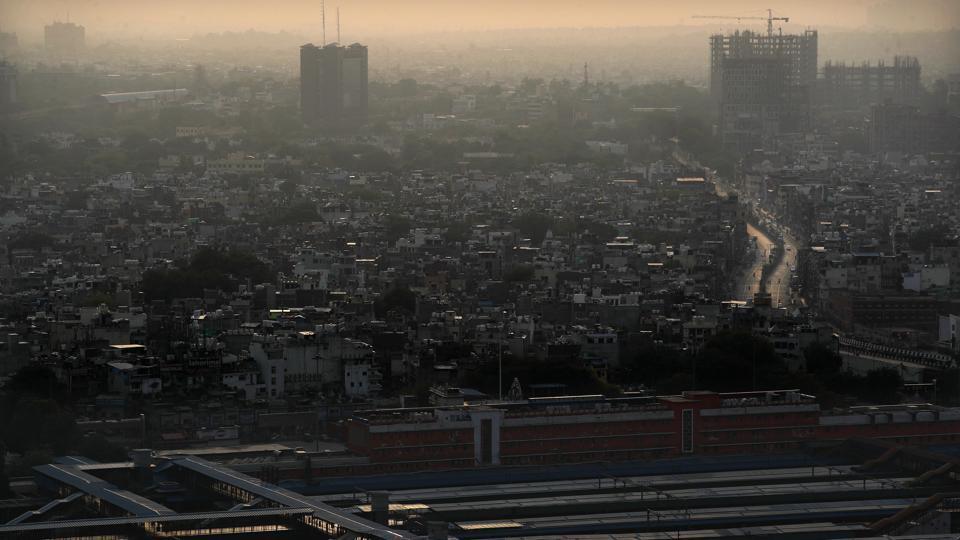
The debate over the rationale behind the trifurcation of the civic services behemoth in 2012 by the then Congress government, and if a reunification may rid it of the financial bankruptcy, administrative lethargy and prevalent corruption has again taken the centrestage after the BJP-led central government has expressed its intention to bring the three bodies back together.
Experts have said the Sheila Dikshit government, while trifurcating the MCDs, reasoned that it would improve overall administrative efficiency. However, more than decade later the objective is far from being achieved. Today, two of the three municipal corporations don’t even have enough funds to pay salaries to their staff; and all three of them run huge deficits that are even more than their entire budget.
This has led to the failure in delivering even the most basic service supposed to be rendered by the municipalities -- sanitation. Areas under the three corporations have consistently fared poorly on the Centre’s sanitation rankings.
In the face of the daunting crisis, municipal leaders as well as employees have been advocating the reunification of the civic body. But will just bunching together of three bankrupt organisations be enough to make them efficient? A look into the finances and liabilities may answer this question.
Salary/pension burden
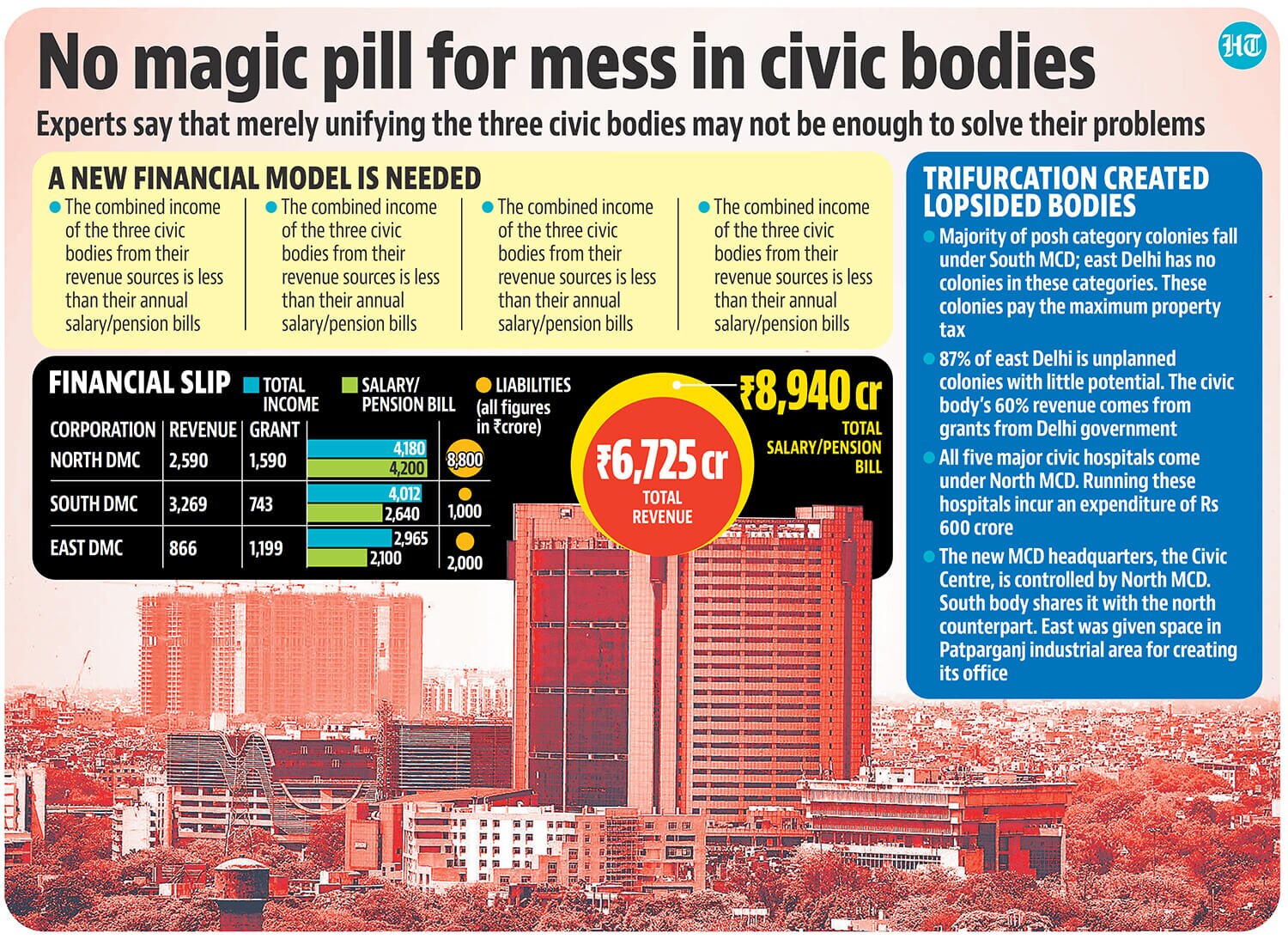
If somebody was going to suggest tightening of the belt to address at least a section of the problem, one has to consider just two numbers. The total annual income of the three corporations from its own revenue sources is ₹6,725 crore; and the total annual salary/pension bill for 160,000 employees is ₹8,940 crore.
According to a reunification proposal submitted to the Delhi lieutenant governor in February last year by the North Delhi Municipal Corporation, the north body said that it spends ₹4,200 on salaries, the south corporation has a salary bill of ₹2640 crore and the EDMC pays Rs2100 crore in salary to its employees.
The proposal also pointed out disparities -- the SDMC contributes 48.6% of the total annual income (internal) revenue, the north MCD’s share 38.5% and the east brings just 12.8% to the table.
A senior SDMC official in the finance department said simply combining the three civic bodies will not help bring them out of bankruptcy. “We need to find a new economic model. Subsidising two parts from the revenue earned from one simply defies logic. In fact, the days of surplus budget are over for the even the south corporation. We must work out a model in which revenue and expenditure is rationalised,” he said.
Other officials in the finance departments of north and east civic bodies, who spoke on condition of anonymity, said direct funding from the Centre on lines of New Delhi Municipal Council, better co-ordination with the state government or a radically different funding model may be considered by the government to improve the state of affairs.
Mounting liabilities
With their expenditure far outweighing revenues, all three corporations face mounting debt and liabilities.
According to North MCD commissioner Sanjay Goel in the last one year alone the financial liabilities of the civic body have increased from ₹7,523.97 crore to ₹8,803.25 crore and it continues to rise. An EDMC finance department official agreed that with even the resource-rich SDMC operating on “hand to mouth” basis, it cannot be asked to support all three corporations. EDMC’s current budget shows liabilities of Rs1,402.9 crores till September 2021 which have now risen to around Rs2000 crore. According to the budget papers, The combined liabilities of all three corporations are at least ₹11,800 crores -- almost double than their income from internal sources.
This explains the dependence of the civic bodies on external sources of income, mostly aid by the state and central government -- the biggest bone of contention between the BJP-ruled MCDs and the AAP government in Delhi.
“The function of municipality is not to pay salaries alone. Funds are needed for development works. We were forced to impose a moratorium on any new work order, but still there is a pendency of five months of pension payments and four months of salary dues,” the EDMC official said.
AP Khan, convener of Confederation of MCD employee unions, said till 2012, the staff never had to face any delay in the payment of salaries. “The problems began around 2016 and the situation has only deteriorated since. Now we have a situation in which 160,000 employees and 60,000 pensioners are suffering,” he said. The Confederation has been demanding reunification during its strikes held over the last three years.
However, a senior municipal functionary said that simply unifying the civic bodies will not write off such huge liabilities. They added that civic officials have requested the central government to provide a cash stimulus of ₹16,000 crore to clear liabilities and launch financial recovery.
Experts speak
Tanvir Aeijaz, associate professor in the department of Political Science at Ramjas College said the central theme of trifurcation was better administrative efficiency with each smaller local bodies that will be able to manage an inequitable distribution of population as well as economically diverse areas. “Delhi is not at all a homogeneous city. There are planned areas, jhuggie clusters, large swathes of unauthorized colonies and resettlement areas,” he added.
Officials across all three corporations are unanimous that drastic change will be needed to make Delhi a more liveable city. They argue either the centre should directly fund the civic body or share a part of the GST collection from the city . “Direct funding may be an uphill task as it may require amendment through the central finance commission,” an SDMC official said.
Debolina Kundu, professor at the National Institute of Urban Affairs, said completely different in size, economic status and the populations that they serve. She said only reunification will not work. “The centralization may help in balancing the resources while bringing equity in finances, but Delhi is not a small city and administratively many reforms would be required to ensure better services to the people,” she added.