E-Paper



Winds bring relief to Delhi, but air still ‘very poor’
Delhi recorded a maximum temperature of 27.5 degrees Celsius (°C) on Monday – one degree above normal, while the minimum was recorded at 11.4°C, normal for this time of the year

 Prefer HTon Google


Delhi’s air quality on Monday registered a marginal improvement on the air quality scale, though not enough to take it out of the “very poor” category, where it has stayed put for the past one week. Monday was also the first day this November when visibility improved to beyond 3,000 metres in Palam, said officials of the India Meteorological Department (IMD).
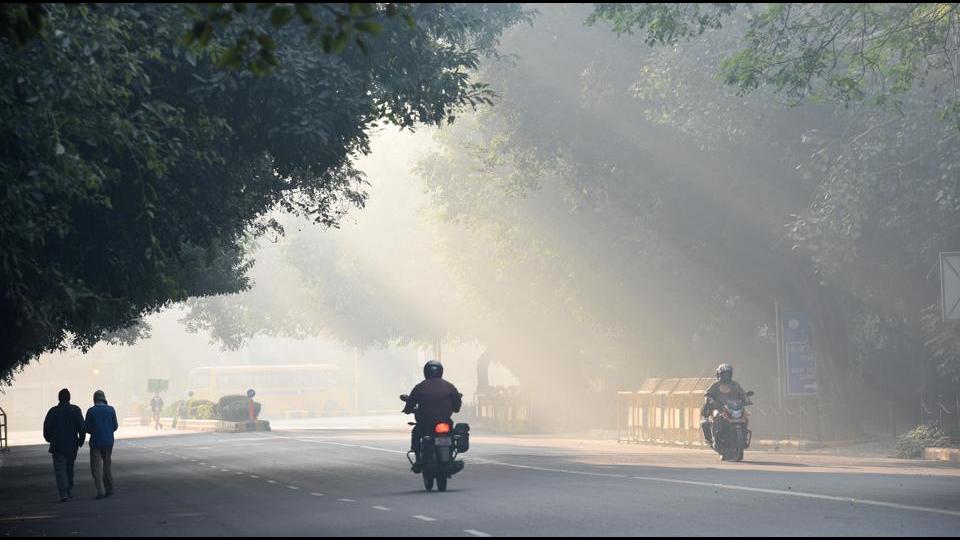
The air quality index (AQI) readings did not cross the 300 mark in at least 10 stations, owing to a combination of strong surface winds and low contribution from stubble burning. The overall AQI of Delhi was 311 at 4pm on Monday, according to the Central Pollution Control Board (CPCB), a climbdown from Sunday’s reading of 349. Weather analysts said wind speeds touched 25km/hr during Monday, helping disperse pollutants.
An AQI between zero and 50 is considered “good”, 51 and 100 “satisfactory”, 101 and 200 “moderate”, 201 and 300 “poor”, 301 and 400 “very poor”, and 401 and 500 “severe”.
The IMD said this is the first time this month that visibility has gone beyond the 3,000 metres mark in Delhi, ranging between 1,500 and 3,200 metres during the day in Palam. Agencies forecast strong surface winds to continue on Tuesday as well, and the air quality to improve to the ”poor” category, provided the fire count remains low.
According to the Union earth ministry’s System of Air Quality and Weather Forecasting And Research (Safar), 909 fire counts were recorded across the northern plains in the past 24 hours, with the contribution of stubble burning to Delhi’s PM 2.5 share pegged at 6%. PM 2.5 are fine, inhalable particulate matter with diameters that are generally 2.5 microns, or about 30 times smaller than a strand of human hair.
“Local surface winds were relatively high on Monday and similar winds are expected on Tuesday, which increases dispersion. Air quality is expected to improve to the “poor” category in the next two days; however, wind speed is expected to drop after November 24, which may lead to a deterioration in air quality,” said Gufran Beig, founder and project director, Safar.
Delhi recorded a maximum temperature of 27.5 degrees Celsius (°C) on Monday – one degree above normal, while the minimum was recorded at 11.4°C, normal for this time of the year. Mercury is set to fall in the coming days, the IMD said, dropping to 10°C by Wednesday. “This was the first November day, when visibility was over 3,000 metres at the Palam station. Wind speeds ranged between 15-25km/hr. However, by November 24, wind speeds will drop considerably,” said RK Jenamani, scientist at the IMD.
Over the past couple of years, weather changes have generally come to Delhi’s rescue, after a spike in pollution seen due to Diwali and stubble burning. Last year, Delhi’s AQI had spiked to 435 (severe) on November 15 — a day after Diwali— but rain the very next day saw the AQI drop down to 171 (moderate) by November 17.
Similarly, in 2019, strong winds helped in quicker dispersion of pollutants. “In 2019, the dispersion of pollutants was as fast as the build-up and this was because of strong winds. In 2018, it took much longer for dispersal to take place, as wind speeds remained low after Diwali,” a Centre for Science and Environment (CSE) analysis said.
Tanushree Ganguly, programme lead at the Council on Energy, Environment and Water (CEEW), said meteorological conditions and wind speeds play a key role in improving air quality, with fast winds once again coming to Delhi’s rescue.
“Delhi’s air quality improved marginally to the lower-end of ”very poor” category today after staying in the upper end of ”very poor“ for the past one week. The relatively stronger surface winds in the afternoon are mainly responsible for the improvement. However, forecasts indicate a dip in AQI on November 24 due to a fall in wind speed. Given that meteorology will continue to influence the city’s air quality in the coming days, the Delhi government should actively incorporate insights from IIT-Madras’ early warning system to plan and execute pre-emptive measures to keep pollution levels under control,” she said.