
 E-Paper



Yamuna flood: Power back, water recedes but residents keep caution
Residents said that the foul odour and inaccessible roads not only made lives difficult, but also led to health concerns

 Prefer HTon Google


New Delhi
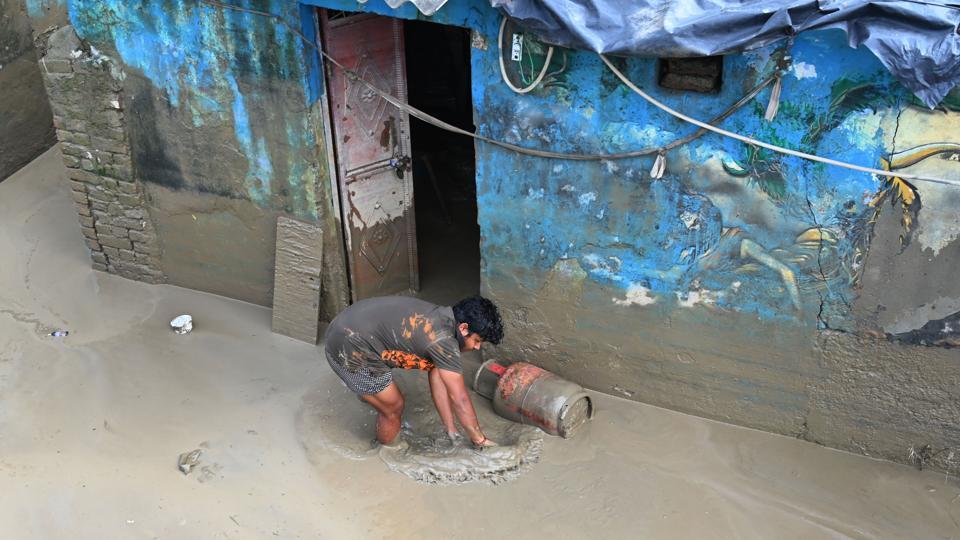
It was a day of hope and despair for residents of the Yamuna floodplains. While the water level receded, leading to the reopening of the Nigambodh Ghat and the Yamuna Bank Metro station, residents of Yamuna Bazar and other low-lying areas were in for a rude shock as the flood left localities and houses covered in silt and mud.
Residents said that the foul odour and inaccessible roads not only made lives difficult, but also led to health concerns.
According to data from the Central Water Commission (CWC), the water level at the Old Railway Bridge—which is representative of the city—was 205.4 metres at 6pm on Sunday, dipping from the 206-metre mark. HT took stock of the affected regions on Sunday.
Yamuna Bazaar
At Yamuna Bazaar, the tales of woes and despair continued as the river left behind heaps of mud.
Geeta Kashyap, 49, said, “People have started to come back to their houses but the houses are not liveable right now. Wherever you look, there is mud. I was initially living in the camp but then I shifted to my brother’s house with our mother because she was very sick.”
“I went back to clean the house today but I could not complete it. It is hours of tiresome work to clean so much mud. I will go back tomorrow again to see if I can clean some more,” she added.
Ashok Bakshi, an e-rickshaw driver, said that while the water level had receded a lot, it was not of much help.
“We still cannot shift back to our houses. People have started cleaning; this last week has been so tiring that people just want to shift back to their houses,” Bakshi said.
Monastery Market
While people living in the area started moving back to their houses, most shops remained shut as the last remnants of floodwater continued to remain.
“I had shifted most of my goods to the upper floors. So, I have come back to shift everything back into my shop,” said Gagan Singh, who runs a bag shop at the market.
While most of the water has receded, parts of the residential colony continued to suffer.
“Most people have started coming back and setting up their places again. I returned from my friend’s place on Sunday. Of course, some of the water remains but people are very anxious to get their belongings back. Most people had shifted their stuff to the upper floors and left only with necessities,” said Pinky Shamila, who had been staying with a friend in Majnu Ka Tilla for the past four to five days.
Nigambodh Ghat reopens
The Municipal Corporation of Delhi (MCD) on Sunday reopened Niagmbodh Ghat, which is Delhi’s largest and oldest crematorium. While the clean up is still on, cremations resumed at the ghat, which was shut since Wednesday.
Avdhesh Kumar, a supervisor of the crematorium, said 11 cremations took place on the day. “While the minor clean up of soil left by river water is on in parts of the complex, we have resumed the operations. This time the damage due to flooding is very less as most of the equipment, hearse vans and CNG burners had been removed in anticipation of it,” he said.
The cremation has 120 funeral platforms for conventional use and six CNG-based furnaces. During the 2023 floods, the cremation facility was shut for seven days. There was extensive damage to offices, hearse vans, stack parking, and CNG furnaces. During the 2023 floods, a retention wall of the ghat had also collapsed. The wall, rebuilt in 2024, collapsed again last week.
Yamuna Bank Metro station
Access to the Yamuna Bank Metro station resumed on Sunday, the Delhi Metro Rail Corporation (DMRC) said. Access to the station was cut off due to waterlogging of the approach roads on Thursday.
DMRC posted on X on Sunday: “Yamuna Bank Station Update The approach road leading to Yamuna Bank Metro Station is now accessible.”
On Thursday, the Delhi Metro had issued an advisory stating that the station would not be open. However, it still continued to act as an interchange.
Civil Lines
The situation at Bela Road, which had water up to a height of four to five feet, started improving as water levels receded.
Nitin Narain, a resident, said, “The floodwater had reached an electric transformer, which led to power outage. Many residents left after 12 hours as there was no power for at least two days. Now, the power is back as officials have placed a cement block under the transformer to increase its height. The water has also reduced due to pumping machines. Slowly, people are coming back.”
Arpita Dayal, an architect and professor at the School of Planning and Architecture, who had left the area on Wednesday, said, “We only came back because the water had been removed. However, we are scared this would happen again after a heavy spell of rains and/or Yamuna flooding. There’s still no solution from the PWD side towards improving the drainage system at Bela Road.”



Stay updated with all top Cities including, Bengaluru, Delhi, Mumbai and more across India. Stay informed on the latest happenings in World News along with Delhi Election 2025 and Delhi Election Result 2025 Live, New Delhi Election Result Live, Kalkaji Election Result Live at Hindustan Times.


