
 E-Paper



Cong woos Punjabi voters in push to reclaim Gurgaon 20yrs after
Congress has chosen Mohit Grover, a young Punjabi candidate with deep party roots, to lead its charge in Gurgaon

 Prefer HTon Google


After two decades of struggle to reclaim its traditional stronghold, the Congress party is making a determined bid to win the Gurugram assembly constituency in the upcoming assembly elections. Political analysts suggest that anti-incumbency against the ruling Bharatiya Janata Party (BJP), coupled with Congress’ strategic decision to field a Punjabi candidate, Mohit Grover, in this largely Punjabi-dominated constituency, could tip the scales in Congress’ favour, experts added.
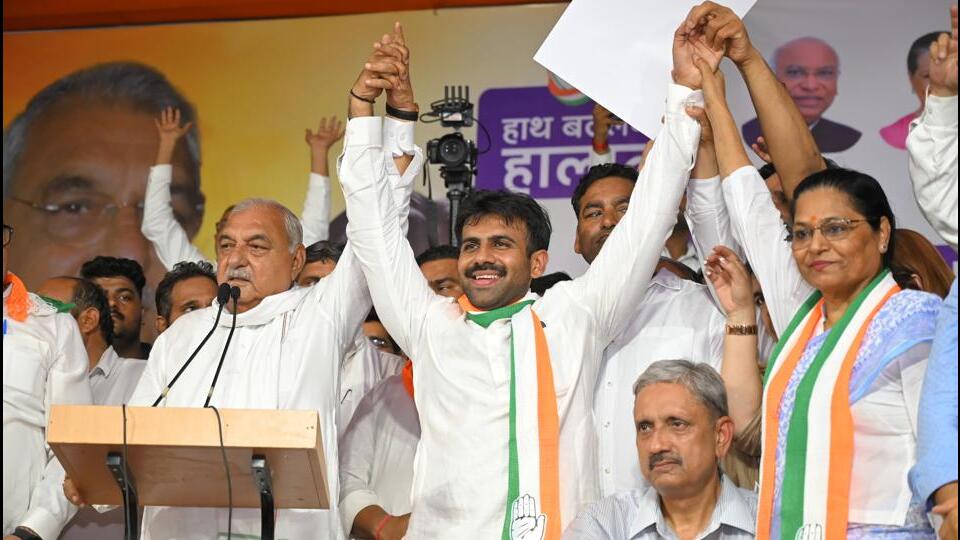
Congress has chosen Mohit Grover, a young Punjabi candidate with deep party roots, to lead its charge. Grover, who narrowly lost the previous election as an independent, is now seen as Congress’ best hope to galvanise the Punjabi community and other key voter groups. “We are looking to bring everyone together, beyond just caste lines,” Grover said during a public meeting, emphasising unity and a broad-based vision for development.
Anil Arya, a political expert, stated, “The Gurgaon constituency has a Punjabi majority, with nearly 90,000 Punjabi votes. In the last election, Grover contested as an independent and secured 48,638 votes, of which 50% came from Punjabi-dominated booths. This time, there is no security where will Jat, Dalit, and Muslim, votes likely leaning in whose favour. If Grover could secure around their support then have high chances to win. After Dharambir Gaba, this is the first time Congress has given a ticket to a Punjabi candidate, a long-standing demand of the community. Although the death of Grover’s father, who managed the community’s affairs, was a setback, the Punjabi community, traditionally aligned with the BJP, seems to be rallying behind him. He has a high chance of tipping the scale in Congress’s favour,” he added.
Gurugram has historically been a Congress bastion, especially from the first Haryana assembly election in 1967 until 2005. Congress’ Punjabi leader Dharambir Gaba held the seat for five terms from 1982 to 2005, showcasing the significance of the Punjabi electorate, which remains a large and influential demographic, experts said. Despite Gaba’s defeats in 2009 and 2014, the Congress remains hopeful that the Punjabi vote, estimated at over 100,000, will help them regain the seat. Additionally, SC voters (45,000-50,000) and Jat voters (40,000-45,000) make up significant portions of the constituency, further contributing to Congress’ chances of success.
“We are looking to bring everyone together, beyond just caste lines,” Grover said during one of his meetings. “The entire Gurugram and its 36 communities are my family,” he added. Grover’s family has long-standing ties to Congress, and his 2019 run as an independent garnered significant cross-community support.
According to Grover, his campaign is focused on addressing the shortcomings of his previous election. “I was young then, and it was my first election. Now, I am fully prepared,” Grover said. He noted that the voters are disillusioned with the BJP’s 10-year tenure, pointing to issues such as stalled development and a lack of concrete solutions to local problems.
Congress has consistently relied on a Punjabi candidate since 1982, and this strategy continues with Grover at the helm. The party also anticipates support from Brahmins, Yadavs, BCs, and OBCs. Grover dismisses reliance on caste-based politics, asserting that he has gained the support of all communities in Gurugram. “I do not depend on caste, and all communities are with me,” he added.


