
 E-Paper



Crores spent, but unfinished drainage projects leave Gurugram vulnerable in monsoon
The inefficiency and delays in civic projects point to potential bureaucratic hurdles, financial mismanagement, and possibly corruption

 Prefer HTon Google


Gurugram does not have a perennial river yet the city regularly experiences waterlogging during the monsoons. Experts attribute this to encroachments on and obstructions in the natural flow of the city’s three main stormwater drains. The shift in land use, overreliance on mechanical pumping, and an inadequate internal drainage network disconnected from the master drain system contribute to the city’s annual flooding despite normal rainfall.
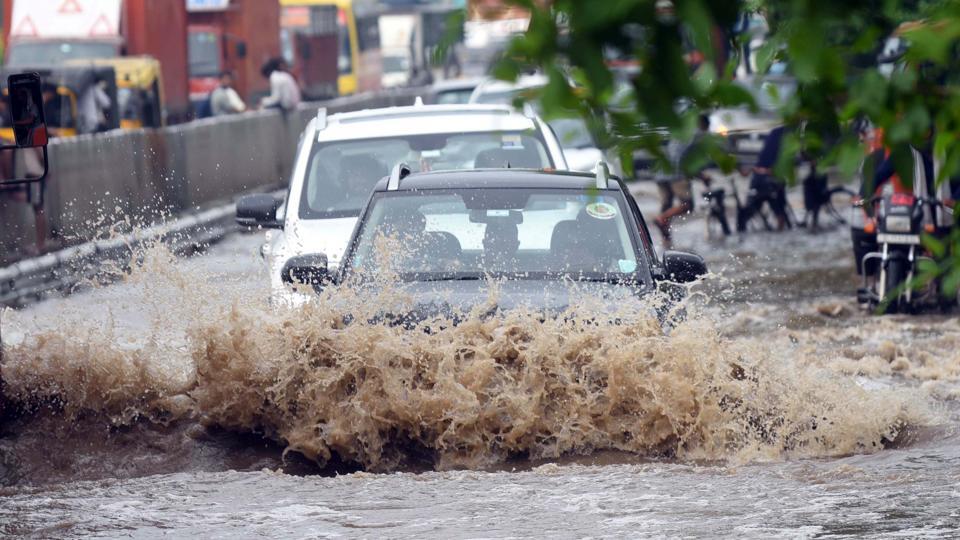
However, the persistence of flooding in various parts of the city after short rain spells despite the expenditure of hundreds of crores of rupees on cleaning stormwater drains and sewage systems highlights the failure of civic agencies to complete crucial infrastructure projects. Major projects at Hero Honda Chowk, Southern Peripheral Road (SPR), and the Dwarka Expressway remain unfinished, leaving residents to face annual waterlogging issues.
The inefficiency and delays in these projects point to potential bureaucratic hurdles, financial mismanagement, and possibly corruption. Despite significant funds allocated for these projects, the quality of construction and maintenance of existing drainage systems remains questionable.
Obstruction of drains
Gurugram has three major drains called Leg 1, originating from Nathupur village, Leg 2, originating near Chakkarpur, and Leg 3 (also called Badshahpur drain).
Leg 1 passes through DLF Phase 3, Udyog Vihar, Sector 23, Rotary Public School Rezangla Chowk, New Palam Vihar, railway track crossing, Bajghera, and finally joins the Najafgarh drain.
To connect the Leg 2 drain with the Najafgarh drain, the authority will construct the pending section of 550 metres, officials said.
The 21.5-km-long Leg Two rain starts from near Sectors 27, 28, Chakkarpur village, passes through Millennium City Metro station earlier called MDI Chowk, Atul Kataria chowk/ Sheetla Mata Road, Sector 5, New Palam Vihar, Northern Peripheral road, Dualatabad, and finally to Najafgarh drain.
The most important drain as far as evacuation of storm water from Gurugram is concerned is the Badshahpur drain or Leg Three drain. Starting from Ghata irrigation dam to Vatika Chowk on Sohna road it is called Khost drain, thereafter it is called the Badshahpur drain and it passes through Golf Course Extension Road, SPR, Hero Honda Chowk, Khandsa, Gadholi Khurd, and ends at Najafgarh drain. Its length is 28 kilometres.
The natural storm water drains used to be wide and carried water through their natural contours but presently these drains across the city have been either encroached, or land along these drains have been sold and construction carried out. These drains have also be concretised and boxed as a result of which water does not seep into the ground. Also these drains suffer from waste and illegal sewage being pushed into these channels, which leads to spilling of water into drains.
Experts said that large-scale construction has led to extensive concretisation of land in Gurugram, exacerbating the waterlogging issue. “Due to the concretisation, the city experienced severe heat this summer, and now, surface water cannot be absorbed by the earth, resulting in inundation,” an expert said. The failure of civic agencies to preserve village ponds and bunds like Ghata Dam and Jharsa Dam, along with construction in their catchment areas, has further worsened the situation, leading to water spilling across the city instead of being retained in these natural reservoirs.
“It is heart-wrenching to see that the unplanned development of Gurugram has led to its deterioration. Waterlogging has become commonplace, and the administrative incapability to address drainage issues adds to the city’s woes. Gurugram, once envisioned as the Singapore of India, is now a disaster zone plagued by pollution, flooding, corruption, and poor sanitation. The solutions lie in proper urban design and resource allocation with a robust and empowered Development Authority. Green belts, rainwater harvesting, sewerage and drainage systems, road redesigns, and the revival of water bodies need to be integrated into a multi-pronged approach. Why is the government oblivious to Gurugram residents’ woes, proposing quick fixes instead of long-term solutions?” said Gauri Sarin, founder of Making Model Gurugram, a citizens’ initiative.
“Waterlogging in residential areas is due to a lack of desilting before rains. In Ardee City, desilting work was abruptly stopped in September 2023, with the reason given that the monsoons were over. The contractor was supposed to restart before the 2024 monsoons, but that never happened. We don’t even know if the contractor was paid for work that was never executed,” said Chaitali Mandhotra, a member of the Ardee City Residents Welfare Association (RWA).
Kusum Sharma, a resident of Suncity Township in Sector 54, said that the city needs more drains. “Currently, we have only three main drains. Gurugram has expanded rapidly, but there has been no expansion of the drainage system. We need at least two more main drains. Garbage and debris block the gully traps, leading to waterlogging even after a half-hour of heavy rain. Additionally, the lack of regular desilting of sewerage and stormwater pipelines worsens the situation,” she said.
Colonel Hari Bhagwan (retd), president of the Oyster Grande Condominium Association, said that waterlogging and flooding have become common in the Dwarka Expressway area. “The government must develop a robust and sustainable drainage system to prevent flooding on this newly constructed road,” he said.
Vikram Singh, executive engineer at the Gurugram Metropolitan Development Authority (GMDA), said that the authorities have made some progress in combating the situation. “In 2020, we identified 79 waterlogging hot spots in the city. Key infrastructure developments and remedial measures have reduced these to 16 locations. GMDA is working to identify and address all bottlenecks to further enhance the city’s drainage network. The construction of the remaining 500 metres of Leg 2 Drain is in progress, and drainage installation in new sectors is also underway,” he said.
Narhari Singh Bangar, MCG commissioner, said that their teams are getting all drains cleared. “People illegally dump debris and fresh waste into the drains. The desilting is already ongoing and we have cleared a lot of drains but a lot more is required. The teams are working day and night but the residents should also take responsibility,” he said.
Amid the mismanagement, some point to the loss of traditional water management systems. “There was a time when every village had two ponds that stored rainwater, which was used throughout the year. These ponds have either been encroached upon or acquired by developers and government agencies, and they have vanished,” said Manish Yadav from Wazirabad.
Catchment commercially exploited
A retired urban planner said on condition of anonymity that large tracts of land in Ghata Dam’s catchment area have been commercially exploited, reducing the dam’s capacity. “The Khost Nallah on Faridabad Road has also been narrowed. The concept of mechanical pumping for stormwater has not been successful,” he added.
The delay in completing key drainage projects, such as the drain along the SPR and the one at Hero Honda Chowk, continues to exacerbate waterlogging issues in Gurugram. GMDA officials said that only 30% of the work on the SPR drain has been completed, and the project is expected to be finished by the middle of next year, while the Hero Honda Chowk project is stalled due to a land dispute, leaving residents to endure another monsoon season of waterlogging.


