
 E-Paper



Gurugram: Cabinet minister backs stability for civic officials
Cabinet minister Rao Narbir Singh announced a policy to stabilize official transfers until 2027, addressing concerns from Gurugram's RWAs on development delays.

 Prefer HTon Google


Announcing a policy aimed to provide stability in official postings, Cabinet minister Rao Narbir Singh, during HT Gururgam First’s thrid monthly RWA meet on Saturday, said that transfers of officials within a short time period often hinders development works in the city.
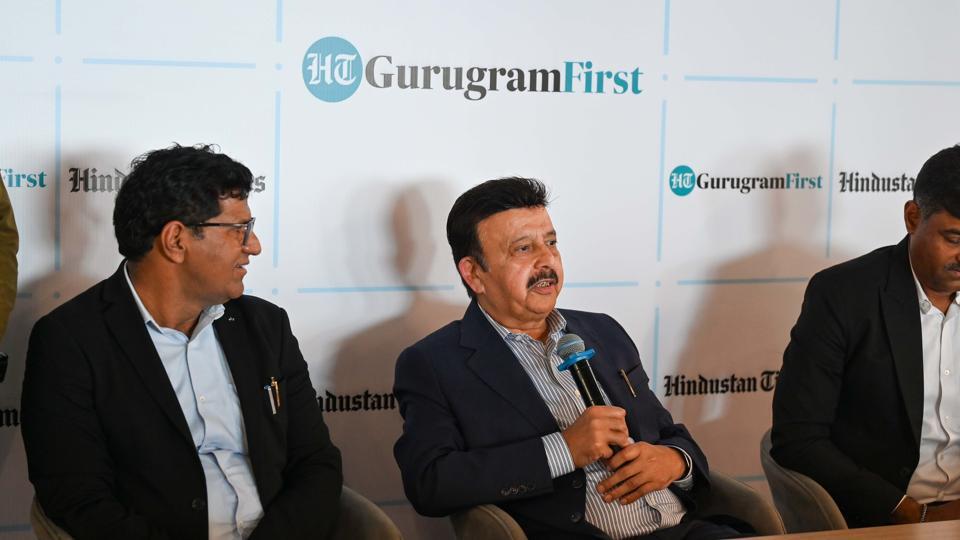
Officials from the Municipal Corporation of Gurugram (MCG) and Municipal Corporation of Manesar (MCM) acknowledged the issue of frequent transfers raised by resident welfare groups (RWA). “Often, officers are moved within six months, even before they can begin executing solutions on the ground,” an official said.
Responding to the concerns, Singh said, “Till 2027, officials will not be transferred unless there is a complaint of corruption. As a government, we have decided to give officers at least two years so they can understand the problems and deliver results.”
The meeting was attended by senior civic officials from MCG, MCM, experts, and representatives from 15 RWAs. Issues such as the city’s worsening cleanliness challenges and the need for structural reforms, accountability and citizen participation, among others were discussed.
The minister heard detailed feedback from RWAs on irregular waste collection, overflowing drains, poorly maintained parks, construction debris on roads and the absence of consistent on-ground supervision.
A key demand raised by RWAs was the formulation of a formal policy that would allow resident bodies to take over sanitation management in their respective sectors. RWA representatives said they are ready to maintain parks and manage sanitation work at least 10% cheaper than private contractors.
Dr Naresh Kumar, joint commissioner, MCG, said, “There have been instances in the past where development funds were returned unused. In such cases, action was taken against 20 officials. Residents are demanding vision and speed, and rightly so, because Gurugram’s population is growing rapidly and systems must keep pace.”
Kumar added, “Through a dedicated team of around 85 assistant sanitary inspectors (ASIs), the corporation is closely monitoring waste collection and disposal operations. Staff conduct regular inspections in high population areas, particularly near T-points close to colonies,” he said.
He added that daily commissioner-led meetings now seek zone-wise updates on sanitation. “We also review the number of trucks carrying both legacy and fresh waste to the Bandhwari landfill every day,” Kumar said.
According to MCG officials, night sweeping is now carried out daily, though manpower shortage continues to be a challenge.
Meanwhile, Sushil Kumar Thakran, executive engineer from MCM said, “Cleanliness cannot be ensured by authorities alone. A large portion of garbage found on roads is generated and dumped by residents. Even after penalties, this behaviour continues. We can clean roads repeatedly, but change is needed at the user level,” he said.
Chaitali Mandhotra, co-convener of United Gurugram RWAs and a resident of Ardee City RWA (Sector 52) said door-to-door collection is almost absent in informal settlements, unauthorised colonies and village areas. “This leads to garbage being dumped on roads. Even in sectors and high-rise societies with private collection systems, waste does not integrate with MCG’s stream. Segregation at source is almost missing,” she said.
Rinky Singh, RWA president of Sector 37C, emphasised awareness and resident participation. “Sanitation cannot improve unless citizens are involved in solutions, not just complaints,” she said.
Anuj Mathur, executive member, Tulip Purple RWA (Sector 69), said, “Such constructive forums that bring together citizens, administrators and policymakers are essential for building a cleaner, more accountable and sustainable Gurugram. Open dialogue and shared responsibility are the only way forward.”
Environmental expert Ruchika Sethi Takkar told Singh, “As environment minister, you can bring real change by ensuring polythene is eliminated and food outlets shift to paper-based alternatives.”
Participants of the meet concluded that the system must move from complaint-driven to solution-oriented collaboration, with RWAs, officials and the government jointly working towards a cleaner, more liveable Gurugram.

Stay updated with all the Breaking News and Latest News from Mumbai. Click here for comprehensive coverage of top Cities including Bengaluru, Delhi, Hyderabad, and more across India along with Stay informed on the latest happenings in World News.


