
 E-Paper



The hills have eyes that keep a lookout for cops
Cascading communal violence led to the death of two home guards while more than 200 people were wounded since July 31 in Haryana’s Nuh and Gurugram districts

 Prefer HTon Google


That day, the hills rang out with the sounds of violence. A thin black tar road, framed by the rugged Aravallis on either side, leads to the Nalhar Mahadev temple, 8km from Nuh, Haryana. On July 31, a day now seared into the National Capital Region’s (NCR) memory, a procession organised by the right-wing Vishwa Hindu Parishad (VHP) and the Bajrang Dal at the temple was at the centre of an attack by Muslim groups. For three hours, as many participated in the communal clash and some cowered, the hills reverberated with gun fire, the clatter of stones, and the shattering of glass bottles used as weapons. The clashes spread quickly. Almost immediately, the communal embers strayed into the Faridabad and the twinkling corporate edifices in Gurugram for several days, leaving six people dead and 88 people injured.
A month later, there is a tense quiet, but not quite.
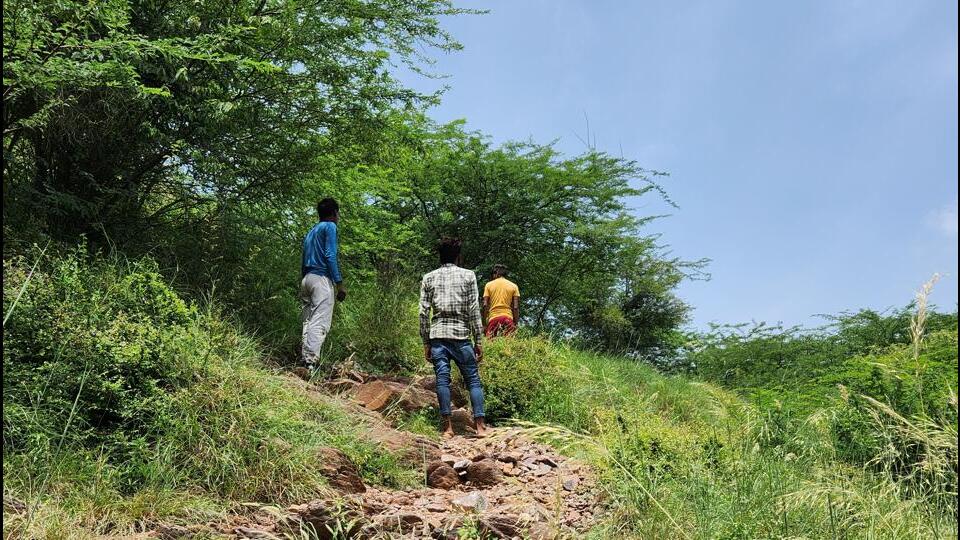
The tarred road has little signs of activity except for a swarm of security personnel. At the entrance of the temple, under the intricately carved arch that spans the crumbling-around-the-edges road is a police vehicle and a clutch of chairs, on which are perched personnel from both the Haryana Police and Central Armed Police Force, watching for any movement. There is little sign of this on the road. But there is movement. In the hills; behind the boulders that loom over them at a height; hidden behind the trees and the shrubbery. For the jagged Aravallis around Nalhar are now home to over 300 men and teenagers, all Muslims, from at least six villages in the area that live in makeshift camps, hiding because they are afraid they will be arrested for their involvement in the riots.
It is not as if the police do not know they are there. In the past three weeks, there have been three alleged shoot-outs with security personnel and four people have been arrested, three of them with bullet injuries in the leg.
But still, the hills are a safe refuge, for the scraggly paths are second nature to the men that have spent their lives in the area, traversing them since they were children. There are “secret” entry and exit points, and an elaborate system of lookouts. And the proximity to their homes in the plains, provide an avenue for the supply of food and water. “There must be 300 men and teenagers that are hiding in the hills, most from the villagers near Nalhar. We are locals, and their knowledge of the topography means it is possible to sneak back home for supplies. In this terrain, we are safer than anywhere else,” said Mohammad Afzal, a resident of Tauru.
The pressure on Nalhar
For three hours on July 31, it was almost as if Nalhar was under siege. By 11am, over 300 saffron clad men of the VHP and the Bajrang Dal had collected around a kilometre away. It was meant to be a religious procession, but several of them were armed, with swords, rifles and country-made pistols. Meanwhile, some Muslim groups, as previously reported by HT, had been organising too. They had sourced guns, bottles and fuel (for Molotov cocktails), stones, even sought reinforcements from neighbouring districts in Rajasthan.
The violence began around 2pm, and the village rang out with indiscriminate fire. Stones and glass bottles came crashing down at the yatra from vantage points, forcing some to take cover inside the Nalhar Mahadev temple. Those three hours left three people dead and 56 injured; most of the casualties were of the Hindu marchers and police personnel.
Overall, the Haryana police registered 61 cases of rioting, murder, attempt to murder, the spread of rumours on social media, and sections of the Arms act across police stations in the district. While a large majority of FIRs cite violence by hitherto unnamed people(and no charge sheet has been filed yet), police officials said that they have created a list of 450 suspects based on their investigations, of which 285 have already been arrested. Some of these men are among those that are hiding in the hills. HT has seen this list of suspects put together by the intelligence and crime units, the two wings leading the investigation.
In the days that followed the July 31, cascading communal violence led to the death of two home guards while more than 200 people were wounded and dozens of vehicles were set on fire by mobs in Haryana’s Nuh and Gurugram districts. Deputy superintendent of police (Hodal) Sajjan Dalal was shot in the head and is undergoing treatment with inspector Anil Kumar of Gurugram police, who sustained a bullet injury in his abdomen, police officials have told HT.
The violence eventually spiraled and spread to neighbouring districts, including Gurugram, where mobs set afire a mosque and pillaged several shops and restaurants. Around midnight on July 31, a mob attacked the Anjuman Jama Masjid in Gurugram’s Sector 57 and set it ablaze. Imam Mohammad Saad, 26, was killed, and Khursheed, a staff member at the mosque, sustained serious injuries. “There were five people inside the mosque at the time of attack.
Following the violence, the local administration kicked off a demolition drive in Nuh in which 1,208 properties/structures were razed, according to a report by the state government, which was prepared on the directions of the Punjab and Haryana high court. The demolitions continued till the morning of August 7, when the high court intervened and questioned the manner it was being carried out.
On August 28, there was another security challenge in the fraught environment after right wing groups called for another “Shobha Yatra” in Nuh, despite no permission from the state administration. Eventually, a “Jal Abhishek” was carried out by the VHP, but there was no yatra, and there was no violence.
Over the past month, police teams have launched several operations in the hills, and have said that they have recovered illicit firearms and ammunition, swords, glass liquor and cold drink bottles that were stockpiled to be used as weapons during the attack. Police officers said that have also found stones lying in piles at multiple places, suggesting that they were collected and strategically placed. From Nalhar and neighbouring villages, there have been at least 70 arrests, a significant proportion of the 285 arrested across Nuh, Gurugram and Faridabad.
On at least three separate occasions though, the hills have rung out with gunfire again. On August 10, a 10-member police team arrested Munfeed Khan and Saikul Khan, both from Gawarka in Tauru for their alleged involvement in the clashes after a chase. Police said both men tried to evade capture in the Sihlko hillocks, and opened fire, to which the personnel responded. One of them suffered a gunshot injury to his leg, both were arrested, and a country made pistol and a motorcycle seized from them.
Eleven days later, the police arrested 25-year-old Amir Khan, a resident of Tauru’s Didhara village, one of those hiding in the hills, who also allegedly fired at the team that went to arrest him. He was shot in the right leg, and arrested. On his person, the police said, was a firearm and five live cartridges.
On August 24, the same thing happened again. 26-year-old Osama of Ferozepur Namak village was arrested after a gunfight in Nuh. He too, he was shot in the leg.
Rajuddin Meo, a social worker in Nuh, said these encounters were not unusual and the exact same version of events in each added to the atmosphere of fear, and raised questions. “The police often arrest suspects from the villages, show them as encounters and plant weapons. This needs to be investigated,” Meo said.
The Nuh police however said that the three shoot-outs had left six police personnel injured and that it was a coincidence that in all three cases the accused were shot in the leg. Nuh SP Narender Bijarniya said, “Police teams are careful while they shoot (those hiding in the hills). The bullets are in the leg to stop them from fleeing and to ensure they are captured alive.”
The lair in the forest
On August 18 , HT reached the Nalhar Mahadev temple and sought to enter the hills to track down some of those that have made the forests their home for the past month. The security personnel at the temple forbade the team from going inside, citing security concerns. Locals that still lived in the villages were hesitant to act as guides, afraid that even journalists could be decoys for the police.
Eventually however, at 11.30am, three local men began the climb to their hiding spots from a non-descript spot near Nalhar, within sight of the temple, and HT followed. The slope was a path that had been extensively used; the earth was levelled and close to barren; the wild foliage removed. Once the ascent began, there was a thin walking path, wide enough just for one human being to pass through, framed tightly by thorny shrubs and acacia trees. There was evidence of inhabitation for the past few weeks; strewn bottles of beer, half-filled water bottles, stale food, bidi stubs and tobacco sachets.
There were points where there was a sharp fork and the path branched out. These were by design, the guides said. It ensured only those that knew the lay of the land, reached the final destination.
After about half an hour, in a clearing surrounded by rocks, the HT team was asked to wait under a tree. A few minutes later, four men returned with the locals, a dark cloth wrapped tightly around their faces; only their eyes visible.
These were men that had been hiding in the hills for over a week. One identified himself as Zuber Khan, 24, a resident of Nalhar. He says he went into hiding because his family was afraid he was about to be arrested. He does not deny that he pelted stones, but said that he “got carried away.” “We are a group of 15 friends that became very excited on that day and got carried away. Now our photographs have been circulated on Whatsapp groups and the police have identified us. We had no choice but to hide in the hills.”
Next to him, 25-year-old Mohammad Harun, also from Nalhar, said that he collected stones with his friends because he believed “his community was under attack.” “We started throwing them at vehicles. There were a lot of people there, and we did not know what the exact issue was. Now there is no place to hide except the mountains we know so well. Some afternoons we sneak into our homes when there is lax deployment, and return with food and water. We keep changing our hideouts,” Harun said.
The two other men, who did not want to be identified said that people had fanned out across the mountains in small groups, some of them armed and ready for a confrontation. “We keep a vigil on all routes in and out,” one said.
But living in the wilderness has its costs. Prepared they may be, but the fear of a raid in the dark is constant. “We are afraid of wild animals, snakes and insects. Most of us haven’t slept for several nights. We sleep in the daytime in small batches. Those that are awake stand guard,” the other of the two men said.
The pleas for them to return
In their now near-deserted villages, those that remain said that even those that may not have been involved in the July 31 violence had moved to the hills to avoid arrests. In some homes, only the elderly remain.
Social activists such as Rajuddin Meo said that a a majority of the violence was perpetrated by men from “Rajasthan and Uttar Pradesh” who arrived in the area with arms and ammunition. “Those who are hiding in the hills are poor people and have no legal backup if cases are filed against them. We have visited them to try and convince them to come down. They are from villages like Shahpur, Nagina, Uleta, Kareda, and Nalhar. They are managing with great difficulty,” Meo said.
Aftab Ahmed, the Congress MLA from Nuh, said that they had asked respective sarpanches and the family members of people that were involved in the clashes to get them to surrender before the police. “Those who are not involved have been asked to meet officials and give evidence if they have any, or help the police in their investigations. We do not want the innocent to be arrested or those involved to roam around freely,” Ahmed said.
Nuh superintendent of police Narender Bijarniya said that they have identified the spots in hills where suspects are hiding, and were conducting raids. “They have the advantage of height and can see police movement. We have started surveillance through drones, but we cannot risk the lives of our people. They are carrying weapons and every raid has to be properly planned. We have already given warnings to their families, and they are supporting us in our requests for the fugitives to surrender. They cannot stay in the hills forever,” he said.
Back in the hills, one of the four men said they had already begun preparing contingency plans. The hills were no permanent solution, but a safe, temporary base. “If we descend, we will either be shot or be put in jail. Even bail will be difficult. So we will stay in the hills for now,” he said.
And when they can no longer stay in the hills, they will leave, he added.
“We will never return.”


