
 E-Paper



Ancient chauvanistic thought still rules society: Bilkis Bano petitioners
Roop Rekha Verma spoke about the culture of violence that has been perpetuated throughout Indian history

 Prefer HTon Google


Women petitioners in the Bilkis Bano gang rape case were honoured at a seminar and felicitation ceremony organised by the All-India Democratic Women’s Association (AIDWA), held at Udyan Bhawan, on Saturday.
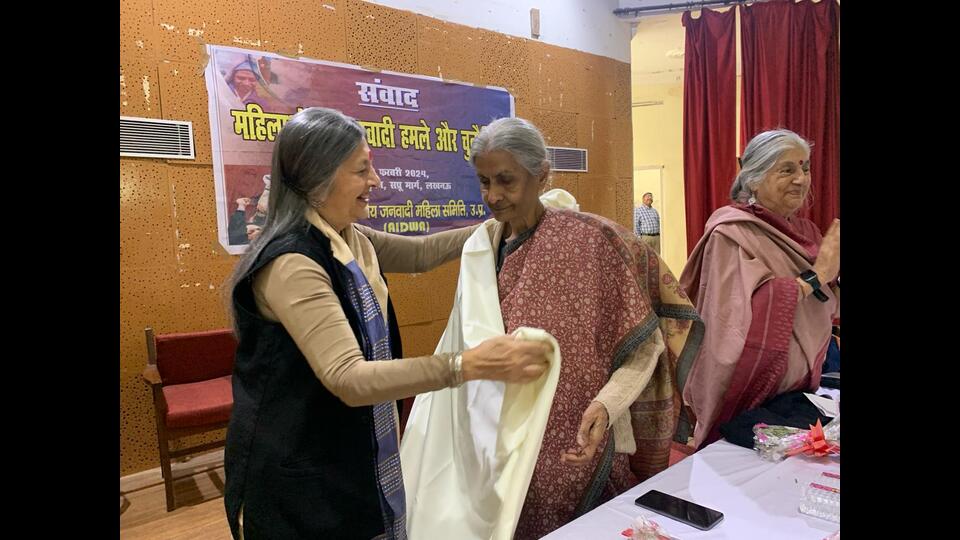
The panel of speakers at the seminar consisted of Roop Rekha Verma, former V-C of Lucknow University, Subhashini Ali, women’s activist and former MP, and Brinda Karat, first female member of the CPI(M) politburo.
Verma and Ali were feted for their contribution to the imprisoning of the 11 men accused by Bilkis Bano.
The seminar centred around the theme that society is yet to truly evolve from the ideologies about women that were spelled out in the Manusmriti, an ancient Indian text that promoted class inequalities and gender-based biases.
In her address, Roop Rekha Verma spoke about the culture of violence that has been perpetuated throughout Indian history, even despite the several movements for women’s rights that were even joined by men. According to her, there are three main challenges facing women achieving the full extent of their rights - firstly, a formerly unimaginable phenomenon has now become a matter of fact, activists and others who speak out for their rights are at risk of being penalised or arrested by their government and law enforcement; the communal sentiment has become so strong that women forget to stand alongside other women in their fights for their rights, and finally, the rising number of not just rapes, but brutal rapes, leaving the victim in a near-death state.
Ali broke down and simplified the discussion for all rural women who were in the audience. She exemplified the rape cases that took place in Hathras and Unnao, and how many years it took to bring some semblance of justice to the victims. “If it continues this way, we cannot hope for ever having a system that metes out justice for women,” she said.
Karat opined that it is not only about violence against women, but also about an attack on the lives of women. “In India, more women have been burned to death than soldiers have been martyred in war,” she said. She also pointed out that most government offices do not have a sexual harassment complaints cell, as required by law.
In the audience, along with joint secretary AIDWA, Madhu Garg, were several AIDWA members from across the city, be it from rural or urban areas, and the programme ended with spirited slogans on women’s rights and gender-based discrimination.


