E-Paper



India’s military strength being forged in defence factories: Sanjay Seth
Addressing defence personnel, industry leaders, innovators, start-ups and academia at the symposium, Seth commended the armed forces for dismantling the nefarious designs of India’s adversaries by eliminating terror hideouts during Operation Sindoor, which was launched on May 7 last year in response to the April 22 Pahalgam terror attack, targeting terror infrastructure in Pakistan-controlled territories.

 Prefer HTon Google


Union minister of state for defence Sanjay Seth on Tuesday said India’s military strength is being forged in the factories of its defence industries, crediting the success of Operation Sindoor to the courage and determination of armed forces, reinforced by the effectiveness of indigenously developed, state-of-the-art weapons and systems.
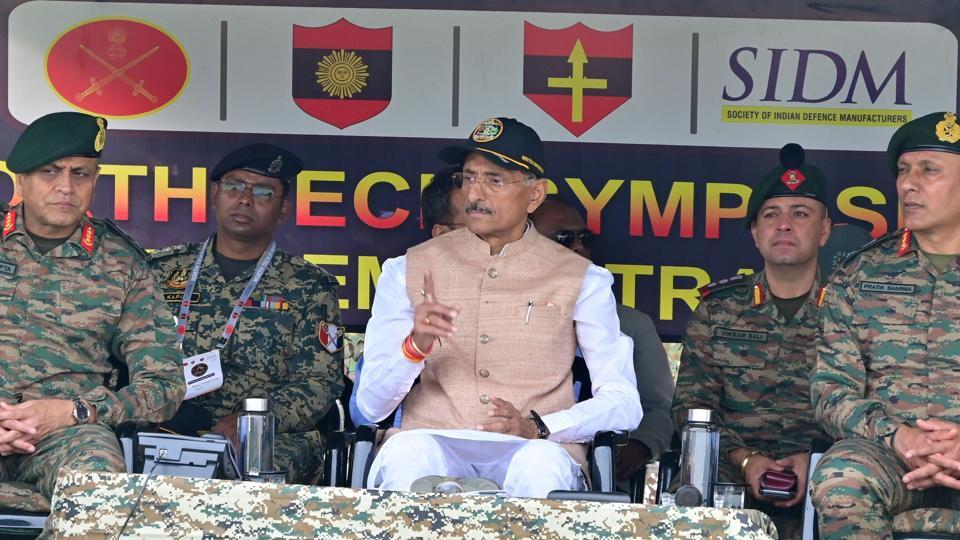
Speaking on the second day of the three-day ‘North Tech Symposium-2026’ at Cobra Auditorium in Prayagraj, Seth described MSMEs as the backbone of the Indian economy and start-ups as the country’s brand ambassadors.
“Our start-ups and MSMEs are the driving force of future growth and will play a pivotal role in realising Prime Minister Narendra Modi’s vision of ‘Viksit Bharat’ by 2047. They are the Vishwakarmas of our age,” he said.
Addressing defence personnel, industry leaders, innovators, start-ups and academia at the symposium, Seth commended the armed forces for dismantling the nefarious designs of India’s adversaries by eliminating terror hideouts during Operation Sindoor, which was launched on May 7 last year in response to the April 22 Pahalgam terror attack, targeting terror infrastructure in Pakistan-controlled territories. The strikes triggered four days of intense clashes, which ended with an understanding to halt military actions on May 10.
Seth said the effective use of Made-in-India equipment reflects the collective resolve of the government, defence public sector undertakings (DPSUs) and the private sector, especially innovators, start-ups and MSMEs, to achieve ‘Aatmanirbharta’ (self-reliance) in defence.
The minister asserted that record defence production and export figures underscore the emergence of a “New India” committed to strengthening its own capabilities to safeguard national interests.
“This New India does not cast an evil eye on anyone, but it does not look away either when its sovereignty is threatened,” he added.
Emphasising the rapid pace of technological change, Seth urged industry stakeholders to think out of the box and stay ahead of the curve amid global uncertainties. Highlighting government initiatives aimed at strengthening the defence ecosystem, he reiterated that innovation must remain a continuous process and assured full support from the Centre.
He also acknowledged the transformative impact of the Uttar Pradesh Defence Industrial Corridor and called on industry players to take this growth to greater heights.
Speaking on the occasion, General Officer Commanding-in-Chief (GOC-in-C), Central Command, Anindya Sengupta, urged industry partners to collaborate closely with the armed forces to meet evolving operational requirements in emerging domains and help build a future-ready Indian Army.
“Self-reliance will lead to strategic autonomy, technological sovereignty and operational flexibility,” he said.
The three-day symposium has been organised by the Indian Army’s Northern and Central Commands in collaboration with the Society of Indian Defence Manufacturers (SIDM) under the theme ‘Raksha Triveni Sangam – Where Technology, Industry & Soldiering Converge’. The event, inaugurated by Union defence minister Rajnath Singh on Monday, features 284 stalls by private defence manufacturers showcasing cutting-edge technologies.
Seth also saw live demonstrations of unmanned aerial vehicles (UAVs), drones, counter-UAV systems, all-terrain vehicles, surveillance equipment and other defence products organised as part of the symposium.
GOC-in-C, Northern Command, Lt Gen Pratik Sharma; GOC, 1 Corps, Lt Gen V Hariharan; president, Society of Indian Defence Manufacturers (SIDM), Arun T Ramchandani; industry captains, innovators, start-ups and academia representatives attended the session.
Meanwhile, Union minister of state (independent charge) for science and technology, earth sciences Jitendra Singh on Tuesday said India has entered a decisive phase in its defence journey, where technology, indigenous innovation and private sector participation are shaping a new global identity.
Speaking on the second day of the three-day symposium, the minister said modern warfare is no longer defined solely by physical strength, but increasingly driven by advanced technologies, real-time data systems and automated platforms. This shift, he noted, has significantly enhanced India’s operational capabilities and global standing.
Singh said that over the past decade, India has transitioned from being a major importer of defence equipment to an emerging exporter. “Defence production has reached ₹1.54 lakh crore, marking a 174% increase, while exports have surged to ₹23,622 crore — a 34-fold rise during the same period,” he said.
On India’s expanding technological base, Singh said sectors such as space, atomic energy, artificial intelligence and quantum technologies are now integral to defence preparedness. He added that India has already made rapid progress in quantum-secure communication capabilities, which will be critical for future warfare systems.
He noted that reforms in key sectors have opened new avenues for industry participation, enabling faster innovation cycles and scaling up of indigenous technologies.
The minister also highlighted the evolving role of the armed forces, noting their contributions not only to national security but also to disaster response and humanitarian assistance.
Singh said India’s pursuit of self-reliance in defence is rooted in technological sovereignty, with a focus on developing, owning and sustaining critical technologies within the country.