
 E-Paper



Rhino Action Plan 2022—2030: Plan to make UP’s KWS second home for one-horned visitors from Nepal
Rhino Action Plan will soon be launched by the UP government in collaboration with WWF to provide favourable conditions to rhinos visiting the grasslands of KWS.


Sprawling in around 550 sq km area in the Bahraich district of UP, the Katarniaghat Wildlife Sanctuary (KWS) is set to become the second home to one-horned rhinoceroses. Other than the Dudhwa National Park (DNP) which has its own resident rhino population, the movement of rhinos is spotted in KWS, said forest department officials.
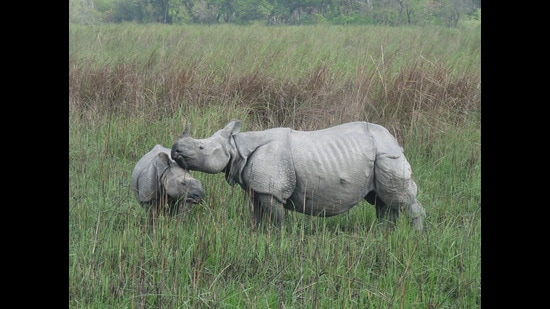
It is for this reason that the UP government in collaboration with WWF is set to launch Rhino Action Plan soon in order to boost the existing rhino population in DNP and also to provide favourable conditions to rhinos visiting the grasslands of KWS. However, the launch date is yet to be announced.
“With all preparations complete, we are set to launch Rhino Action Plan 2022—2030. The plan not only aims at rhino conservation but also at providing a suitable habitat to the migratory population of rhinos. Under the plan, the two areas—Trans Girwa and Sajauli area of KWS —where the movement of migratory rhinos has been spotted, have been included in the plan to develop a suitable habitat in KWS,” said Akash Deep Badhwan, divisional forest officer (DFO), KWS.
He said that both Trans Girwa and Sajauli area have witnessed heavy movement of migratory rhinos off-late, which he said was surprising. “Khata corridor, the trans-boundary that covers an area of 82 sq km and connects Bardiya National Park in Nepal to KWS, has off-late witnessed high movement of rhinos from Nepal to India. Not only the foresters but the change has been acknowledged by the locals as well. Hence, the plan is to provide a suitable habitat to the incoming rhinos in order to increase their stay time,” he added.
Dr Mudit Gupta, senior landscape coordinator, terai, who is taking care of the project, said that the project would largely focus on expanding rhino range to the KWS. “We will first carry out the security assessment of the two areas that have been shortlisted under the project. We will ensure that there is no threat or distraction to the migratory population. It will be ensured that minimal human interference takes place in order to provide rhinos a home-like habitat,” said Gupta.
According to the 2020 census, the population of single-horned rhinos in DNP has increased to 42. The ongoing conservation efforts are expected to give a further boost to the existing rhino population in DNP. Sanjay Pathak, field director, DNP, too hailed the move and said that the plan would be beneficial in expanding rhino range to the KWS.


