
 E-Paper



Shakti in khaki: From help desks to top posts, women reshape UP Police
This Navratri, the idea of ‘Shakti’ finds expression in a force where female personnel are increasingly moving into mainstream policing and positions of authority. According to the state government’s 2026-27 budget document, over 35,443 women have been recruited into the police department since 2017. The government has also said the women’s police workforce has grown from around 10,000 to more than 44,000.

 Prefer HTon Google


The role of women in Uttar Pradesh Police is expanding beyond help desks and police stations handling complaints by women. From leading districts and supervising investigations to heading specialised units and serving in armed formations, they are taking on responsibilities across the policing system.
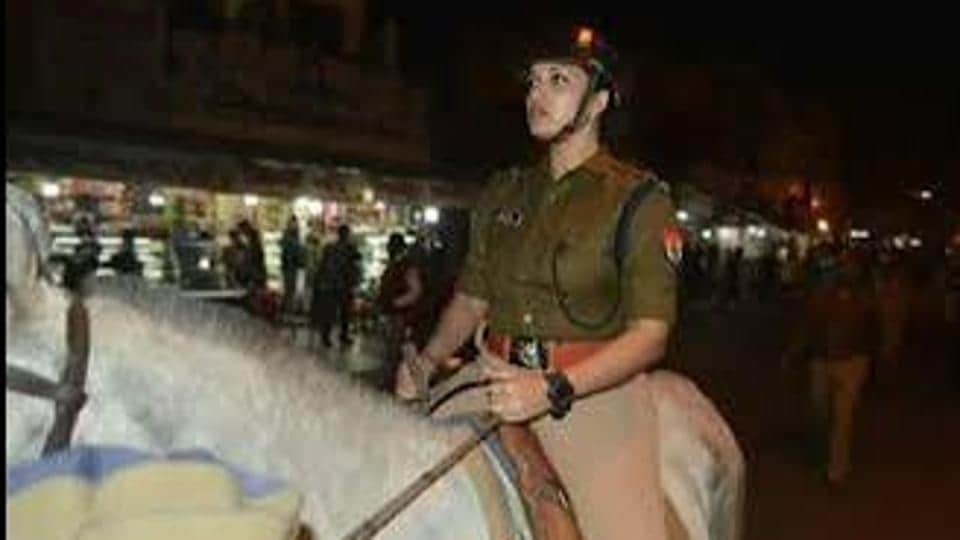
This Navratri, the idea of ‘Shakti’ finds expression in a force where female personnel are increasingly moving into mainstream policing and positions of authority.
According to the state government’s 2026-27 budget document, over 35,443 women have been recruited into the police department since 2017. The government has also said the women’s police workforce has grown from around 10,000 to more than 44,000.
From protecting women to commanding the force
The change is visible at the top of the hierarchy. Anupam Kulshrestha, a 1995-batch IPS officer, serves as ADG, Kanpur Zone; Padmaja Chauhan holds senior responsibilities in the Women and Child Security Wing and Fire Services; and Laxmi Singh heads the Gautam Buddh Nagar Police Commissionerate.
Other women officers occupy influential assignments in intelligence, vigilance, training and commissionerates. Aparna Kumar is joint commissioner of police in Lucknow, while Manzil Saini serves as IG in vigilance, and Geeta Singh holds an IG-level assignment in training.
At the district level, officers such as Khyati Garg in Lakhimpur Kheri, Raveena Tyagi in Barabanki, Aparna Rajat Kaushik in Mirzapur, Prachi Singh in Ambedkarnagar, Shardha Pandey in Kanpur Dehat, Ankita Sharma in Bijnor and Aarti Singh in Fatehgarh, illustrate how women are taking responsibility for policing beyond gender-specific mandates.
The changing face of field policing
According to departmental figures, there are 3,196 women investigators and 3,115 women sub-inspectors and inspectors. The state also has 75 women cyber units and 78 women police stations.
Women personnel are involved in investigating offences, collecting evidence, questioning suspects and coordinating with forensic teams. Cyber units handle complaints involving online harassment, stalking, impersonation and digital blackmail.
The Women and Child Security Organisation, with units across all 75 districts, supports women-focused policing through initiatives such as Women Power Line 1090 and the Mahila Samman Prakoshtha.
However, the wider change lies in women’s growing participation in policing beyond cases involving women and children.
From uniformed presence to armed capability
Three women’s battalions have been established in the Provincial Armed Constabulary (PAC), named after Veerangana Uda Devi Pasi in Lucknow, Veerangana Jhalkari Bai Kori in Gorakhpur and Veerangana Avantibai Lodhi in Badaun.
The state has also approved the procurement of 373 9mm pistols and 90 automatic assault rifles for the three battalions. The move is intended to strengthen their operational capability for assignments requiring armed response.
Departmental data lists 592 women in the Special Security Force and 44,804 women under anti-crime deployment. Depending on their postings and training, women personnel can be assigned duties involving patrolling, searches, security and law-and-order operations.
The figure alone, however, does not establish how many women have participated in specific operations such as encounters.
The changing role of women in policing is not simply about placing them in uniformed formations. It also requires specialised training, appropriate equipment and opportunities to take on operational responsibilities.
Recruitment is opening the next door
On October 14, the Uttar Pradesh Police Recruitment and Promotion Board declared the final results for 32,679 constable and equivalent posts. Of these, 4,481 women were selected, including 2,282 for women’s battalions. The recruitment process attracted nearly 28.87 lakh applicants.
Recruitment, however, is only the first step. Sustaining the change will depend on women having equal access to field assignments, specialist training, leadership positions and promotions.
It will also depend on the support systems available to personnel working in difficult operational conditions.


