
 E-Paper



Allahabad HC orders state govt ₹10-lakh relief over custodial death
A division bench of justice Shekhar B Saraf and justice Manjive Shukla passed the judgement on February 20

 Prefer HTon Google


The Lucknow bench of the Allahabad high court on Friday held that the state is “absolutely liable” for the unnatural death of a prisoner in its custody, even if the death is a suicide.

The court said the right to life and human dignity guaranteed under Article 21 of the Constitution is an “intrinsic, inviolable and omnipresent right”, extending even to a person illegally arrested or detained by the state.
A division bench of justice Shekhar B Saraf and justice Manjive Shukla passed the judgement on February 20 while allowing a petition filed by Prema Devi, who sought compensation for the death of her minor son in Pilibhit district jail.
Directing the respondents — the state government and other authorities — to pay compensation of ₹10 lakh to the legal heirs within three weeks, the court also asked the Uttar Pradesh government to frame guidelines for determining compensation.
It said the government must adopt relevant and cogent parameters for awarding compensation in custodial death cases, akin to the multiplier method based on age, income and dependents as provided under the Motor Vehicles Act, 1988.
According to the judgment, the petitioner’s son, an undertrial in a Pocso case, died by suicide on February 20, 2024. His body was found hanging from the ventilator of a prison toilet.
The National Human Rights Commission (NHRC) had earlier recommended compensation of ₹3 lakh. As it was not paid, the petitioner approached the high court.
The petitioner alleged the deceased was subjected to torture by police personnel over illegal monetary demands, which ultimately led to his death. The state counsel, however, contended it was a case of suicide and there was no material on record to indicate negligence, misconduct or involvement of the authorities.
The state further submitted that the approved compensation would be released after completion of formalities and receipt of the required budgetary allocation.
The court observed that custodial deaths represent one of the most serious challenges to the protection of fundamental rights within the justice system. It also termed it “flabbergasting” that there is no express constitutional mandate for grant of compensation in cases of unlawful detention or custodial death.
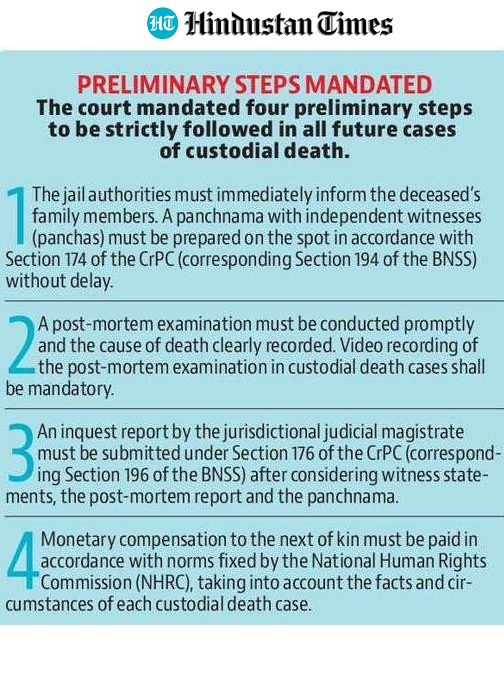
Preliminary steps mandated
The court mandated four preliminary steps to be strictly followed in all future cases of custodial death.
- The jail authorities must immediately inform the deceased’s family members. A panchnama with independent witnesses (panchas) must be prepared on the spot in accordance with Section 174 of the CrPC (corresponding Section 194 of the BNSS) without delay.
- A post-mortem examination must be conducted promptly and the cause of death clearly recorded. Video recording of the post-mortem examination in custodial death cases shall be mandatory.
- An inquest report by the jurisdictional judicial magistrate must be submitted under Section 176 of the CrPC (corresponding Section 196 of the BNSS) after considering witness statements, the post-mortem report and the panchnama.
- Monetary compensation to the next of kin must be paid in accordance with norms fixed by the National Human Rights Commission (NHRC), taking into account the facts and circumstances of each custodial death case.


