
 E-Paper



Ajit Pawar presents interim budget, state debt reaches ₹7.82 lakh crore
Budget an announcement of centrally financed schemes and a jugglery of figures, say experts and opposition


MUMBAI: Finance minister Ajit Pawar on Tuesday presented a ₹6 lakh crore interim budget with a revenue deficit of ₹9,734 crore. The interim budget or vote on account for four months is a compilation of old and ongoing welfare schemes and infrastructure projects put together in an attempt to showcase the “development” face of the government ahead of the Lok Sabha polls. While the government is aiming for a $1trillion state economy, its debt burden has reached ₹7.82 lakh crore after a net borrowing of ₹72,000 crore.
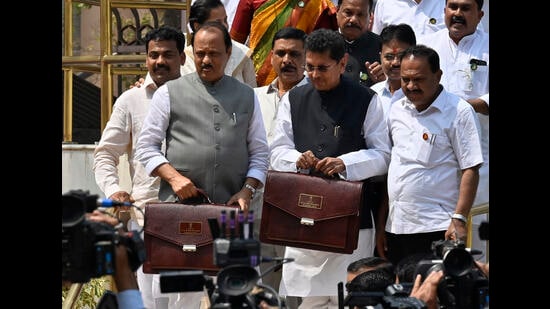
Mentioning the newly inaugurated Mumbai trans-harbour link and soon-to-be-inaugurated Coastal Road, Pawar announced the extension of the Bandra-Versova sea link to Palghar and the Eastern Freeway to Thane. He also announced that the land acquisition in Maharashtra for the Mumbai-Ahmedabad bullet train was almost complete and the first phase of the Navi Mumbai International Airport would be commissioned by March 2025. He announced schemes for farmers and backward classes, including Dhangars, Marathas and minorities, and also announced a hefty allocation for Shivaji-era forts and memorials of historical and national figures.
The ₹6,57,719-crore interim budget is estimated to have a ₹9,734-crore revenue deficit and a ₹99,288-crore fiscal deficit. The revenue for FY 2024-25 is expected to be ₹4,98,758 crore. With a borrowing of ₹71,713 crore in FY 2023-24, the total debt burden of the state has gone up to ₹7,82,991 crore. The spending on salaries, pensions and loan interest is ₹2.90 lakh crore which is 58.1% of the revenue receipts, up from 51.79% in FY 2023-24. Of this, ₹56,727 crore is towards the payment of interest.
The old ‘Lek Laadki’ scheme for the girl child announced in the last budget with a financial assistance of ₹1.01 lakh to girl children below 18 was reiterated again this year, with the additional announcement of the pink auto rickshaw scheme for women, in which 10 major cities of the state will see autorickshaws distributed to over 500 women drivers. The finance minister also repeated the old announcement of setting up medical colleges in 11 districts and an AIIMS in Pune.
Pawar thanked prime minister Narendra Modi at the beginning of his 53-minute budget speech for his “support”. “The state received ₹8,618 crore as GST compensation, ₹7,058 crore as an interest-free loan for 50 years for capital investment, and six Vande Bharat trains,” he said. “Apart from this, a provision of ₹15,554 crore has been made to Maharashtra. The PM has announced welfare schemes for youth, women, the poor and farmers, which will help in raising the standard of living of Maharashtra’s citizens.” CM Shinde later said that the Modi government had given the nod to all the schemes proposed by his government, which was implementing infrastructure projects worth ₹8 lakh crore.
Bleak picture of state economy
The state has set a goal of a $1 trillion economy in five years. However, the state’s GDP hovers at 8% when it needs to grow at 14% for the next five years to achieve the goal. Although the state government has been advised by the Economic Advisory Council to invest heavily in key areas such as services, infrastructure, manufacturing and tourism, the budget lags behind in allocations for these sectors. The government has made an allocation of ₹92,009 crore for capital expenditure, which is less than 20% of the estimated revenue receipts of ₹4.99 lakh crore.
More worrisome is the spending on salaries, pension and the interest on borrowings by the state government. “The spend on these has gone up to 58.1% from 51.79% in FY 2023-24, owing to the rise in expenditure on pensions in one year,” said a finance department official. “The government is expected to implement a new scheme similar to the old pension scheme ahead of the assembly polls. This will increase the spending on pensions, leading to a reduction in the development budget and capital expenditure.”
Of the estimated revenue receipts in FY24-25, ₹1.56 crore are from State GST, ₹62,500 crore from VAT, ₹55,000 crore from stamp duty and registration, ₹30,500 crore from state excise duty and ₹14,875 crore from motor vehicle tax. There will be a substantial increase in capital investment in government projects, state PSUs and the private sector. The state GDP stands at ₹42,67,771 crore while capital expenditure is pegged at ₹92,030 crore. ₹1.92 lakh crore has been allocated for development works, with the highest allocation of ₹14,266 crore for agriculture and allied sectors.
Jugglery of figures
The government has revised its estimated revenue generation in FY 2023-24 to ₹4.87 lakh crore from ₹4.50 lakh crore. Officials, however, expressed doubts about the revised estimate, saying that previous experience had proved otherwise. “For instance, the revised revenue estimate for 2022-23 was shown as ₹4.31 lakh crore while presenting the budget last year, inflating it from ₹4.03 lakh crore in order to keep the deficit low,” said an official. “The actual revenue receipts for FY 2022-23 were ₹4.06 lakh crore, which has been shown this time in the budget. This is a jugglery of figures.”
Rupesh Keer of Samarthan, a think-tank which studies the state budget, said, “This shows how the priorities of the state government have faltered. Such figure-based gimmicks result in a cut to capital expenditure and development works. There is no problem with taking loans, but these are not spent judiciously and to create assets.”
Deputy CM Devendra Fadnavis said that the borrowing would not be a hurdle in the government’s avowed aim of becoming a $1trillion economy. “The largest economy in the world is that of the US, and even that is not debt-free,” he said. “It is true that to achieve the goal, we will have to grow at 14% for the next five years. Our planning and goals set through this budget are in that direction, with the focus being on infrastructure and other key sectors. These sectors could be boosted through borrowing. At the current growth rate of the GDP, we will achieve the goal of $1 trillion by 2033-34, but our target is to achieve it in the next five years by augmenting the growth rate.”
Former finance minister and NCP (Sharadchandra Pawar) MLA Jayant Patil said the state government’s budget was full of announcements of centrally funded schemes. “It lacks planning and policy,” he said. “It is nothing but an attempt to emotionally attract people from various sectors, keeping the forthcoming elections in mind. Last year’s estimated deficit was over ₹16,000 crore and the government has tabled supplementary demands of over ₹1.05 lakh crore. It should explain how it managed to adjust the supplementary demands and last year’s deficit in the budget presented today.”


Stay updated with all the Breaking News and Latest News from Mumbai. Click here for comprehensive coverage of top Cities including Bengaluru, Delhi, Hyderabad, and more across India along with Stay informed on the latest happenings in World News.


