
 E-Paper



Pune festival noise battle wins wide support
Pune-based anti-noise pollution activist Vidyanand Bapat campaigned against the use of high-decibel DJ and Dolby systems in religious celebrations.

 Prefer HTon Google


As the citizen-led agitation against festival noise pollution picks up momentum in Pune, the Indian Medical Association (IMA) has also urged organisers to exercise restraint during festivities, and warned citizens to exercise caution against excessive exposure to loud DJs and intense laser lights.
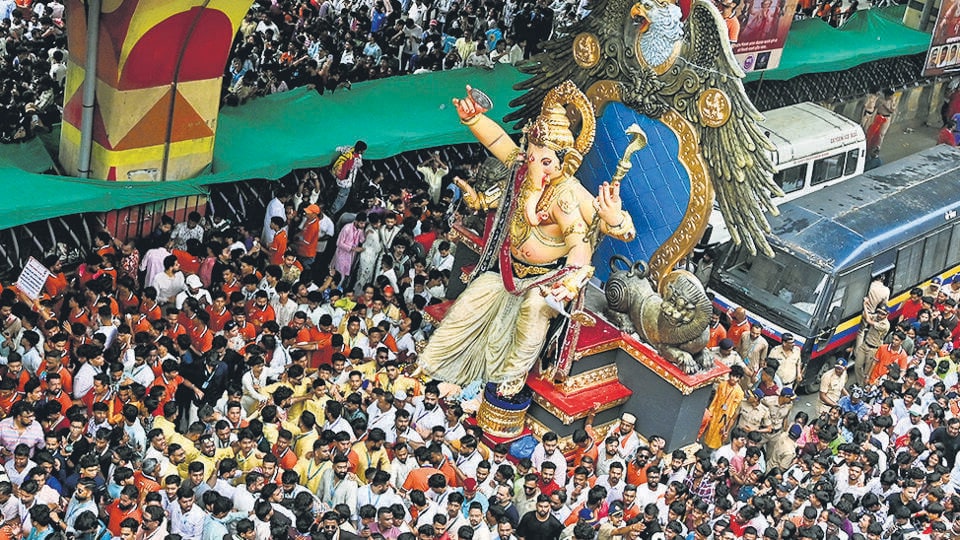
While the IMA regularly takes a strong stand against festival pollution, particularly crackers and laser lights, this time it has specifically urged against the use of loud DJs and intense laser lights that have become increasingly common during celebrations. Direct exposure of intense laser beams can cause eye irritation and blurred vision besides resulting in retinal injury that can potentially result in blindness in severe cases, the IMA warned.
The Pune battle picked up steam after Pune-based anti-noise pollution activist Vidyanand Bapat, who campaigns against the use of high-decibel DJ and Dolby systems during religious celebrations, was assaulted by a goon while giving an interview to a TV channel on September 3. He had also been confronted by Ganesh mandal organisers during an earlier meeting at the Pune Municipal Corporation (PMC). But the violence did not silence him.
Also Read I Celebrate festivals without DJs, lasers: Maharashtra minister to Ganesh mandals
Bapat’s activism has since found huge support in Pune, with citizens’ groups taking to the streets. More significantly, 31 prominent Ganesh mandals themselves demonstrated during the Dahi Handi celebrations that festivals and noise were not synonymous—coming together for a DJ-free Dahi Handi programme, they relied on dhol-tasha, halgi, cultural performances and traditional festivities, keeping the fun and energy of Dahi Handi intact.
Pune police steps up surveillance
The Pune police too have revved up their act, consistently recording violations of the noise rules and seizing mandals’ sound systems in Bibwewadi and the Bharatiya Vidyapeeth area in Katraj for using more bass and top speakers than they had permission for. Pune police commissioner Amitesh Kumar had directed mandals to restrict sound systems to four bass and four top speakers and to not use plasma speakers and laser lights.
More significantly, for the first time, over 110 police personnel were deployed with decibel meters and readings were collected at over 1,000 locations. “Most areas were much quieter, but we will analyse the readings and take further action against violations,” said Prashant Amrutkar, deputy commissioner of police (Special Branch).
The administration’s approach also found political support in Meghna Sakore-Bordikar, BJP MLA and minister of state. “Last year, I lost my cousin due to loud noise. Loudspeakers are troublesome to many, and there have to be curbs on them,” she said. CM Devendra Fadnavis too has called for control over excessive DJ noise and advocated a return to traditional forms of celebration.
Maharashtra's battle against noise pollution
The battle against noise pollution is spreading across Maharashtra, with different regions adopting their own methods. In Solapur, a phased reduction in sound systems is being effected rather than an overnight ban. Restrictions began with two bass and two top speakers in January 2024. From January 2025, this was reduced to one bass and one top speaker, while the 2025 Ganesh festival allowed one bass and three to four horns. “The gradual approach helped us get mandals to comply. A sudden ban could have faced resistance and created law-and-order problems,” said Solapur city police commissioner Rajkumar Meganathan.
Sangli has adopted an even tighter limit, permitting mandals one top and one bass speaker during Dahi Handi and Ganesh festivities. Superintendent of police Tushar Doshi said no noise-related cases had been registered during Dahi Handi so far.
Solapur’s minimising strategy appears to have worked during this year’s Dahi Handi celebrations, with no noise-pollution cases reported by the Solapur city police although Solapur Rural had numerous violations during Urs celebrations with DJ systems. No such case was reported during Krishna Janmashtami celebrations in the district, according to superintendent of police Atul Kulkarni.
Also Read I Drumming up the spirit of Ganesh Chaturthi: Inside Maharashtra's Dhol Tasha pathak tradition
Kolhapur too has reported a marked difference. While there were over 800 noise-pollution cases registered across the district last year, none were reported during this year’s Dahi Handi celebrations. “We will not compromise on noise pollution. Our aim is not to stop celebrations but to ensure that devotion and tradition are celebrated without inconvenience, noise pollution or safety concerns,” said Kolhapur superintendent of police Neelotpal.
In Nagpur, a daylong standoff between police and event organisers over playing DJ music at Badkas Chowk ended late on Friday evening when the music resumed but without the throbbing bass sound. The evening festivities proceeded in the presence of senior police officers ensuring compliance with noise pollution regulations. “We have made sure the bass system was removed. Only three speakers are being used, and the police are constantly monitoring the decibel level,” said Nagpur DCP Rahul Madne.
DJ systems, decibel meters
Clarifying the scope of the orders, police commissioner Vishwas Nangre Patil said that while there was no blanket ban on standard DJ systems, there were strict restrictions against high-powered multi-layer setups, modified DJ vehicles, and high-intensity laser/beam lights. Prohibitory orders under Section 163 of the Bharatiya Nagarik Suraksha Sanhita (BNSS) will remain in effect from September 3 to November 1, 2026.
To ensure strict compliance during the festival, every police station has been equipped with decibel meters calibrated for residential, commercial, and silent zones. CP Nangre Patil warned that violating Supreme Court and high court guidelines could lead to prosecution under the Environment Protection Act, carrying penalties of up to five years imprisonment and a ₹1 lakh fine. He reiterated that the goal was not to disrupt business but to enforce legal frameworks.
Also Read I Ganesh Chaturthi special| Three generations sculpting faith since 80 years
Significantly, citizens subjected to unbearable noise under the pretext of religion are now demanding enforcement before programmes begin rather than action after complaints or violations. The High-Sound Speaker-Free Pune Action Samiti is seeking greater coordination between the police, PMC and Maharashtra Pollution Control Board. The group wants authorities to inspect sound systems before events, stop unauthorised equipment, publish noise-monitoring data and make officials accountable for enforcement.


Stay updated with all the Breaking News and Latest News from Mumbai. Click here for comprehensive coverage of top Cities including Bengaluru, Delhi, Hyderabad, and more across India along with Stay informed on the latest happenings in World News.


