
 E-Paper



Explore Mumbai’s marine biodiversity in 10-day bioblitz
The areas covered include Haji Ali, Nepean Sea Road, Carter Road, Bandstand, Juhu Koliwada, Girgaon Chowpatty, and Bhuigaon Beach


Mumbai: For most people, an outing to the beach or the seaside is about staring into the distance. But what most may not be aware of is the treasure trove hiding under their feet: the wealth of marine biodiversity on the shores.
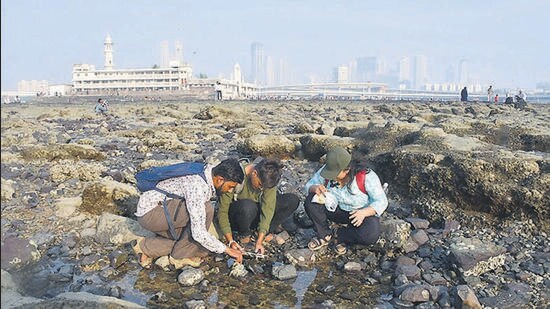
To change this and involve citizens in documenting this neglected marine wealth, the Mumbai-based Coastal Conservation Foundation (CCF) and the Visakhapatnam-based East Coast Conservation Team (ECCT) have organised a 10-day India Intertidal Bioblitz, which began on January 26. A bioblitz is an event where people focus on spotting and identifying as many species as possible in a specific area over a short time period.
Seizing the days of low tide around the new moon, the India Intertidal Bioblitz set its sights on the shores of Mumbai, Goa, Visakhapatnam, and Andaman. In Mumbai, the explorations are headed by the Marine Life of Mumbai, an arm of the CCF, and the Naturalist Foundation. The areas covered include Haji Ali, Nepean Sea Road, Carter Road, Bandstand, Juhu Koliwada, Girgaon Chowpatty, and Bhuigaon Beach.
The idea behind the bioblitz, according to Pradip Patade, co-founder of CCF, is to introduce tidepooling, the small pools of water left behind by receding tides, to people with the help of an expert. Participants can then document their marine biodiversity findings on the citizen-science crowdsourced platform iNaturalist. “This way, instead of having data scattered in different places, awareness about the wildlife on the costs increases, and researchers too can have a glimpse into the data,” he said.
The CCF has been logging observations on the iNaturalist platform since 2017. As many as 180 people have logged over 11,000 observations, said Patade, through which the organisation learnt there are at least 600 species found on the shores of Mumbai.
“When any common Joe lands up on a shore in Mumbai and beyond, they can put the location onto iNaturalist, and it will pull up the list of the organisms spotted there, along with other details,” said Patade. “This way, people have an idea what to keep an eye out for, as chancing upon them otherwise can be difficult.”
Descending onto the rocky shores of Haji Ali on Monday with the Naturalist Foundation’s guide Umesh Avadootha, an assistant biologist with the Byculla zoo, was a team of five: three zoology students who came all the way from Ulhasnagar, a former zoology student-turned-shark researcher, and their friend–the only one new to this world.
The bioblitz quickly revealed itself to be an exercise in looking closely and patiently. “The organisms we are looking for are extremely miniscule,” said Ashutosh Singh, one of the students. “So, when we come across a shallow pool of water among rocks, we are watching for any signs of disturbance and where it’s emanating from. We look at the spaces between rocks where there can be a possible hiding space, where the source may be lying camouflaged.”
A pro-tip from Avadootha is to carefully observe areas with a layer of green algae, where it is possible to find the solar-powered elysia sea slug, which feeds on the algae, incorporates it into its digestive system, and uses it for photosynthesis. In case you thought photosynthesis was only restricted to plants.
Avadootha and gang chanced upon several of the organisms commonly found on the rocky shores of Mumbai, thanks to the shared habitat they share: snail eggs that look like white specs on rocks, crabs eating the snail eggs, Gobi fish, brittle starfish, clams, sea anemones, hermit crabs encased in seashells, snail shells and their fragile exoskeleton (they can be spotted by their jerkier movement compared with snails), nerite snails, a polychaete worm, a butterfly seashell with its blue outline, and sponges, among others. Haji Ali is also home to the Cratena pawarshindeorum, a recently discovered sea slug species named after researchers from the Bombay Natural History Society.
Another batch was exploring Carter Road at the same time, where Patade and his team of eight had a lucky spotting of an octopus: fleshy pink, swaying in the water, around a foot long, it slithered back to hiding under rocks no sooner than they had clicked a few photos, the delight of the sighting still sharp in their minds for long after.
Stay updated with all the Breaking News and Latest News from Mumbai. Click here for comprehensive coverage of top Cities including Bengaluru, Delhi, Hyderabad, and more across India along with Stay informed on the latest happenings in World News.


