E-Paper



How 3 highways linking Mumbai to the rest of India have turned into deathtraps
Three Hindustan Times reporters fanned out and undertook back-breaking journeys on the Mumbai-Ahmedabad, Mumbai-Nashik and Mumbai-Goa highways

 Prefer HTon Google


Mumbai: National highways connecting cities and states are essential for economic development in terms of both trade and tourism. When well constructed and maintained, they reduce travel time and ensure human hours are not lost.
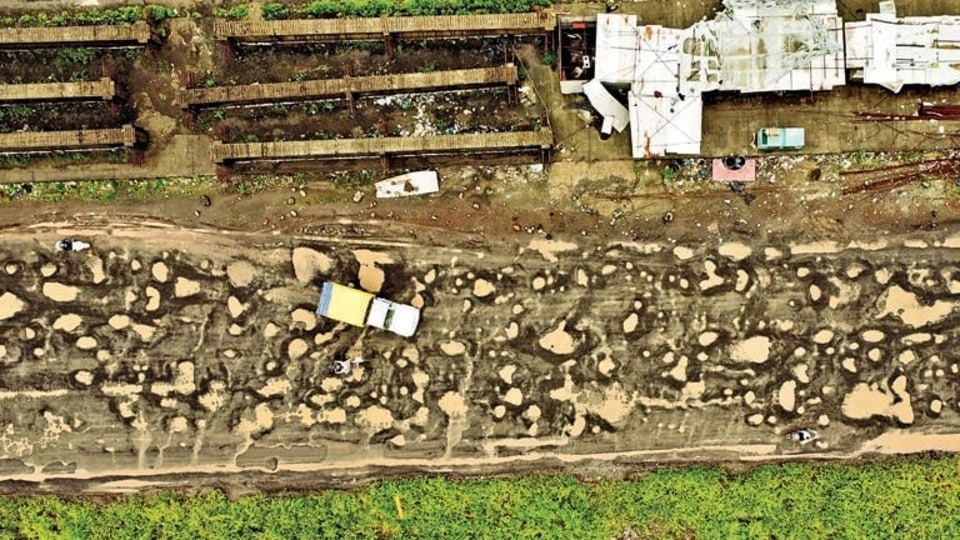
However, the three national highways that are considered vital gateways to Mumbai, the country’s financial capital, are a nightmare for commuters.
Three Hindustan Times reporters fanned out and undertook back-breaking journeys on the Mumbai-Ahmedabad, Mumbai-Nashik and Mumbai-Goa highways. Each of them were marked with potholed-ridden stretches that run for kilometres, badly constructed and maintained roads, shoddy concretisation and other incomplete work.
Commuters told HT that the poor condition of the roads, which worsens during the monsoon, causes traffic snarls, accidents, and light and heavy vehicles to breakdown.
Six-hour drive from Mumbai to Goa remains a pipe dream
In 2011, the central government decided to expand the Mumbai-Goa National Highway 66 from two to four lanes, promising a smooth, pothole-free drive and reducing travel time by five hours. With the initial deadline of 2016 long gone, 13 years later, a smooth NH 66 remains a pipe dream.
The low quality of work is a major concern for commuters on NH-66, which is crucial for goods transport to and from industrial areas in Panvel, Indapur, Mahad, and Lote villages, and connectivity to southern parts of India. The highway is especially busy during festival seasons and weekends.
Government officials have said the highway will be completely opened by December 2024. Divided in 11 “packages” or phases for speedy completion, the total length of the Mumbai-Goa highway is 460 km. The 84-km stretch between Panvel and Indapur falls under the National Highway Authority of India (NHAI), while the remaining portion is managed by the state government-led National Highway Public Works Department (NH PWD).
The first phase, known as the zero phase, between Panvel and Indapur in Raigad district, is still under construction. Four flyovers in this stretch are yet to be completed. Meanwhile, NHAI is already doing patchwork on the road, which was constructed just six months ago.
Package 1, from Indapur to Wadpale, is in very bad condition. It is ridden with potholes in the 1.5-km stretch near Lonere village and near Temple village. There are potholes every kilometre across the Wadpale-Bhogaon-Kashedi Ghat (packages 2 and 3). Package 4, up to the start of Parshuram Ghat, is in good condition, but parts of the road were closed due to the collapse of the newly constructed road, forcing a diversion. In Parshuram Ghat, landslides occur once a week.
Jaydeep Joshi, a resident of Parshuram village, said, “Despite several communications with NHAI since the construction work began, there are numerous errors left by the contractors. There are no proper outlets for the natural waterfalls from the Parshuram hills, causing water to flow on the road, which leads to landslides.”
Joshi also highlighted the broken old steps of the hills connecting Parshuram and Pedhe village. “Both villages depend on each other for various reasons like farming and schooling. Around 300 students from Parshuram village travel daily to Pedhe village for school. What was once a five-minute walk via the old steps is now a 15-minute bus ride,” he added. During this monsoon, two lanes of the Parshuram Ghat are closed due to landslides.
In fact, students and doctors of the Parshuram Hospital and Research Centre in Lote have asked for an underpass near the college. Dr Machindra Govalkar, a doctor from the college, said, “We are treating almost 60-65 patients a month for accident treatment. Our students have also suffered from accidents many times. Daily travel from nearby villages is dangerous for these students due to the lack of facilities like an underpass or skywalk near the college.”
The next package, from Parshuram Ghat to Aarwali, is partially constructed. The bridge construction in Chiplun is facing major challenges, with parts collapsing during the last and current monsoon.
Prakash Kane, a businessman in Chiplun, said, “NHAI contractors are not serious about their work. They built a drainage system alongside the road. But due to mismatched levels, water does not pass through, causing knee-level waterlogging on the highway from Bahadur Shaikh Naka to Powerhouse, leading to accidents and vehicle damages.”
Kane also criticised the low-quality work on the bridge. “Due to mismanagement and poor construction quality, NHAI now needs to cut part of the 84 pillars built for the flyover in Chiplun. This is a waste of taxpayer money,” he added.
Package 6, from Aarwali to Kante, includes Sangameshwar to Oni, the most accident-prone area of this highway. To date, aside from setting pillars for the flyover near the Sangameshwar ST depot, the construction of the 36 km road is yet to begin.
Parshuram Pawar, a Sangmeshwar resident and member of the commuters’ transport association, said, “The government should be focused on this accident-prone area, but no work has begun till date.”
Pankaj Gosavi, an NHAI official, accepted there are potholes near Lonere. “There are two patches of potholes from Indapur to Parshuram Ghat, which we are planning to fill with the paver blocks,” he said. Asked about the landslide at Parshuram Ghat, Gosavi said, “We invited a professor from the Indian Institute of Technology to review the landslide-prone areas. After his report we will take necessary action on it. Till then, we put various safety equipment as well as vehicles on the highway for immediate relief.”
More than 40 diversions from Panvel to Ratnagiri: Commuter
Nikhil Pawar, a marketing professional, travels to Khed, Chiplun, and Ratnagiri three times a week. “Riding my motorcycle, potholes and mismanaged road diversions make it very dangerous to travel on the Mumbai-Goa highway on this patch, as I have to go through Parshuram Ghat and Bhoste Ghat,” said Pawar.
There are more than 40 road diversions between Panvel and Ratnagiri. “A year ago, while travelling to Ratnagiri, there was a diversion on the downside. When I was returning to Chiplun at night, the diversion had changed, and due to low visibility, I lost control and hit a mound of soil. This happened to me twice in a year,” Pawar said.
An exhausting, back-breaking drive
In October 2021, Union road transport and highways minister Nitin Gadkari had announced that his ministry would spend ₹5,000 crore within the next two-and-a-half years to upgrade the Mumbai-Nashik national highway. Gadkari had said that travel time between the two cities would not be more than two hours, and a sizeable stretch of the highway would be made of concrete.
Nearly three years later, the condition of the highway remains pathetic, especially due to potholes and construction work on bridges and underpasses. Travel time between the two cities is anywhere between six and eight hours for a distance of 170 kilometres.
“Not only is time lost, but fuel and energy is also wasted. Besides, vehicles are damaged due to bad roads. Motorists are unable to ascertain the depth of potholes filled with water. We get exhausted driving the vehicles, zigzagging to find a way through the traffic and the potholes,” said Ashok Patil, a retired school principal from Shahapur, located along the highway, around 70 km from Mumbai.
Sushil Narkar, who works in a logistics firm and regularly commutes between Bhiwandi and Nashik, said, “They take toll of ₹140 for a car, but are not bothered to maintain the road. At most junctions, the roads are washed away and filled with potholes. Vehicles are diverted to narrow service roads due to bridge work, leading to traffic.” Narkar added that the traffic jams are giving him headaches and back problems, forcing him to take frequent leaves.
Neha Singh, a Kalyan resident who regularly commutes to Mumbai by road, said the traffic situation is especially bad on the weekends. “I was travelling from Kalyan to Bandra Kurla Complex for a function. However, I could cross only 15 kilometres in one and a half hours. Eventually, I had to drop my plans to travel further and was forced to take a U-turn mid-way,” she said. Singh added that, ordinarily, you can reach Thane from Mumbai in 45 minutes. But it takes around two hours to go from Thane to Kalyan, a distance of around 24 km.
This is why Swapnil Athawale, a Girgaum resident, recently went to Igatpuri for a picnic with his friends on a Tuesday. “We travelled on Tuesday when the traffic movement was comparatively good, and we did not face any major traffic jams,” he said.
The highway police have increased manpower on weekends. “Apart from regular travellers, who travel to Nashik and Dhule, picnickers who want to travel to Igatpuri to see waterfalls add to traffic snarls on weekends. Due to the rain, one has to also keep a tab on the Kasara Ghat, where boulders can fall, and even landslides take place,” said Mohan Dahikar, superintendent of Thane highway police.
Bhausaheb Salunkhe, project director of NHAI in Nashik, under whose jurisdiction most of the highway falls, said the vehicle count increases from 40,000 per day to 80,000 on weekends. Many containers, which come via the Samruddhi Highway from Nagpur, take the exit at Igatpuri and then join the old highway to travel to Mumbai or Navi Mumbai.
“There are potholes at certain locations, and we fill them immediately during dry spells. We have also provided traffic wardens from our side at various places. The work has already been accelerated. It was mostly slowed as villagers had opposed it, said Salunkhe.
A deadly patch for tyres, good business for puncture shops
Mohammad Shakil, who runs a puncture shop at Khadavali junction on the Mumbai-Nashik highway, said he attends to at least three to four tyre burst cases daily due to potholes and bad service roads, which are used due to traffic jams on the highway.
“Most of the time, the condition of the spare tyres is also bad, so they want to fix new tyres. However, I don’t sell new tyres, so I ask them to get the burst tyre repaired, fill air in it, and travel till Kalyan where they can get a new tyre fixed,” he said.
Shakil said that the bridge work at Khadavali junction, Shahapur and Vasind has been slow. The newer potholes, which are three- to four-feet wide with a depth of 10 to 12 inches are damaging the tyres and vehicles.
1.2 million human hours lost in a day
Megha Sood travelled from Dahisar toll plaza to Talasari toll plaza, a distance of 121 km. She observed random patches on the four lanes of each carriageway being concretised, resulting in potholed stretches at regular intervals, which slowed down traffic.
Heavy vehicles passing from both directions were seen squeezing into a single lane at a few places. In many areas, vehicles were forced to take service roads, most of which were in poor condition. In some patches, weak bamboo barricades had collapsed on the already narrow service roads, causing further jams. At night, dust particles from construction material hanging in the air obscured visibility.
According to highway police, at least 100,000 vehicles use the highway daily. “Approximately 80,000 vehicles cross the Khaniwade toll plaza, which further increases to 100,000 as we enter the limits of the Vasai Virar City Municipal Corporation (VVCMC) area, which causes traffic congestion during rush hours,” said a traffic police officer.
Even if you assume that one vehicle has, on average, two passengers and a driver, each of them is wasting at least four hours travelling on this stretch. It is a massive loss of at least 1.2 million human hours a day, said the highway police officer.
The officer added that the monsoon season’s first rainfall, which lasted barely 10 minutes, led to a chaotic situation on the highway, especially near Ghodbundar Road in Thane, where hundreds of motorists got stuck in heavy traffic for over four hours due to waterlogging and potholes.
Commuters who travel on NH 48 daily claim that it takes around four hours for people residing in Palghar, Vasai and Virar to reach Mumbai and Thane. “The jams create much anxiety for those dealing with medical emergencies,” said Dr Sunil Ingale, who runs an ambulance service in Vasai. “There is no option for the driver but to drive on the wrong side as, ordinarily, it takes over three hours to cover the distance of around 30 km from Dahisar to Vasai,” he added.
“We have lost lakhs of rupees in a year due to the bad roads. I have lost 25% business in the last six months, and it’s becoming a very costly affair for small and medium enterprises like ours to run units in the Vasai-Virar belt,” said Ravindra Raghuvanshi, 77, member of Laghu Udyog Bharati, an organisation of micro and small Industries in India. The organisation have raised multiple complaints about the highway over the past six months, but their pleas have mostly fallen on deaf ears.
NHAI officials said they were aware of commuters’ perils. They cited various reasons for traffic jams, including heavy vehicle breakdowns, wrong-side driving, multiple-lane driving, ongoing work by various agencies, encroachments, and illegal parking on service roads. They also blamed motorists for driving through the concretised patches before allowing them to dry.
The officials claimed that white-topping was delayed as they were not granted permission to close one section of the road while doing the work, resulting in a completion time of 50-55 days per kilometre. Officials have submitted a proposal to the state, seeking its nod for a pilot project to fully block a one-kilometre stretch for white-topping.
Sumit Kumar, NHAI manager for the Thane region, said the police and civic bodies were not cooperating while the white-topping work is going on. He added that the work would be done when a dry window is available and requested the traffic police to manage traffic flow.
2 hours to travel 3 kilometres: Daily ordeal for many villagers
Apart from commuters and motorists using the highway, the incomplete work has most affected the 10,000 villagers who live on the periphery of the highway. Over 5,000 residents who travel daily to schools, colleges, and offices from Mira Road or Thane spend at least two hours traversing three kilometers from their villages behind Kinara Dhaba to Ghodbunder junction.
“The children and office goers cannot reach their destinations on time. Several times, school children had to miss their exams as they reach their destinations late,” said Sushant Shrikant Patil, president of the Bhumiputra Rojgaar Hakk Saurakshan Samiti. The organisation had held a protest on NH 48 two weeks ago against the incomplete white-topping work and poor condition of the roads.
“After the protest, we were given assurance by NHAI that they would increase the pace of the work, but nothing has happened,” Patil said. Members of the organisation asserted that there was no need to concretise the highway. They said the work started haphazardly with no apparent coordination between the agencies.