
 E-Paper



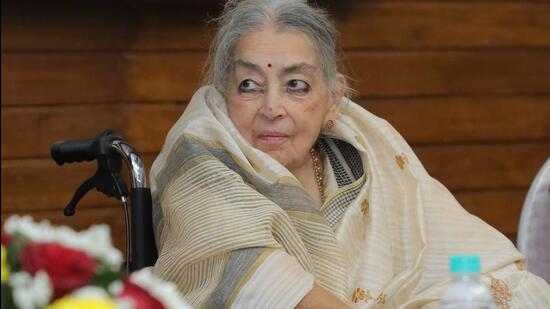
Lalitha Lajmi - A view into her soul
Her retrospective opened on 12th January, 2023, exactly a month before her death. It opened because she had dreamed of a befitting recognition for her contribution in Indian Art History as the only woman to have turned the gaze of the muse on herself. Until her, women had only been depicted as nude anatomical studies by male painters


Lalitha Lajmi lived bravely, her art mirroring life as it was. At her retrospective, currently on view at Mumbai’s National Gallery of Modern Art, is a watercolour from 2012 where she depicts herself lying down in a funeral chamber with several performers dancing around her, each with a distinct resemblance to her.
Her practice is defined by an endless series of self-portraiture where she depicted herself in fantasies, nightmares, quotidian scenes of the home, as a performer, sometimes as Raj Kapoor in Mera Naam Joker, or a Persian Princess to an alter ego of Frida Kahlo. A shrine in her retrospective depicts her self-portrait pumping blood into a portrait of Frida Kahlo. This, her last work on canvas, is among the many homages to her alter ego Frida.
“Freedom that came too late, has come to me now. There is no age to love or to be loved,” she said to me one evening in November last year. We were talking about her upcoming retrospective. “To make art you must have passion, you must fall in love and somewhere in the exuberance feel the pain of what love brings to life.”
Her retrospective opened on 12th January, 2023, exactly a month before her death. It opened because she had dreamed of a befitting recognition for her contribution in Indian Art History as the only woman to have turned the gaze of the muse on herself. Until her, women had only been depicted as nude anatomical studies by male painters. Committees of such male painters, reluctant to honour her with a retrospective, felt her work was repetitive. Little did they know of her battle to preserve a certain visual presence of women who drew themselves in art, for she came from the generation of the genius male painter. Ultimately, her retrospective opened with Jitish Kallat, actor Aamir Khan, Saryu Doshi and her gallerist for two decades, Tarana Khubhchandani leading the reception. There are texts by Adil Jussawala and Ranjit Hoskote which lead the audience through the works of a woman artist celebrating interiority.
She spent her happiest days with her husband Captain Gopi Lajmi at their Port Trust home in Colaba. She wold walk from there to both Fort Convent at Wodehouse Road and to Campion School at Cooperage Grounds where she taught art. While the boys at Campion would endlessly trouble her, the girls at Fort Convent would gush over her sarees. My sister, my aunts and many in my extended family were taught by her while I ever won a Camlin Art Prize as aa student was on her account. She thought there was merit in my abstract paintings of the comets that I daydreamed of as a child.
Lalitha valued her family greatly. She would read detailed letters that her son Devdas wrote during his early days in shipping, each year she would draw and write texts in a diary that would be given to her daughter, the feminist filmmaker Kalpana Lajmi on her birthdays. The last one of them was in 2016. Kalpana’s death to Lalitha was a loss of companionship, the only one she truly held.
She held her family close including her cousin Shyam Benegal and the family of Guru Dutt. Her brother Guru Dutt lost his life to the many entrapments of the mind. His last movie on the pain of unrequited love 'Kaagaz Ke Phool' 1959, was her favourite movie. The movie now seen as seminal in the history of Indian cinema was a box office disaster, as pain was unrelatable in cinema. Lalitha held great pride in being acknowledged as Guru Dutt’s sister. Like him, she drew pathos in her work, though towards the end she claimed to be drawing happy paintings. She never shied away in depicting the uncomfortable truths of a relationship or peeling the masks we wear to hide our emotions, or the faces we change to face a questioning world.
At a time when mental health concerns are urgent and widespread, Lalitha’s works are exceptional in their ability in speaking out and dealing with the complexities of our minds. In the 1970s, she began therapy in the form of psychoanalysis, where she had her dreams read and interpreted. She confronted them by painting surreal fantasies and nightmares to conquer her existential fears. This is her etch in art history as a printmaker.
I spoke to her every other day during the first phase of the 'covid lockdown' in 2020. At that time, she was drawing on a long-stained Japanese paper scroll brought to her by a relative in the 1970s. She was painting embryos, birds, human anatomy and the vertebrae. A self -taught artist, she was not only capable in handling complex drawings but she was also illustrating life at a time when we were all quite weak.
Perhaps she drew her strength from the oleograph portrait of Parvati or Gauri, located on the threshold of her kitchen and living room. Lalitha means beauty, and one of the names of Parvati in the Lalitasaharshnama. She embodied the indigenous idea of the mother goddess devoid of the terms of patriarchy.
Lalitha in Sanskrit means she who plays. She performed her role as an artist. An artist, a performer and a friend whose contributions to our lives is greater than we could ever return.
She died as the oldest woman artist and printmaker in India. Like her brother, whom she loved and missed dearly, she leaves a definitive stamp on the history of art in India.
Sumesh Sharma is an artist, writer and curator based in Mumbai
Stay updated with all the Breaking News and Latest News from Mumbai. Click here for comprehensive coverage of top Cities including Bengaluru, Delhi, Hyderabad, and more across India along with Stay informed on the latest happenings in World News.


