
 E-Paper



Malavika’s Mumbaistan: Searching For Our Humanity
The hard truth is that the world is sadly apathetic and insensitive to the plight of the suffering poor and the attention paid to the rich and famous is vastly disproportionate. What’s more, by the time the fate of the fishing boat had entered the news cycle, as far as the media and the public was concerned, the story was almost over


As news of the ill fated Titan submersible emerges, following a week when high drama and suspense had consumed public attention, it comes as no surprise that there are many who draw comparisons with the attention afforded this tragedy, as against that afforded to the uncountable refugees who lost their lives, after the fishing boat they were travelling on capsized in international waters, off the Greek coast just a few days earlier.
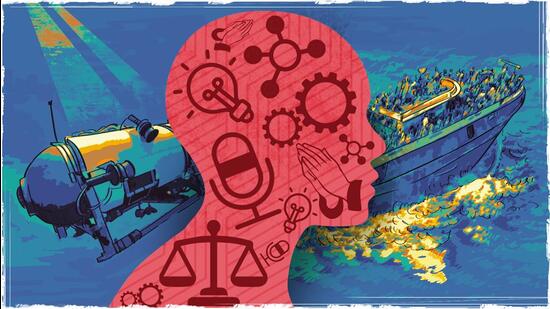
Many have pointed out to the relative lack of media coverage, public concern and state action, that the capsized refugee boat received, though it was a vastly greater tragedy, involving far more people than in the incident of the Titan submersible; and the inevitable accusations of bias against the poor and needy and the media’s fascination for the rich and famous, were subjects of hot debate and discussion.
***
Why would five men who paid substantial sums of money to undertake a risky and expensive expedition to satisfy their wanderlust and sense of adventure, garner more of the world’s attention, empathy and resources, than hundreds of hapless refugees fleeing for their lives, under unimaginably harrowing conditions and from life-threatening situations? Didn’t the hapless victims of the capsized boat deserve at least the same, if not more of the public’s prayers, attention and tears?
After all, weren’t the men who’d undertaken the deep sea voyage to view the Titanic, in their 22 -ft submersible, well aware of the risks involved? Hadn’t they signed waivers indicating that they were cognizant of the dangers they were putting themselves in? And above all, unlike the hapless refugees on the fishing boat that capsized, didn’t they have a choice to undertake the journey, something that the asylum- seekers did not?
***
But of course, we know the answers to that question:
The hard truth is that the world is sadly apathetic and insensitive to the plight of the suffering poor and the attention paid to the rich and famous is vastly disproportionate.
What’s more, by the time the fate of the fishing boat had entered the news cycle, as far as the media and the public was concerned, the story was almost over. The boat had already capsized and the way cynical newsrooms work, the story did not yield much by way of nail-biting suspense and tension, except as a heartbreaking tragedy.
One more, in a series of catastrophes that the world has gotten so used to and unfortunately almost immune to as a consequence.
***
The Titan’s disappearance, on the other hand, was a live-action drama, one that engaged people’s suspense, horror and imagination. The fact that so many wealthy and accomplished people had endangered their lives and paid enormous amounts of money to board what looked like a flimsy, toy contraption, resembling something out of a crazy science-fiction movie, to visit the wreckage of the Titanic, which in itself is the subject of a perverse fascination, made for irresistible breaking news.
Suspense, curiosity and horror fuelled the search’s appeal and people watched united in hope and fear, as the details of the story unwound in real-time.
It was the uncertainty of how events would turn out that animated the spectators. Would the missing Titan be somehow found under those extenuating circumstances? Would its passengers be intact and alive at the end of the search? What would they be able to tell us of their ordeal and survival? For a public brought up on a 24X7 diet of cliffhangers and wild -story telling on OTT platforms and pop culture platforms, the sad truth was that this was right up their street as far as ‘entertainment’ went.
***
What do these tragedies and our response to them tell us about who we are and what we’ve become? A world where the plight of hundreds of fugitives packed like sardines into a makeshift contraption which capsizes, garners less empathy and interest than that of five men on an expensive adventure spree?
Truly, the truth is disheartening.
Unless one takes into consideration one other recent story that garnered almost as much interest as that of search for the ill-fated Titan.
It was the 40- day intense search for the four missing Colombian children from the Cessna plane crash in the Amazon rainforest on 1 May this year.
Like the one for the Titanic, this one too played out over many days and involved a well-conducted, documented and impassioned search. The children aged 13, nine, four and 11 months, hailed from the Huitoto indigenous group in Colombia and their plight had convulsed their entire nation, with the president of Colombia commandeering more than 100 soldiers to comb the area of the crash, joined by hundreds of other volunteers.
Forty days to search a remote jungle area infested with wild animals and poisonous plants is a long time, but the children’s rescuers had not given up hope. And when their footprints and a few items like a soiled nappy and a kid’s water bottle had been discovered, the search had only intensified.
Like in the case of the Titan, this story too stoked the imagination, suspense and horror of the public. Would the poor, hapless children, whose mother had perished in the crash, be found alive and intact? What were the chances of such a miraculous occurrence happening? For weeks the speculation had continued, engrossing all who followed it.
Ultimately and miraculously the children had been found. Mal-nutrioned, hungry and covered in insect bites, but alive and responsive. The whole nation had rejoiced. As had others, beyond geographical borders and ethnicities, whose humanity had been stoked by the story.
After all, who could not empathise with the plight of the missing children and join the exhilarating, daunting search for finding them?
***
So when the damning evidence emerges of our apathy to the hundreds of refugees who lost their lives when their boat capsized, in contrast to the attention we paid the Titan and its passengers, I find myself looking for hope for our shared humanity in the fact that four lost indigenous Colombian children evoked the same sense of empathy and interest.
Not because they were rich or famous or powerful –but because they were human and ultimately -like all of us -vulnerable and fraught too.
Because, in the end, it is our shared humanity that unites us. As humans we pray for triumphant outcomes and happily -ever- afters, wherever required. Be it in the Amazon rainforest or in the deep seas of the Atlantic.
And sometimes our prayers are answered and sometimes they aren’t. But we must never, ever give up our hope and prayers or stop caring.
Because that’s what makes us human.

Stay updated with all the Breaking News and Latest News from Mumbai. Click here for comprehensive coverage of top Cities including Bengaluru, Delhi, Hyderabad, and more across India along with Stay informed on the latest happenings in World News.


