
 E-Paper



Marathwada floods impact prasad in temple towns
The GI-tagged, khoya-producing hub of Bhum in Dharashiv has lost its most precious asset, its cows. The taluka supplies khoya and pedhas to temples across Maharashtra and neighbouring states

 Prefer HTon Google


Bhum (Dharashiv): Prasad in temples, especially pedhas, at pilgrim centres in Maharashtra and neighbouring states, could be in short supply due to the unprecedented rain and flooding in Marathwada.
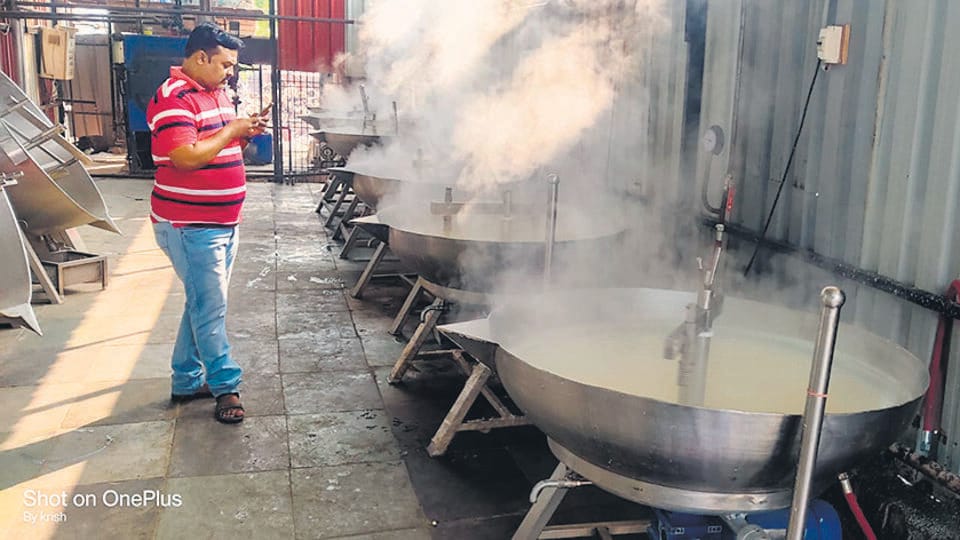
Production of khava, or khoya, a dairy product widely used in making sweetmeats, has fallen drastically, and is expected to decline further, even as dairy farmers begin to count their losses in Bhum taluka in Dharashiv district.
The taluka, a GI-tagged, khoya-producing hub in Maharashtra, has lost its most precious asset – its cows – in the floods. Bhum is one of the highest milk producers in Marathwada but milk collection has already dropped to 3.20 lakh litres a day from 3.80 lakh litres, and khoya production has fallen by 5 tonnes a day, from 40 tonnes.
The taluka has reported the death of 64 cows and calves, with another 165 missing due to the downpour. Residents across Marathwada, worst hit by the torrential rain, were hurriedly evacuated, their cattle and poultry perishing in floods that have lasted ten days. Farmers here say the number of cows lost is much higher as the government does not register deaths unless there is formal paperwork.
Vishwanath Datkhile, a dairy farmer from Belgav Pimpalgao in Bhum, is among the leading contributors to the region’s milk production. Of the 48 Jersey cows he had reared across 25 years, 16 were swept away in the floods and 18 died in their sheds, unable to break free from their tethers.
The Datkhiles, a family of ten, used to sell 180 litres of milk daily, a figure now down to just 20 litres. “We have lost over ₹35 lakh as each cow cost us ₹1 lakh. My father started dairy farming in 2000. Now, just one spell of rain has destroyed everything he built over 25 years,” says Vishwanath’s son, Hrishikesh.
The cattle that’s survived may not have sufficient to eat as waterlogging has destroyed dry fodder stocks. The cows are also fighting Lumpy, a disease that has erupted among the cattle owing to the flooding.
“We have started distributing financial assistance to farmers after conducting post-mortems on the dead cows. We are also taking precautions with regard to the cattle’s health,” says Santosh Duggam, the taluka’s livestock development officer.
But this is no consolation for the dairy farmers of Bhum, a taluka with an amazing story of resilience and survival. Residents of one of the most drought-prone talukas in Marathwada, the farmers here turned to animal husbandry a few decades ago as there wasn’t enough water to grow much of anything.
It wasn’t very long before the use of modern technology and innovative dairy farming practices not only boosted milk production here, but raised the fat content in the milk as the cows in Bhum graze on open grasslands.
The taluka soon became a major khoya producing centre, supplying it to sweet makers in temple towns such as Shirdi and Tulajapur in Maharashtra, Gangapur in Karnataka, and towns in neighbouring Andhra Pradesh and Tamil Nadu, says Krishna Satpute, who produces over 100kg of khoya a day and supplies it to Mumbai.
An official from the taluka’s dairy development department says that before the floods, 25% of the milk produced in Bhum was used to make khoya, and the rest was sold to brands like Gokul and Mother Dairy.
In December 2023, the ‘Kunthalgiri Khoya’ made in Bhum received a Geographical Indication (GI) tag, recognising its unique quality and reputation linked to its geographical origin. The taluka has over 600 khoya producing units, of which 500 use wood-fire furnaces and over 50 use boilers.
“More than 25,000 farmers in Bhum are engaged in dairy farming and over 5,000 traders in selling pedhas at temples. The flooding has affected the trade badly,” says Vinod Jogdand, chairperson of the Khava Cluster Association.
Jogdand, who was instrumental in getting the GI tag for the khoya in Bhum, is also working on getting solar-powered furnaces for the khoya makers. “The farmers have not yet come to terms with their losses. Many are still in temporary shelters, while others are struggling to cope. It will take a few weeks for the business to go back to its pre-monsoon production.”


Stay updated with all the Breaking News and Latest News from Mumbai. Click here for comprehensive coverage of top Cities including Bengaluru, Delhi, Hyderabad, and more across India along with Stay informed on the latest happenings in World News.


