
 E-Paper



State okays felling of 5,000 trees for bullet train, Mumbai-Vadodara E-way
These are terrestrial trees and in addition to them, several thousands of mangroves will go because of these developments.


Mumbai: The environmental impact of major infrastructure projects continues to grow in the state, with the Maharashtra State Tree Authority recently allowing 5,032 trees to be felled in Palghar and Thane districts for the Mumbai-Vadodara Expressway (MVE) and the Mumbai-Ahmedabad bullet train.
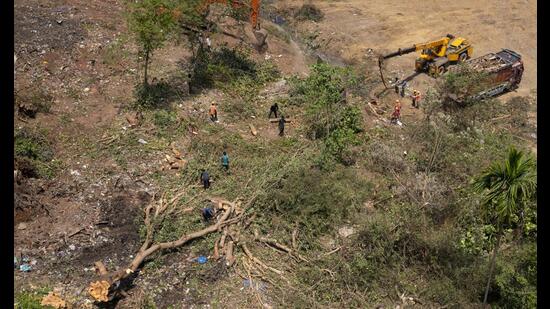
These are terrestrial trees and in addition to them, several thousands of mangroves will go because of these developments. Moreover, the Brihanmumbai Municipal Corporation (BMC) in April had also sought public comments on the proposed felling of an additional 1,687 trees in Vikhroli East for the bullet train, permissions for which are yet awaited.
Of the 5,032 new trees earmarked for felling, 3,747 are located in Palghar district, of which 3,066 are located within the Vasai Virar Municipal Corporation (VVMC) limits. They include 38 heritage trees, which are at least 50 years old or more. Another 681 trees are located in Ghlovira, Vevoor, Navali and Morivali villages, which will go for the National High Speed Rail Corporation Limited’s 508-km long bullet train.
Finally, another 1,285 trees in Thane district will go for the Mumbai-Vadodara Expressway, in the Kulgaon Badlapur Municipal Council (KBMC) limits, of which 776 trees will be transplanted as per the minutes of the MSTA’s last meeting on April 13 — a copy of which was accessed by Hindustan Times this week.
In all, the state Tree Authority has mandated the plantation of 62,228 new trees as compensatory afforestation by the National Highways Authority of India (NHAI) and the NHSRC. Despite requests from Hindustan Times, officials did not provide details regarding the locations for compensatory greening, nor did they provide clarity on the girth classes and nature of the 5,032 trees, i.e., whether they are invasive, exotic or native species.
The Bombay High Court last month had also allowed NHAI to divert 0.0785 hectare of mangrove forest and cut down 350 mangrove trees in Thane and Palghar districts.
“The trees will be felled between Shirsad and Masvan, for the main carriageway of the MVE, and for a connecting spur between Amne and Bhoj. Work orders to start clearing these trees will be issued soon. To be sure, they are not located on forest land. For any work on forest land, we have got permission from the Union environment ministry separately,” said an NHAI official familiar with the details.
The Mumbai-Ahmedabad line is the first bullet train project in India, of which 155 km will pass through Maharashtra. Eleven types of mangrove species, the habitat of 177 species of resident and migratory birds, otters, turtles, fish, crabs, oysters, wild boar, monkeys, flying fox, fishing cats, civets, mongoose, wild cats etc. will be directly affected by the project, according to an 85-page report by the Mangrove Society of India (MSI).
The MVE, on the other hand, is an eight-lane, 379-km expressway between Vadodara and Mumbai planned under the National Highways Development Project (NHDP) Phase VI and Phase II. It will reduce travel time between the two cities to four hours from the current seven hours through the national highway (NH)-8.
In addition to these trees, the MVE will also lead to the diversion of 193 hectares of protected forest, reserved forest and mangrove land in Palghar, leading to the felling of 18,073 trees on forest land alone.

Stay updated with all the Breaking News and Latest News from Mumbai. Click here for comprehensive coverage of top Cities including Bengaluru, Delhi, Hyderabad, and more across India along with Stay informed on the latest happenings in World News.


