
 E-Paper



‘Move from words to action to gradually remove current hatred in society’
Speakers at the Conclave of Religions–Mumbai 2026 stressed compassion, coexistence and environmental responsibility as values shared across faiths

 Prefer HTon Google


MUMBAI: As religious polarisation and ecological crises continue to test societies across the world, religious leaders, scholars and public intellectuals gathered at the JW Marriott, Juhu, on Saturday for the Conclave of Religions–Mumbai 2026, where speakers repeatedly stressed compassion, coexistence and environmental responsibility as values shared across faiths.
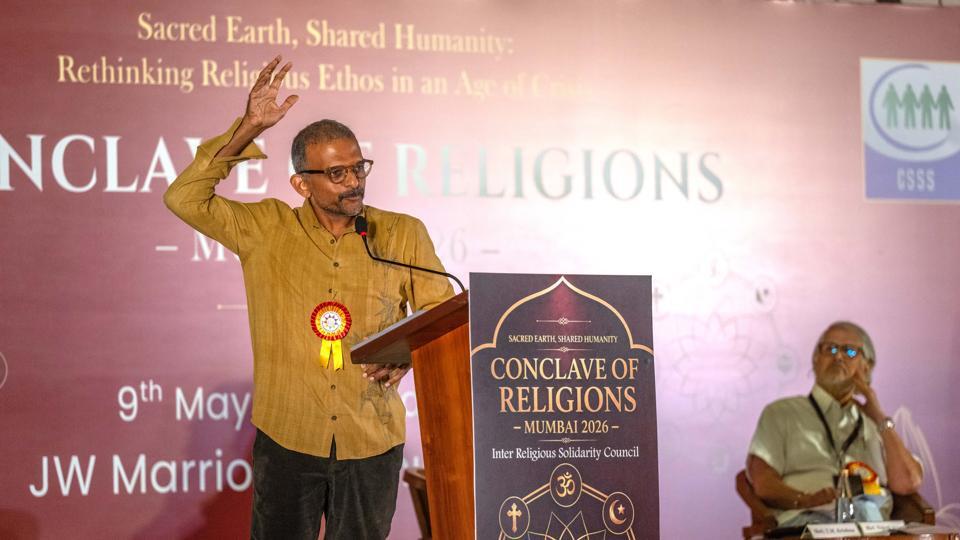
Organised by the Inter-Religious Solidarity Council and the Centre for Study of Society and Secularism, the theme of the conclave was ‘Sacred Earth, Shared Humanity: Rethinking Religious Ethos in an Age of Crisis’. The gathering brought together religious heads, civil society members and academics for discussions on religious extremism, social cohesion and ecological preservation.
Carnatic vocalist and public intellectual T M Krishna, who delivered the keynote address, said the central challenge lay in society’s unwillingness to confront difficult questions directly such as the growing conflict between organised religion and spirituality. Speaking about the need for dialogue, he said that while many spoke of building bridges, the real task was finding common ground across communities and beliefs. The chair was Najeeb Jung, former lieutenant-governor of Delhi.
The first session was moderated by Fr Frazer Mascarenhas and featured speakers from multiple faiths, who emphasised that peace, empathy and compassion formed the essence of all religions despite differences in practice and tradition. “All expressions of love ultimately emerge from the same pool of compassion,” said Bishop Dominic Savio Fernandes.
Continuing in the same vein, Buddhist monk and professor Geshe Tenzin Damchoe said that religion should not divide people. “If we keep thinking ‘I am Buddhist’, ‘I am Hindu’, or ‘I am Christian’, we create barriers among ourselves,” said. “Our first fundamental idea should be that we are all human beings. India remains an example of peaceful coexistence despite its diversity, and we should not generalise entire communities because of a few people who misuse religion for personal gain.”
Dr Surinder Kaur, another speaker, remarked that India was “a fabric woven with different religions, castes and communities”, and all of these needed to stay together. “Positive discussions alone are not enough,” he declared. “We now need to turn these words into action to remove hatred gradually.”
Dr Sameer Sharma, an environmentalist and entrepreneur who belongs to the Bahá’í community, also stressed the importance of action over rhetoric in the conclave’s second session, which was on environmental ethics. “Environmental protection has become a key mission for the Mumbai Bahá’í community,” he said. “We are working towards building the city’s first zero-waste-to-landfill community and encouraging Bahá’ís to adopt sustainable lifestyles while contributing to the Swachh Bharat Mission.”
Religious leaders in this session spoke about ecological protection as an extension of faith and moral responsibility. This panel too featured a diverse group of speakers, and was moderated by Fr Luke Rodrigues of the Archdiocesan Office for Environment.
Stay updated with all the Breaking News and Latest News from Mumbai. Click here for comprehensive coverage of top Cities including Bengaluru, Delhi, Hyderabad, and more across India along with Stay informed on the latest happenings in World News.


