
 E-Paper



Nagpur hospitals discharge patients early to admit others
As the second Covid wave sweeps Nagpur causing an unprecedented spurt in cases and mortalities, the city is also reeling under an equally unprecedented shortage of hospital beds

 Prefer HTon Google


As the second Covid wave sweeps Nagpur causing an unprecedented spurt in cases and mortalities, the city is also reeling under an equally unprecedented shortage of hospital beds.
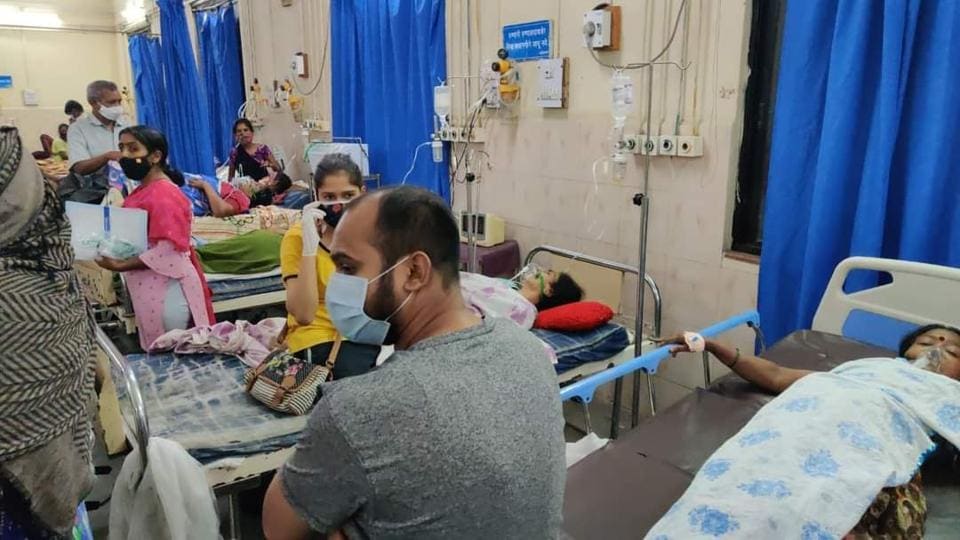
With the rising number of patients needing hospitalisation, hospitals – Government Medical College and Hospital and Indira Gandhi Medical College and private hospital in particular -- have resorted to early discharge of patients to make way for new patients needing a bed. In the process, the patients already under the spell of the virus and who have not yet recovered, face various other health complications and need hospitalisation again.
Take the case of Sunil Madavi, 26, who works as an attendant at a city cancer hospital. Sunil was admitted to the GMCH after he contracted coronavirus last month. “He was discharged within nine days. After reaching home, he was disoriented, did not recognise family or friends and spoke incoherently. We got him admitted to a private hospital sensing something was amiss,” Madavi’s colleague Anup Thakre said. Subsequent tests showed Madavi was still reeling under Covid infection. “We again admitted him to GMCH and this time we requested the hospital authorities to discharge him only after he recovers. But he was discharged after 10-12 days and shifted to another government facility for quarantine,” said Madavi’s father Wamanrao.
The GMCH superintendent Dr Avinash Gawande said that they have only 900 Covid-19 beds. “It’s really very difficult to accommodate everyone as hardly 18-20 patients get discharge per day as against 70-80 new admissions every day,” he said.
It is even alleged that two Covid patients were made to share a bed, reflecting the frightening reality of the bed crisis. Officials, who preferred anonymity, say the bed shortage is also because people flock to government hospitals to avoid the exorbitant cost of treatment at private hospitals. Even private hospitals divert critical patients to government hospitals. Dr Gawande said that after arranging for more beds, the crisis is manageable.
Former guardian minister of Nagpur and state BJP general secretary Chandrashekhar Bawankule alleged that those with Covid were being admitted in the same ward as patients being treated for other illnesses. “There are no beds in Nagpur,” he said.
The pathetic situation of the government hospital could be gauged from the fact that a unique sit in dharna in front of government-run medical college and hospital here was staged on April 11 by the resident doctors to highlight the inconvenience which patients are facing due to neglect of district administration there. The agitating doctors highlighted the shortage of beds, oxygen cylinders etc. at the government hospital and blamed the district administration for not co-operating in the Covid-19 pandemic situation, even though it was going on since last year and have gone from bad to worse in the last one month.
Dr Sanjay Chilkar, the nodal officer of Nagpur Municipal Corporation for Covid-19 management said that Covid cases were initially reported from slums and highly congested areas. “Now we find cases from the middle-income population and entire households are getting affected -– a phenomenon more pronounced in the second wave.” He blames people’s carelessness towards Covid-safety norms of —wearing masks, avoiding large gatherings and crowded places for the spurt in infections.
Two days before Holi, the main markets of Sitabuldi and Itwari areas were teeming with people and vehicles. People were out shopping for Holi and buying vegetables and fruits from scores of vendors. There was a constant stream of vehicles. Pedestrians, many of them without masks, were walking slowly, brushing past each other, Chilkar pointed out. Holi was on March 28. And after Holi, as many as 40,646 positive cases were reported from Nagpur city within two weeks, that’s virtually double than the last month’s figure when an average 2250-2500 cases were reported every day.
Following the Covid surge, the district administration in Nagpur imposed a partial lockdown from February 1 and later a total lockdown from 15 February to 31 March and a night curfew from April 1. Testing was also ramped up, from merely 5,000 to now around 15,000 testing every day. Unfortunately, even after growing positive cases, there is still a sizable segment in Nagpur city population are not wearing mask in public.
According to Dr Vijay Joshi, a senior doctor of local civic body and the coordinator of private and government hospitals for the Covid-19 patients in Nagpur said that lack of awareness among people is a challenge, as they don’t understand the seriousness of the virus. “Initially there was even hesitancy towards Covid-19 vaccine, but now people are coming for it,” says Dr Joshi and claimed that as many as 3, 67,476 people of Nagpur city were vaccinated till Monday evening.
Amidst a massive spurt in Covid cases in Nagpur, testing has tripled to around 15,000 tests per day, according to the guardian minister for Nagpur district, Nitin Raut. As many as 1,322,892 people were tested so far. He said there are 2,991 oxygen beds, 1413 ICU and 532 ventilator beds available for Covid-19 patients in Nagpur city.
However, this could not prevent the surge of the deadly disease. The increased testing might be another possible reason why more cases are being reported in Nagpur district, says Ravindra Thakare, the district collector.
Chilkar said that there are over 57,819 active cases in Nagpur and of them 80% patients are asymptomatic. “In view of the present situation, we only recommend 20% mild and moderate patients to the hospitals. It is indeed a challenge as we have only 4,441 Covid beds (including from the private hospitals) in Nagpur city,” he said and claimed that the government is increasing the capacity in view of the growing situation. The state government already sanctioned ₹65-crore to tackle the outbreak in Nagpur. This amount will be used to increase beds, add more ICU beds, ventilators and provide more infrastructures in government-run hospitals at Nagpur.
Meanwhile, authorities have imposed protocols for the second wave to ensure better surveillance. For instance, the authorities did away with strict home isolation for the first seven days and another seven days home quarantine after one test positive. However, the earlier protocols were stricter than the new one. During the first wave, there were strict hospitalisations (even for the asymptotic patient) for 14 days and another 14 days for home quarantine, said Chilkar.
Asymptomatic to moderate cases are now sent to two designated Covid care centres. There are 138 Covid hospitals in Nagpur city. The more severe cases are sent to government-run medical college hospitals or civic hospitals for treatment.
The locals, however, say the authorities of not doing enough to contain the outbreak. Mohan Kothekar, a rights activist, blames the authorities for not doing enough to prevent the infections from recurring. There was no sticker at homes of infected patients which were mandatory during the first wave last year. Kothekar, who resides in an apartment on Amravati Road in west Nagpur locality pointed out that in his apartment at least four to five families with couples and children were found positives, but the civic body didn’t put a sticker at their homes to alert the neighbours. Children and elders from their family, who had tested positive, were also moving about freely.
A new variant of Sars-Cov-2 was detected in random community samples from Nagpur, the Union government said earlier this month. The Union health ministry said a novel variant with a combination of two mutations E484Q and L452R was found in 206 samples taken from state since December. “We sent swab samples of few patients to the National Institute of Virology at Pune a few days ago and the reports established the new strain of coronavirus,” Raut said.


