
 E-Paper



Pathare Prabhu CHS at Khar hits a century
It was on January 9 that the society turned 100 but the Omicron virus put a spanner in the works, and the celebrations had to be called off. The centenary will thus be celebrated on January 7 in the coming year.


Mumbai: Nestled between 11th Road and Linking Road in Khar West is a cooperative housing society that belongs to one of the city’s oldest communities, the Pathare Prabhus. Comprising 52 bungalow plots with a hundred families, the society hit a milestone of a century this year.
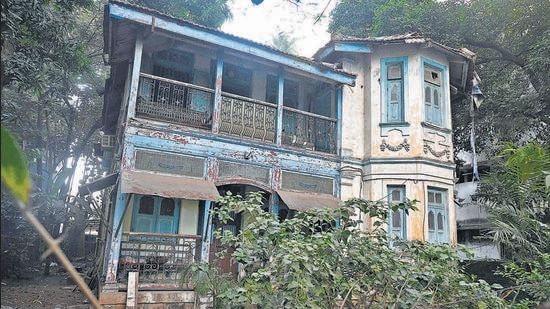
It was on January 9 that the society turned 100 but the Omicron virus put a spanner in the works, and the celebrations had to be called off. The centenary will thus be celebrated on January 7 in the coming year with an evening of entertainment at Bal Gandharva Rang Mandir in Bandra West, where the 52 members of the society will be gifted a silver medal each. The members also plans to illuminate the society for seven days as well as host a light and firecracker show.
Prasad Kirtikar, 70, who is the secretary of the society, said that while originally there were only bungalows in the society, many members later opted to construct buildings in their place to accommodate expanding families as well as make some money from renting out space to tenants. “Nearly four generations of Pathare Prabhus live in this locality,” he said. “I belong to the third generation.”
Ashok Talpade, 79, another old-timer from the society has many sepia-toned memories of the plot full of flowering plants, and even remembers sighting rainbows in the evening during the monsoon. “The atmosphere was pleasant in those days unlike today,” he said.
The society was founded on January 9, 1922, and its total area is 32,000 square yards divided into 52 plots which are on 11th Road, 12th Road and Linking Road in Khar West. It is located near Chitrakar Dhurandar Marg, named after famous artist M V Dhurandar, who was also a Pathare Prabhu.
The Pathare Prabhus migrated from North India some 3,000 years ago to Paithan. They settled in Mumbai about 1,000 years ago and since then have been an important part of the city. Revealing the antecedents of the housing society, Kirtikar said that members of the community used to assemble in the Pathare Prabhu Social Club established in 1888. “There was a meeting to discuss the setting up a cooperative society meant solely for Pathare Prabhus,” he said. “It was decided that no plots should be sold to people who did not belong to the community.”
Advocate Vinayak Harischandra Pradhan was entrusted with the work of locating the land, which the society purchased from the British government for ₹1.54 lakh. It was given on lease to interested members for 998 years at the rate of Rs1 per annum.
In 1979, the society received a legal notice from the government to open its gates to all communities. Determined not to comply, the society fought on the issue for 21 years. Eventually the matter was taken to the then cooperation minister who in turn gave a ruling in 1987 that the community had a right to form an association under Article 19 of the Indian Constitution. Thereafter, the Supreme Court gave a similar ruling in the case of a Zoroastrian society.
Boasting educated member and professionals like lawyers, doctors and engineers, the Pathare Prabhus are proud of their culture which they say is different from that of other Maharashtrians. “Our pagdi (turban) is different from Lokmanya Tilak’s pagdi,” said Talpade. “It is our trademark attire. Our food habits and preparations are different; we are mainly fish-eaters. We are Kshatriyas, and Prabhus mean landowners.” Talpade and Kirtikar named the late politician Pramod Navalkar when asked for a prominent Pathare Prabhu.
“We are a community of mainly reformists,” said Talpade. “We banned sati in 1929. We also banned the practice of dowry after a play called ‘Hunda’ (Dowry) was released. Till then, we used to give 40 tolas of gold in dowry; now we give only ₹51 during kanyadaan. We promoted widow remarriage and introduced reformist education. We educated our women, and they even controlled our properties and farms. We are all educated intellectuals. Our community was 100 percent literate in the eighteenth century, including women.”
The Pathare Prabhus’ philosophy is simple: to enjoy good food, especially a thali full of pomfrets and Bombay Ducks, and make merry. “Every Saturday, we meet and speak on some issue. This tradition of intellectual discourse has been on for 100 years,” said Talpade.
The ‘intellectual discourse’ right now is on the issue of reservations, he added. “Our children are not getting admission on merit despite scoring 98 percent due to the reservation policy,” he said. “They are frustrated and are leaving the country. So we are contemplating demanding reservation for our community like the Marathas.”
Stay updated with all the Breaking News and Latest News from Mumbai. Click here for comprehensive coverage of top Cities including Bengaluru, Delhi, Hyderabad, and more across India along with Stay informed on the latest happenings in World News.


