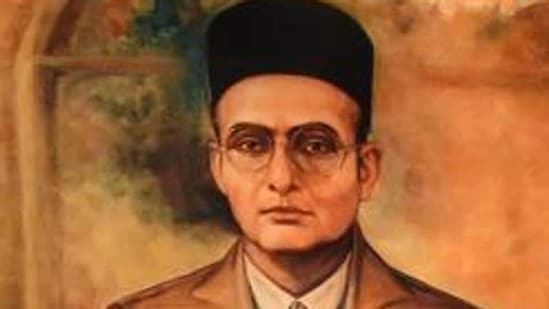
Last month, the Uddhav Thackeray-led Sena faction issued a warning to its Maharashtra Vikas Aghadi (MVA) ally after Congress leader Rahul Gandhi’s perceived insult of Vinayak Damodar Savarkar, the erstwhile Hindu Mahasabha leader held in high esteem by the ruling Bharatiya Janata Party (BJP).
Vinayak Damodar Savarkar.
To be sure, Gandhi has repeatedly brought up Savarkar’s name – last November, when Gandhi was passing through Maharashtra in his Bharat Jodo Yatra, his remarks about the early 20th century Hindutva ideologue drew the ire of BJP and Eknath Shinde-led Sena, who led protests across the state. Most recently, he made another reference to Savarkar at a press conference that he held following his disqualification from the Parliament.
Uddhav Thackeray, who has often been taunted by Maharashtra chief minister Shinde and the BJP for joining hands with secular parties, chose to show his support base this time around that he had not left Hindutva behind.
At a rally at Malegaon on March 27, Thackeray said that Savarkar was a “god-like figure” whose insult will not be tolerated. "We are together in the fight to save democracy, but do not make statements or take steps that will create fissures within the alliance," Thackeray warned Gandhi.
Sena’s love for Savarkar dates back to the 1980s when the party, led at the time by founder chief Bal Thackeray, turned to the Hindutva ideology as a means to reach out to a wider support base.
Its foundational sons-of-the-soil, anti-migrant ideology had won it a degree of influence in Mumbai and Thane enough to trump other parties in the civic polls. By 1985, Bal Thackeray realised he needed firmer ground. Two years later, in an assembly byelection in Mumbai's Vile Parle constituency, Sena came on board the Hindutva plank. This was also around the time that the Vishwa Hindu Parishad (VHP), an affiliate of the BJP, launched the Ram Janmabhoomi movement questioning the presence of the 16th-century mosque Babri Masjid, seeking instead to build a Ram temple in Ayodhya (now renamed Prayagraj), a place that many Hindus consider to be the birthplace of Ram.
Shiv Sena won the seat and was inspired to continue the agenda in 1988 municipal corporation election in communally sensitive Aurangabad (now Chhatrapati Sambhaji Nagar). The party won the civic body and has been in power in the central Maharashtra city for decades, barring a few exceptions.
The success of the Hindutva agenda, used by the party for the first time in any election, caught the attention of the BJP that was eschewing its Gandhian socialist ideology — cited at the time of its formation in 1980 — in favour of a Hindutva agenda. The party approached Bal Thackeray, and what came about was one of the longest-running political alliances in India.
Bal Thackeray periodically invoked Savarkar, one of the few Maharashtrian Hindutva leaders, even though the party’s idol remained the 17th-century Maratha warrior-king Chhatrapati Shivaji.
Significantly, Bal Thackeray's father, the late Keshav alias Prabodhankar Thackeray, a renowned social reformist with close ties to the country’s first law minister and Dalit rights champion B R Ambedkar, was a staunch critic of Savarkar and saw him as a Bramhinicial leader.
In Maharashtra, however, Savarkar was already a household name: stories about his participation in the freedom struggle and his imprisonment in Andaman island were taught in schools. His books, including one on the 1857 war of independence, and poetry, including the famous “Ne Majasi Ne Parat Matrubhoomi La” (Take me back to my motherland) — penned while he was imprisoned at Marseille in France in 1910— were already popular.
In 2004, when the Congress-led United Progressive Alliance (UPA) government removed a plaque commemorating Savarkar at the Andaman jail, Shiv Sena was vocal in criticising Congress minister Mani Shankar Aiyer. Bal Thackeray participated in a protest where Aiyer’s effigy with shoes. Congress, then the ruling party in the state as well, was presented as being both anti-Hindu and anti-Maharashtra.
“Bal Thackeray always took a convenient stand that suited his politics be it related to culture, ideology or even Chhatrapati Shivaji Maharaj and for that matter in Savarkar… When he praised Savarkar for his fight for freedom, he never went into his concept of Hinduism or his opinion on the cow,” said Sena chronicler Sanjay Patil.
Surendra P Gangan is Senior Assistant Editor with political bureau of Hindustan Times’ Mumbai Edition. He covers state politics and Maharashtra government’s administrative stories. Reports on the developments in finances, agriculture, social sectors among others.Read More

 E-Paper