
 E-Paper



Silent storytellers: Walk through a songline that connects India and Oz
The Australian Consulate-General and Unbox Cultural Futures collaborate to bring the ‘Walking Through a Songline’ (WTAS) art exhibition to India


MUMBAI
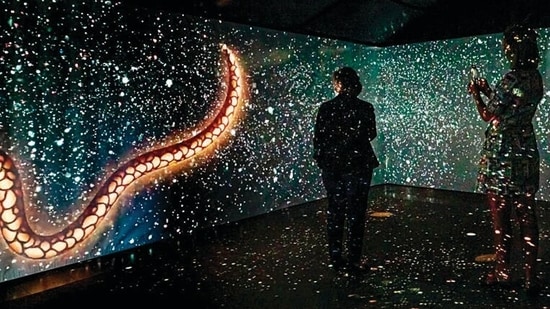
While cricket comes to mind when one mentions Australia to Indians, the countries have another connect way before current nation states marked their boundaries. It is when indigenous people from (what we now call) India crossed continents to establish the extraordinary ‘First Nations culture.’
A window to explore this kicks off today as Mumbai’s Museum of Solutions (MuSo), the Australian Consulate-General and Unbox Cultural Futures collaborate to bring the ‘Walking Through a Songline’ (WTAS) art exhibition to India.
This powerful award-winning digital immersive art exhibition -- produced by National Museum of Australia and Mosster Studio -- will travel across Mumbai, Delhi, Bengaluru, Chennai and Kolkata on its India lap.
Nicholas McCaffrey, Australia’s deputy high commissioner to India told HT: “WTAS underscores the value in leveraging new technological interventions to preserve and promote indigenous artworks and cultural legacies of Australia and India.” Underlining how both nations increasingly find alignment in geo-strategic and geo-economic interests, he said, “WTAS is part of our continued and increasing people-to-people engagement with India.”
WTAS, is a component of the National Museum of Australia’s acclaimed exhibition, ‘Songlines: Tracking the Seven Sisters’ currently touring Europe. Digitised by Mosster Studio to preserve one of the oldest cultures in the world, for wider audiences, WTAS comes to India after successfully touring Australia, Thailand, Malaysia, Vietnam, Indonesia, Laos and USA.
Paul Murphy, the Australian consul-general in Mumbai underlined how WTAS interprets the work of over 100 artists while examining the relationship between traditional Australian First Nations knowledge and modern technology. “Told by artists, caretakers and traditional proprietors, the First Nations’ people of Australia have used songs for millennia to explain creation and pass along cultural values like appropriate behaviour and sustainable living practices,” he said.
MuSo director Michael Peter Edson felt WTAS in India offers an opportunity to appreciate the culture of another people, “and through that consider what our own culture is all about”.
“I hope WTAS and the activities we’ve created around it will prompt curiosity in children and their families to explore common characteristics of Australian and Indian First Nations’ people.” He pointed out how India has close ties to the art and culture of indigenous communities, citing Madhya Pradesh’s Bhimbetka rock shelters. “These sites, and their still living cultures, underline the rich historical legacy of the Indian subcontinent. In addition to helping us appreciate the magnificence of such heritage, museums must work together with governments, tourism and creative industries, and academia, business, and all sectors of society to ensure these sites -- and the ways of life they represent -- are available, in their full majesty, to future generations.”
During its 22-day run WTAS will include a special children’s art workshop (April 27) to explore the connections between Songlines and Mumbai city’s cultural heritage. After a curated WTAS walkthrough the children will head to MuSo’s 9th floor Make Lab to create their own songline stories about Mumbai.
“Maybe they’ll create songlines full of fish, islands, boats, birds and family. Or show us walks to school, ice-cream cones, taxi cabs, or the Bombay crow,” said Edosn who added, “Each child will share a story of their world, just as Australia’s First Nations children might have done 10, 20, or 80 thousand years ago!”
On May 4, WTAS will include an art workshop titled ‘Tactile Tales’ for autistic children. The children will bring digital artworks of Songlines to life with felt, wood, glue and paint.
Of Songlines
Ancestral journeys, also known as songlines, are considered knowledge corridors or paths. As told by artists, caretakers and traditional proprietors, the tales comprise the fundamental history of the Australian continent. In communities where texts are not the primary means of communication, songlines serve a similar purpose to the epic poetry of the major oral/ aural traditions across the globe. Only venerated senior custodians have access to public, secret/sacred, or closed versions of this knowledge.
The depictions in WTAS are amongst the most significant of the creation tracks that crisscross Australia. A sorcerer pursuing a trio of sisters in Martu Country, in the Western Desert, where the narrative opens. He is a shapeshifter who tricks the sisters with a variety of disguises – he transforms into delicious delicacies, water, a shaded tree, or a juicy snake. But the sisters are also capable of shapeshifting, and while they race and soar, they create Songlines and fool the sorcerer. The narrative follows the sisters as they pursue each other through the Anangu Pitjantjatjara Yankunytjatjara and Ngaanyatjarra territories, with the sisters’ language changing as they go. Land features like waterholes and rock formations, as well as the night sky, bear witness to their actions.
(100 artists’ digitised work will open today at MuSo and run till May 10.)

Stay updated with all the Breaking News and Latest News from Mumbai. Click here for comprehensive coverage of top Cities including Bengaluru, Delhi, Hyderabad, and more across India along with Stay informed on the latest happenings in World News.


