
 E-Paper



What went into making Mumbai’s Coastal Road
he entire project will be ready only by the end of 2025 when the green space wedged between the coastal road and the traditional thoroughfare will be complete

 Prefer HTon Google


Mumbai: The southbound arm of Mumbai’s Coastal Road will be thrown open to public in February, making it possible for citizens to travel between Worli (Bindumadhav Thackeray Chowk) and Princess Street, on Marine Drive, in under eight minutes, keeping a speed limit of 80kmph. It takes 30 minutes to travel that distance now.
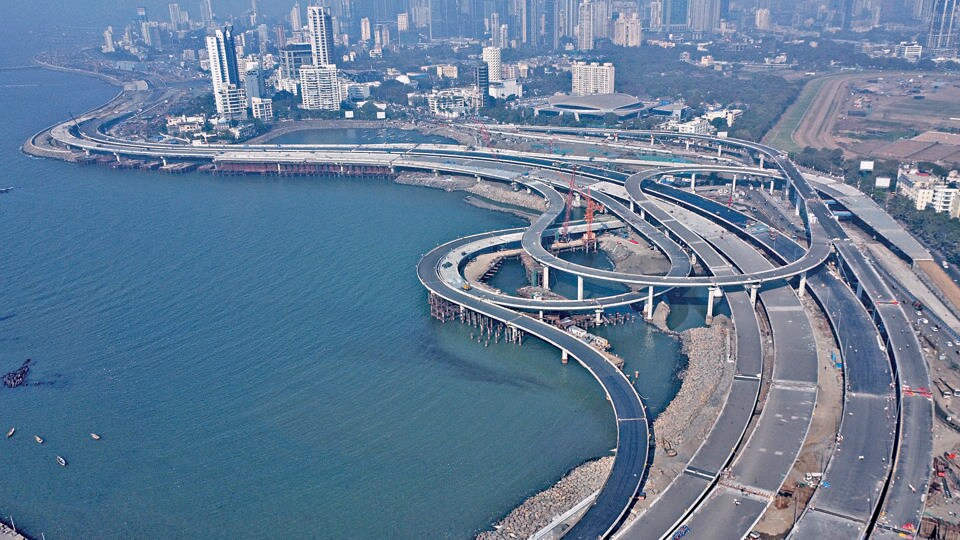
HT visited the stretch on Wednesday to find workers giving finishing touches to this arm. However, it is only this 9 kilometer stretch of the 10.58 kilometer that will be thrown open, as work on the connector to the Bandra Worli Sea Link (BWSL) is still in progress. The northbound arm and three interchanges will open in May, along with the 7.5km promenade. The entire project will be ready only by the end of 2025 when the green space wedged between the coastal road and the traditional thoroughfare will be complete.
For now, only the tunnel – from Priyadarshini Park to Princess Street flyover – is complete. 84.08% of the project is complete and it’s a race against time for the remaining 16% till the May deadline.
A few firsts
Five years in the making, the project faced a few twists and turns, even as it claims to be one of India’s many firsts. Part of the stretch of the project, which will open in 10 days, was awarded to Larsen &Toubro, (L&T) – it included the under-sea tunnels, built for the first time using a tunnel boring machine (TBM) of 12.2-meter diameter.
“The TBM came all the way from China a few months into the pandemic. Its assembly suffered due to a weak labour strength. Many of the 1,000 workers at the site fell sick and had to quarantine,” said an on-site official. Creating the first arm of the tunnel southward took a year; it was completed by January 2022. After this, the machine took a U-turn, making its way northward.
438 meters of northbound boring was achieved in a month, breaking an earlier Guinness World Records. “But a few months later work came to a standstill for three months due to damages on some bearings. Getting reinforcements from China took time, but thanks to the quick pace, the second stretch took only a month more than a year. It was started in April 2022 and finished by May 2023,” said an official.
The TBM machine now sits unassembled awaiting its next use in tunnel from Orange Gate (on eastern freeway) to the Coastal Road’s end on Marine drive.
In future, with the link to MTHL, the route will go all the way up to Pune. An official from L&T hinted that in total, nine such tunnels are planned, “making Mumbai a city of tunnels by 2030”.
A Brihanmumbai Municipal Corporation (BMC) official said the Covid-19 pandemic was a blessing in disguise – as the streets were deserted construction vehicles plied freely. A bulk of the first two years after the tendering process in 2018, went in seeking permissions from CRZ and the Maritime Board. It was paused in 2019 due to a Bombay high court stay on environmental clearances, following several PILs by at least five petitioners.
Love Grove (Worli) to Princess Street
The reclamation from the land-end to the sea was a lesser challenge as experts had to go only two meters deep during low tide and six meters deep during high tide at the coast. This fill -- 72 lakh metric tons – is called graded fill material, which is a combination of marram, sand and graded rock, brought from the Navi Mumbai airport area. The reclamation started in 2020 and went on till the middle of 2021.
“Work could be carried out only during low tide and in non-monsoon months, as the sea is too rough for the equipment to work. It gave us only six to seven months in a year. Trailer trucks with a length of 40-feet passed on the rocks to long reach excavators mounted on chains, using a tip-and-fill method to reclaim land. At most, the coastline has only been extended by 300 meters,” said an official.
The challenges
So, what measures have been taken to prevent flooding when sea levels rise?
“100 to 300 metres of the coastline has been moved. With worries of sea level rise for coastal cities including Mumbai by 2050 owing to climate change, a sea wall is being constructed along the new coastline for protection,” said an official. “Additionally, an underground drainage system is connecting the erstwhile and new coastline to drain water into the sea. Nine sluice gates are also constructed to ensure sea water during a high tide won’t enter the city.”
The tender for the further stretch – from Love Grove to BWSL – was given to HCC in 2018. The reclamation was done between 2020 and 2022. An official from HCC said they faced challenges sourcing material for the reclamation. The pandemic, court hearings and fishermen’s protests against the bridge connecting to the BWSL affected the progress of the project.
“The fishermen’s protest to extend the width between the pillars of the bridge from 60m to 200m connecting the coastal road to the BWSL stopped the work for over four years. We had completed 150m of the 700m,” said a planning head of HCC. “The change in design, cost BMC an extra ₹600 crore.”


