
 E-Paper



Work begins in Thane on country’s first undersea rail tunnel for bullet train
Work on the tunnel is now inching towards the mouth of Thane Creek. A portion of it will pass below the creek, making it India’s first undersea rail tunnel


MUMBAI: Even as Indian Railways battles back-to-back derailments, it is making rapid strides in the progress of the country’s first high-speed rail corridor connecting Mumbai with Ahmedabad. In Mumbai, the National High Speed Rail Corporation Limited (NHSRCL) is carrying out excavation work for the construction of the sole underground bullet train station at Bandra Kurla Complex (BKC) and the first dual rail line underground tunnel for the ₹1.08-lakh-crore rail project.
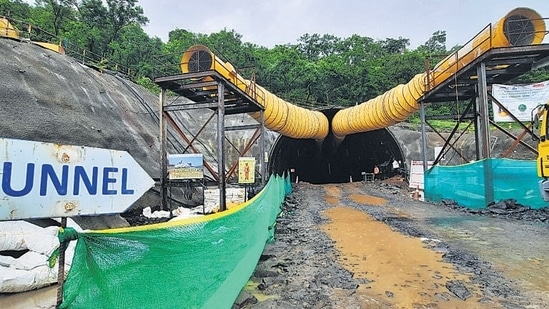
Work on the tunnel is now inching towards the mouth of Thane Creek. A portion of it will pass below the creek, making it India’s first undersea rail tunnel. The NHSRCL engineers have created a one-of-a-kind ‘T intersection’ from the Additionally Driven Intermediate Tunnel (ADIT) at Ghansoli in Navi Mumbai that connects it. At 110 metres, it is also the deepest point of this 21-km-long tunnel.
This entry point is nestled amidst a dense tree cover on the hilltop, water flowing downstream in the backdrop with a road connecting the ADIT. The ADIT acts as an entry/exit point and is perpendicular to the main tunnel. One half goes towards BKC (below Thane Creek) while the other is approaching Shilphata in Thane. In less than a month, 120 metres towards BKC and 110 metres on the Shilphata end have been dug, for which the engineers carried out 218 blasts using gelatin explosives. For the ADIT, 314 blasts have been carried out.
“The tunnel will be almost 25-30 metres deep into the earth’s crust from the bottom of Thane Creek,” said an NHSRCL engineer. “We are doing this work very carefully, using the New Austrian Tunnelling Method (NATM), as there are buildings and other structures around. Despite heavy rains, our work continues at this site.”
NHSRCL is now carving a single-tube rail tunnel for the Up and Down lines, and until now, the earth’s stratum has not given them much trouble. They undertake an average of four explosions a day. Sources explaining the process said that they were drilling almost 180 to 200 two-metre-deep holes using specialised equipment from Japan.
Two massive yellow-coloured, motor-powered rubber tubes force fresh air into the main tunnel through ADIT. This also helps the 150-odd workers who are at the site working two shifts. “Every time we undertake detonation work, we deflate the rubber tubes, switch off the high-powered lights and make our men stand outside. After the explosions, we defume the tunnel by pumping in fresh air,” said another engineer at the site.
Two warning sirens are sounded before multiple gelatin sticks are lit. After the blasting and defuming, a trained workforce enters the tunnel to inspect it and ensure that there are no loose rocks or chances of collapse. The rocks here are so sturdy that blasts dent barely three to four metres of the mantle.
Large JCBs queue up to remove the rocks fallen on the surface, followed by dumper trucks that carry the muck and rock to the designated dumping ground at Turbhe. Once the rocks are cleared, a semi-tunnel is created, which is strengthened using specialised cement, steel bolts and other elements. “A number of monitoring instruments are being installed into the tunnel to gauge any changes in soil, seismic activity and overall health of the tunnel. They give real-time updates and are directly connected to the server,” said another NHSRCL official.
The work is expected to be completed by December this year, and around the same time three large tunnel-boring machines (TBMs) will arrive at the shafts of Ghansoli, Vikhroli and BKC to take over the tunnelling work.
Sources said that the first TBM was likely to enter from Ghansoli before Thane Creek where the NATM works end and would help them go beneath the creek.
Work on the bullet train in Gujarat is a lot faster than in Maharashtra. The 352-km section through Gujarat is expected to open fully in 2027, after the opening of the section’s 50-km stretch from Surat to Bilimora in August 2026. The remaining section all the way till Mumbai is expected to open by the end of 2028.

Stay updated with all the Breaking News and Latest News from Mumbai. Click here for comprehensive coverage of top Cities including Bengaluru, Delhi, Hyderabad, and more across India along with Stay informed on the latest happenings in World News.


