
 E-Paper



Firm covers ‘blast floors’ of Supertech’s twin towers in Noida
Edifice Engineering, the private firm contracted to demolish Supertech’s 32-storeyed twin towers—Apex and Ceyane—in Noida, has started covering some of the floors with pieces of white cloth to ready them


Edifice Engineering, the private firm contracted to demolish Supertech’s 32-storeyed twin towers—Apex and Ceyane—in Noida, has started covering some of the floors with pieces of white cloth to ready them. Officials of the company said that the floors are covered beforehand as an additional security layer. There are about 10 floors in each building where all columns will be demolished during the blast. On the rest of the floors, several columns will be removed before the blast.
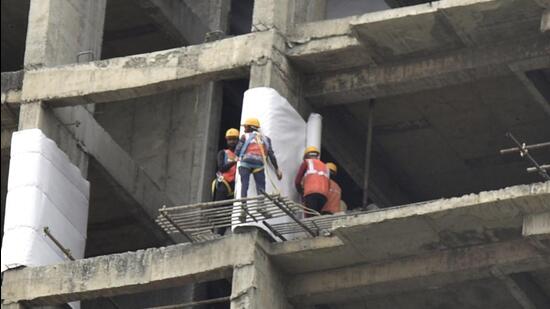
“We are covering the floors--also called blast floors--where all columns are to be demolished for security purposes. All columns on blast floors will come down on the same day. These floors will have several layers of protective covering to ensure that there is no flying debris. On several other floors, we will remove columns and load-bearing walls. These are non-blast floors,” said Uttkarsh Mehta, partner, Edifice Engineering.
He added that the ground, first, second and third floors of both buildings are blast floors and will be covered beforehand. Moving upwards, one floor after every two or three will be designated a blast floor, depending on the final blast plan. Every column and wall will also be separately covered with thin steel sheets and then with geo-textile fabric to prevent flying debris from the structure.
Following the test blast on April 10, officials of Edifice Engineering and Jet Demolitions are now designing the details of the actual blast depending on the structural details. Joseph Brinkmann, the managing director of Jet Demolitions, who conducted the test blast, is also designing the entire demolition process.
“Typically designing the blast with all safety considerations takes two or three months. We have to be extremely cautious because it’s a tall structure and very close to inhabited buildings. We cannot go even minutely wrong with the details. Every building is different and the blast is accordingly customised to ensure that the entire debris falls within the premises,” said Mehta.
The twin towers were to be demolished on May 22 following Supreme Court’s February 7 orders; however, following the test blast, experts said designing the actual blast will take longer than expected as the structure seems stronger than they assumed it would be. Officials expect that the date of the blast may have to be extended by over a month to ensure complete safety.
Officials of Edifice Engineering said they will employ several controlled implosions in a row (which will take place in quick succession) to demolish the towers. From the trial, they noted that more than the estimated quantity of explosives will be required for the final blast. Officials of Edifice Engineering and Jet Demolitions had earlier said that around 2,500-4,000kg of explosives would be required.The company will need to drill 8,810 holes in the two buildings that will each be about 2.2 metres long.
Officials said that the report from the trial may take another week to prepare, following which it will be sent to Petroleum and Explosives Safety Organisation, Central Building Research Institute and Noida authority. Preparing and charging the building will start only after the report is prepared and approved. Charging the building, which refers to placing the explosives at designated points, itself takes over 15 days, officials said.
Stay updated with all the Breaking News and Latest News from Mumbai. Click here for comprehensive coverage of top Cities including Bengaluru, Delhi, Hyderabad, and more across India along with Stay informed on the latest happenings in World News.


