
 E-Paper



Noida: AQI best in last five years on day after Diwali
Noida: The Air Quality Index (AQI) of national capital region cities in Uttar Pradesh was better this year compared to the last five years since 2018, despite less stringent action on the bursting of firecrackers


Noida: The Air Quality Index (AQI) of national capital region cities in Uttar Pradesh was better this year compared to the last five years since 2018, despite less stringent action on the bursting of firecrackers. However, the AQI reading was still in the “poor” category, hovering under 300 in Noida, Greater Noida as well as Ghaziabad.
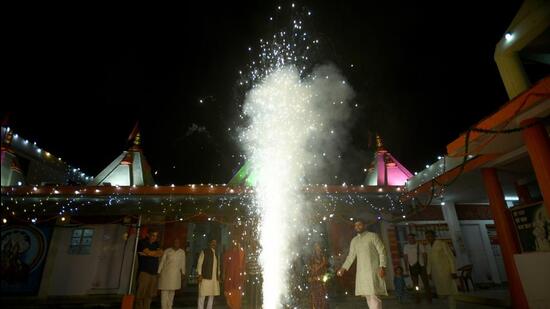
According to Central Pollution Control Board (CPCB), on Diwali, celebrated on October 24 this year, Noida’s AQI reading was recorded at 305 (very poor)--a significant improvement over the last five years, when the city recorded much worse air on Diwali day-- 404 (severe) on November 4, 2021 and 425 (severe) on November 14, 2020.
According to official records of the state pollution control board (UPPCB), the AQI reading on Diwali day in November 7, 2018 and October 27, 2019 was recorded at 288 (poor) and 358 (very poor).
An AQI reading between zero and 50 is considered “good”, 51 and 100 “satisfactory”, 101 and 200 “moderate”, 201 and 300 “poor”, 301 and 400 “very poor”, and 401 and 500 “severe”.
Officials said that there was a spike in pollution levels between 8.30pm and 1.30am on Diwali, most likely due to the bursting of firecrackers.
“Individual hourly monitoring of stations showed that there was a spike in pollution levels after 8.30pm up to 1.30am. After that the levels started reducing. Additionally, the major pollutant usually is PM10 in Noida due to the dust factor. On Monday, the major pollutant was PM2.5. This could most likely be due to bursting of firecrackers,” said Praveen Kumar, regional officer, Uttar Pradesh Pollution Control Board (UPPCB), Noida.
Additionally, despite the spike late at night, the AQI levels reduced to normal (for this time of year) by the next day, with CPCB recording 299 (poor) on October 25, a much better level compared to previous years’ reading of the day after Diwali--432 in 2018 (severe), 397 (very poor) in 2019, 337 (very poor) in 2020 and 475 (severe) in 2021.
Kumar added that with less stringent regulations on firecrackers this year, residents were seen bursting crackers till up to 2am in Noida and Greater Noida. Incidentally, nobody had taken permission for the sale of green crackers in Noida.
To be sure, according to a Supreme Court order, the sale and use of traditional firecrackers is completely banned in the NCR. While the Uttar Pradesh government did not impose a blanket ban on green crackers like neighbouring Delhi, the Commission for Air Quality Management on September 13 this year ordered that the use of green crackers (certified by Petroleum & Explosive Safety Organisation) will be banned in NCR if the Air Quality Index reading of the region crosses 200 (poor).
This year, the average pollution levels have generally been lower this month due to the late retreating monsoon as well. Officials say that while there may be a temporary spike in pollution, it can be attributed more to the overall weather conditions and stubble burning than to the use of firecrackers.
“We saw several ‘good’ air quality days in the last month because of the late retreating monsoon. Over the winter, the AQI will depend on the wind direction and weather conditions, along with stubble burning incidents,” said Utsav Sharma, regional officer, UPPCB Ghaziabad.
Stay updated with all the Breaking News and Latest News from Mumbai. Click here for comprehensive coverage of top Cities including Bengaluru, Delhi, Hyderabad, and more across India along with Stay informed on the latest happenings in World News.


