
 E-Paper



Not just red, orange zones central to Capital’s anti-Covid cleaning drives
Delhi chief minister Arvind Kejriwal on April 12 said that his government was focusing on zones designated “red” and “orange” to isolate and control the outbreak of the coronavirus disease that has so far infected 2,248 people in Delhi and killed 48.


New Delhi: The Delhi government has started an intensive cleaning and disinfecting campaign in the city, particularly in areas on the periphery of Covid-19 hot spots and those that are densely populated, by demarcating them as the “orange zones”, according to officials aware with the matter and government documents reviewed by HT.
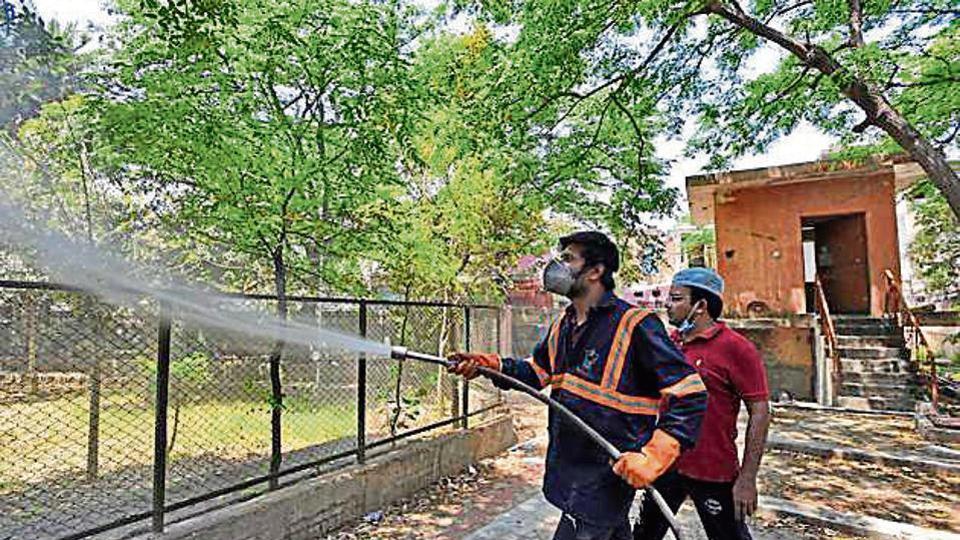
Delhi chief minister Arvind Kejriwal on April 12 said that his government was focusing on zones designated “red” and “orange” to isolate and control the outbreak of the coronavirus disease that has so far infected 2,248 people in Delhi and killed 48. The government has imposed a hard lockdown in its 89 containment, or “red” zones, with people not allowed to step out of their homes and authorities home-delivering essentials.
Along with this, a rolling list of “orange zones”, prepared every two to three days, identifies areas that are not yet infection clusters but could potentially turn into red zones. The Delhi government updates the list of orange zones regularly.
For example, in the April 19 and 20 list -- seen by HT -- Kailash Kunj and Kailash Hills in East of Kailash were included in the list of about 180 orange zones. Some other localities that were listed were Blocks A1, A4 & B5 of Safdarjung Enclave; the entire unauthorised colony of Sangam Vihar; Paschim Vihar; Dwarka Sector 6; Block C of Vasant Kunj; Savitri Nagar near Shekh Sarai; Wards 73 & 75 of Ashok Vihar; D Block of Malkaganj; Okhla Vihar; Block C of Yamuna Vihar and Boulevard Road in Chandni Chowk.
While some of the orange zones are lanes and blocks, others include entire localities – the contours of the high-risk zones depend on the demographic spread in the areas, a senior government official said on condition of anonymity.
A senior government official said that these areas are broadly chosen either based on their proximity to localities from where cases are being reported, on the basis of their vulnerability due to risk factors such as high population density. These zones are earmarked for large-scale disinfection and sanitation drives every few days.
The Delhi government recently acquired Japanese machines, which can sanitise an area of 20,000 square metres in an hour, to spray disinfectants in high-risk areas.
To be sure, Delhi’s red and orange zones are different from the Centre’s district-wise classification on similar lines. Nationally, the central government has classified districts into red, orange and green areas. While red zones, as defined by the Union health ministry, are “highest caseload districts”, also called hot spots; and orange zones are areas where no Covid-19 case has been reported in 14 days. All 11 revenue districts in Delhi are currently hot spots. The orange zones, as defined by the Union government, can be reclassified as “green zones” once no fresh cases are reported for another two weeks.
A second government official, requesting anonymity, said many congested areas have not reported any cases so far but they were included in Delhi’s list of orange zones because infection may spread very quickly there.
Some other areas on the April 19 and 20 list as per Delhi’s classification of orange zones were Mandoli; Ashok Nagar; West Jyoti Nagar; East Gokalpur; Rajgarh Colony in Shahdara; Blocks 52 and 52 of Karol Bagh; Kewal Park Extension and Majlis Park in Adarsh Nagar; F Block of Mansarovar Garden, Madan Park & Chhagan Park in Moti Nagar; Blocks 27 and 32 of Trilokpuri; and Nawada village in Uttam Nagar.
“People in buffer areas are in a state of risk because of proximity issues. They stay close to clusters that have recorded three or more cases. Several orange zones include areas around quarantine centres and hospitals. The reason is the same – proximity,” said the first official, asking not to be named.
“So far, all red zones have been covered for sanitation. They shall witness multiple rounds of disinfection in the days to come. Work on orange zones is part of our regular progress,” said Raghav Chadha, Rajendra Nagar MLA and vice-chairperson of the Delhi Jal Board (DJB) – the agency that is leading the sanitisation programme though sanitation in the Capital normally comes under the municipal corporations.
The municipal corporations and the Delhi Fire Services continue to operate sanitisation programmes in containment zones across the city. While Chadha said that the sanitisation efforts of the MCDs were “not up to the mark”, spokespersons of all three municipal corporations in the city asserted that they have been working round-the-clock and meeting goals set by the area district magistrates, who are the nodal officers under the Disaster Management law currently invoked across the country.
Jugal Kishore, head of the community medicines department at the Safdarjung Hospital, suggested that the government go for “targeted sanitisation”.
“Targeted sanitisation means, instead of randomly spraying disinfectant on roads and walls, the programme should focus on surfaces that are more likely to retain the virus and more prone to human contact. They include railings, stairs, gate handles, knobs, etc. The government can also explore the idea of disinfecting the indoor surfaces of residences in containment zones,” said Kishore, who leads one of the teams that is helping the Delhi government in tests and assessment of the burden of Covid-19.

Stay updated with all top Cities including, Bengaluru, Delhi, Mumbai and more across India. Stay informed on the latest happenings in World News along with Delhi Election 2025 and Delhi Election Result 2025 Live, New Delhi Election Result Live, Kalkaji Election Result Live at Hindustan Times.


