
 E-Paper



Path cleared for extension of Delhi’s Barapullah elevated corridor
The extension will provide signal free road access between east Delhi and south Delhi. Currently the Barapullah elevated corridor, known as the Baba Banda Singh Bahadur Setu, connects Sarai Kale Khan in south east Delhi to AIIMS in south Delhi.

 Prefer HTon Google


The Delhi government is in the final stages of acquiring an 8.5-acre land parcel in the Yamuna riverbed which will pave the way for the completion of the extension of the Barapullah elevated road corridor up to Mayur Vihar in east Delhi, senior government officials who are aware of the development said.
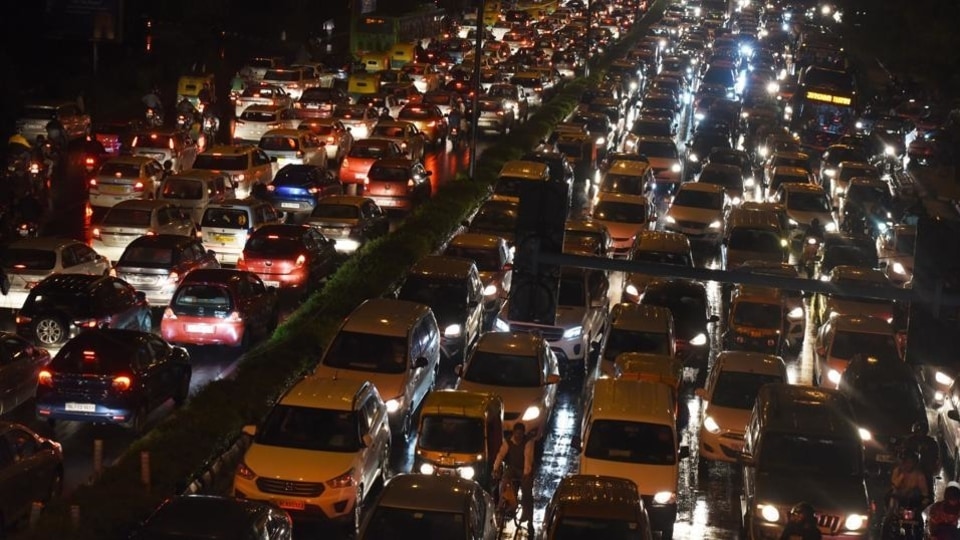
The extension will provide signal free road access between east Delhi and south Delhi. Currently the Barapullah elevated corridor, known as the Baba Banda Singh Bahadur Setu, connects Sarai Kale Khan in south east Delhi to AIIMS in south Delhi. The road corridor was developed for ferrying athletes during the 2010 Commonwealth Games.
The officials said this is the first land acquisition case processed by the Delhi government under the Right to Fair Compensation and Transparency in Land Acquisition, Rehabilitation and Resettlement (RFCTLARR) Act, 2013, said two senior Delhi government officials.
Almost five years after the government initiated the process to acquire two land parcels for the 790m-long section (500m and 290m) of the elevated corridor between Mayur Vihar and Sarai Kale Khan, the revenue department notified the draft Rehabilitation and Resettlement scheme identifying the beneficiaries last month.
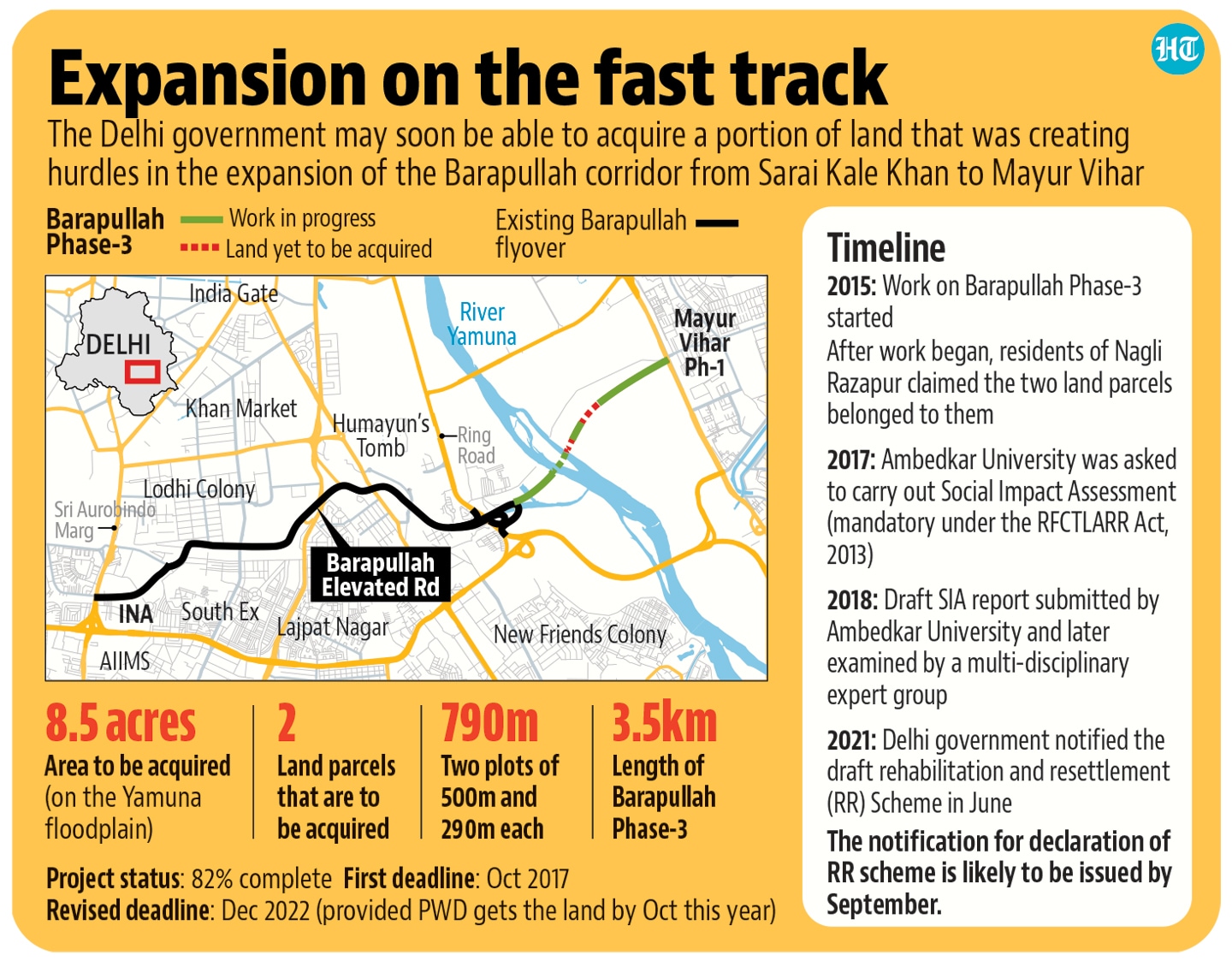
The land parcels belong to residents of Nangli Razapur village, located near Sarai Kale Khan ISBT. Villagers say that they have been waiting for compensation for the past five years. Rajbir Tanwar, a resident, said, “We have held several meetings with government officials in the past five years. But till date there is no clarity on when we will get the compensation amount.”
A senior south east Delhi district official said, “This is the first case processed under the RFCTLARR Act, 2013, by the government. We recently held a public hearing on the matter and have sent the file for final approval. We have been informed that the PWD department has released part payment to the revenue department for the acquisition process.”
Once the final approval is given, it will be sent to Delhi lieutenant governor for approval and declaration of the scheme. “We plan to notify the declaration by September. We will have to acquire the land within one year from the date of declaration,” said the official.
Villagers said they want the government to confirm the compensation amount. Bhopal Singh Chauhan, a farmer and village Pradhan, said, “In the meeting, officials didn’t tell us about the compensation amount. Our demand is that the government should pay ₹3 crore per acre.”
The compensation amount, the district official said, will be finalised at later stages.
Delhi PWD officials said that the ₹1,260 crore-project, which is crucial for addressing traffic congestion on Vikas Marg and Delhi Noida Direct flyway, is more than 80% complete and the remaining work will be completed within one year from the day they get possession of the land.
A senior Delhi PWD official said, “Just 18% of the work, mainly related to the two stretches which have to be constructed, on the elevated corridor is left. If we get the land by October this year, it should be complete by December 2022.”
Ever since the RFCTLARR Act came into force in 2013, the Delhi government’s land and building department officials said that no land has been acquired till date.
A senior official aware of the development said, “As this was the first to be processed, it took some time as we had to appoint a committee to do the Social Impact Assessment and follow all the provisions of the Act. We have 5-6 requests for land acquisition from DMRC and PWD. We are trying to expedite the process so that such delays don’t happen in the future.”
Anuj Dayal, executive director corporate communication, DMRC, “Out of these, about 8.71 hectares of permanent land has already been received by us. Deliberations are in progress for the rest of the land requirement. We are not facing any major issue pertaining to land acquisition as yet for phase 4.”
Infrastructure and urban planning experts say that the new land acquisition Act has made the process difficult. The DMRC has a direct purchase policy and even the National Highways Authority of India (NHAI) has provisions in its Act which makes land acquisition faster and easier. Experts say, there is a need to have a direct purchase policy for crucial infrastructure projects.
Sarvagya Srivastava, former engineer-in-chief of Delhi PWD, under whose tenure the Barapullah Phase-III project was conceived, said, “There is a need to have a direct purchase policy so that crucial infrastructure projects don’t get delayed,” said Srivastava.
He added, “It is due to bureaucratic inefficiency and indifference that such an important project has been stuck, which may lead to cost escalation and inconvenience to the public.”
A Delhi government spokesperson did not comment on the matter.
The DMRC has a procedure in place to ensure transparency in the acquisition process. Dayal said, “Only in exceptional circumstances, to avoid any delay in the completion of the projects, we enter into direct negotiation with private parties. In Phase 3, the DMRC acquired bare minimum land from private parties through direct negotiation.”
The Delhi Development Authority’s Urban Extension Road-II (UER-II) project, which is also referred to as the third ring road, is another case in point. The 79km-long corridor, which will connect four national Highways (NH 1, 2, 8 and 10), was approved by the UTTIPEC, the apex body for approval of traffic and transportation projects in Delhi, in 2016. But the DDA couldn’t start the work due to which it was transferred to the NHAI in 2018 to expedite the process.
Sabyasachi Das, former planning commissioner (incharge) at DDA, said, “One of the reasons for the UER-II project being transferred to NHAI was land acquisition on the new approved alignment. NHAI and DMRC both have provisions to expedite the land acquisition process.”
Nivit Kumar Yadav, director Industrial pollution unit, at the Centre for Science and Environment, said the Act of 2013 is aimed at protecting the interest of farmers who are directly or indirectly dependent on their land.
“The acquisition process is time consuming. It provides for several opportunities to the government to discuss and negotiate with the local community whose land is being acquired. Moreover, to acquire land for crucial infrastructure projects the state government should come up with schemes or policies. Several states such as Andhra Pradesh, Chhattisgarh, Jharkhand etc have come up with alternative solutions to acquire land. Land pooling is one such solution which has been used in Andhra Pradesh’s Amravati,” said Yadav, who also looks after the environment impact assessment and land acquisition related matters.


