
 E-Paper



Plea seeking ASI survey of closed Gyanvapi cellars to be heard on Aug 17
The plea originally sought an order to the ASI for conducting a survey of the closed cellars in the Gyanvapi mosque complex by using ground penetrating radar (GPR) and other modern techniques.


The court of Varanasi district judge Sanjiv Pandey on Saturday fixed August 17 as the next date of hearing on a plea seeking an order to the Archaeological Survey of India (ASI) for conducting a survey of the closed cellars in the Gyanvapi mosque complex by using ground penetrating radar (GPR) and other modern techniques.
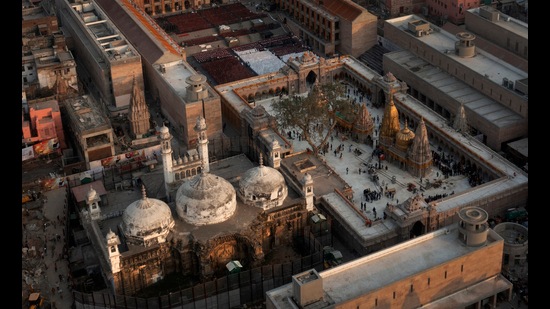
In February this year, Rakhi Singh, the main plaintiff in the “Rakhi Singh and Others Vs State of UP and others” suit, filed the plea in the district court through counsel Saurabh Tiwari, Manbahadur Singh and advocate Anupam Dwivedi.
On Saturday, Singh’s counsel Saurabh Tiwari presented his submission before the court, urging that the scientific survey of the closed cellars of Gyanvapi mosque by the ASI is necessary to determine the religious character of the Gyanvapi complex.
Tiwari said that the matter is pending since February 5. A copy each of the plea has already been given to the advocates of all the parties, including the Kashi Vishwanath Temple Trust.
Tiwari said the Anjuman Intezamia Masjid Committee, which looks after Gyanvapi mosque, filed an objection in the matter.
After hearing the submission, the court of the district judge fixed August 17 for the next hearing.
On January 31, the court of the then Varanasi district judge AK Vishvesha allowed Hindus to offer prayers at the southern cellar of the Gyanvapi Masjid.
Granting the family of a late priest the right to resume prayers in the southern cellar of the mosque after three decades, the then district judge had said that the petitioner Shailendra Kumar Pathak Vyas and a priest appointed by the Kashi Vishwanath trust, which manages the temple next door, will be allowed to enter the premises.
Following that order of the district court, worship began at the southern cellar, known as Vyasji Ka Tahkhana.
The January 31 verdict came days after the same judge furnished a copy of the Archaeological Survey of India (ASI) report on the same complex. The ASI survey conducted a study of architectural remains, exposed features and artefacts, inscriptions, art and sculptures, to conclude that there existed a Hindu temple prior to the construction of the Gyanvapi mosque.


