
 E-Paper



Shrouded in haze, Delhi gasps for breath
For the fourth straight day on Sunday, Delhi’s AQI was in the ‘severe’ zone, with 29% of the city’s PM2.5 load from stubble fires.


A veil of haze hanged over most parts of the city throughout Sunday as Delhi continued to receive a heavy load of pollutants from farm fires raging in the neighbouring Punjab and Haryana, turning the city’s air into a toxic cocktail of ultrafine microscopic particles and gaseous emissions.
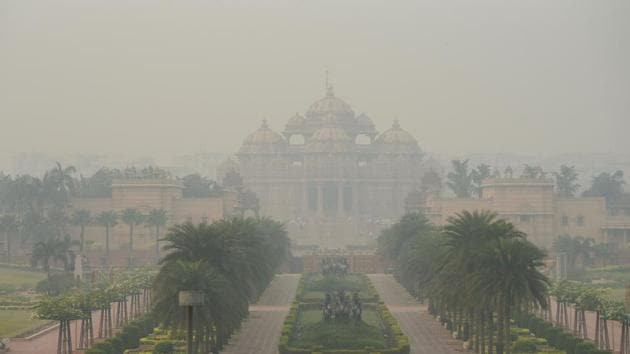
For the fourth consecutive day on Sunday, Delhi’s air quality index (AQI) was in the severe zone with a value of 416, indicating a health hazard to all those who were exposed to such poor air. Crop stubble fires in the northern states contributed to 29% of Delhi’s PM 2.5 load according to estimates by System of Air Quality and Weather Forecasting and Research, Indian Institute of Tropical Meteorology.
The PM 2.5 concentrations touched 250 micrograms per cubic metres on Sunday, over four times the national ambient air quality standards and 25 times the World Health Organisation prescribed limit of 10 micrograms per cubic metres.
There were over 4,900 fire points in Punjab on Saturday and over 3,500 on Sunday, according to data with the ministry of earth sciences (MoES). The combination of smoke from crop fires and calm winds led to air quality deteriorating significantly. Farmer leaders said crop fires are likely to continue till November 15, by when harvesting will be completed. One of the reasons for the prolonged stubble fire period in Punjab is the shortage of farm labour who had moved back to their states during the national lockdown for Covid 19 pandemic.
“Fires will continue for a week or so. All the late varieties of paddy are being harvested now. Many parts of the state faced labour shortage this year. Most of the farm labour comes from Bihar and UP. They travelled back home during lockdown. There was a labour shortage during the beginning of harvesting season,” said Harinder Singh Lakhowal, general secretary, Bharatiya Kisan Union. Agra, Bhiwadi, Baghpat, Bulandshahr, Faridabad, Ghaziabad, Gurugram and many other parts of northwest India also recorded “severe” air on Sunday.
Scientists said air quality is unlikely to improve in the next two days. “In the morning conditions were smoggy but, in the day, relative humidity is under 75% so what we are seeing is only smoke and pollution. Winds are calm so no dispersal of pollutants is possible. Visibility this afternoon is only 600 metres when normally during this season it should be at least 2,000 metres in the afternoon hours. There is no likelihood of improvement till Diwali. At the most, wind speed can increase up to 8 to 10 kmph,” said Kuldeep Shrivastava, head, regional weather forecasting centre.
A western disturbance is likely to impact the north western region around Diwali day on November 14, but that may not do much for dispersal of pollutants. “In fact, the wind direction will shift to easterly briefly on November 11 or 12 when wind speed will fall leading to accumulation of pollutants. The western disturbance is only likely to bring rain and snow to the upper reaches of hill states not to the north western plains,” Shrivastava added.
“There is anti-cyclonic wind circulation in the lower levels and subsidence (settling downwards) of air in large parts of northwest India presently. Both are linked to slow winds and accumulation of pollutants. We have been seeing a very large number of crop stubble fire points. The combination of these factors is leading to air quality index (AQI) hovering between very poor and severe categories for the past four days,” explained RK Jenamani, senior scientist, national weather forecasting centre. “The centre of the anticyclonic wind circulation is just south of Delhi today leading to most of the impact being felt here,” he added.
According to the Royal Meteorological Society, under an anticyclone air is descending forming an area of higher pressure at the surface. Because of these stable conditions, cloud formation is inhibited, so the weather is usually settled with only small amounts of cloud cover. This very stable atmosphere leads to accumulation of pollutants, experts said.
“Winds are in a transitional phase. On Monday evening, they may shift to north-easterly direction but there is no likelihood of any improvement in air quality because wind speed is likely to be very low. Air quality may remain severe on Monday also and we also do not expect any significant improvement around Diwali. The fire counts are extremely high, adverse meteorology is leading to AQI spiking to severe category,” said Vijay Soni, scientist, IMD, air quality division.
Ventilation index was only approx. 6000 m2/s on Sunday. The ventilation index is a function of the mixing height and the wind speed and defines the ability of the atmosphere to disperse contaminants. A ventilation index below 2,350 sq metres/second is considered poor. Mixing height is the height at which pollutants mix in the air.
Commission yet to meet
Though the six full-time members of the Commission for Air Quality Management for the National Capital Region (NCR) took charge on Friday, days after the Centre issued an ordinance on October 29 to set up the new centralised agency with sweeping powers to monitor and act against air pollution, the members haven’t met yet. Rules for the functioning of the commission are also yet to be framed.
“The meeting of the commission members is not dependent on framing of rules. The rules for the functioning of the commission will be framed in due course. The commission will meet next week and start its work,” said Ravi Agrawal, special secretary, ministry of environment.
MM Kutty, chairperson of the commission and former chief secretary of Delhi, did not answer calls on Sunday.

Stay updated with all top Cities including, Bengaluru, Delhi, Mumbai and more across India. Stay informed on the latest happenings in World News along with Delhi Election 2025 and Delhi Election Result 2025 Live, New Delhi Election Result Live, Kalkaji Election Result Live at Hindustan Times.


