


 Live Score
 Cricket Teams
 Cricket Players
Bad light debate: Use of the pink ball during daytime Tests is 'not that simple'
A senior BCCI umpire explains why using the pink ball during daytime Test matches is not feasible

 Prefer HTon Google


The first Test between South Africa and Australia ended earlier today at Kingsmead, Durban. The visitors played very well for the large part of the game to win by 214 runs, but the showdown—the first between the teams in the rainbow nation since the Sandpapergate series in 2018—garnered as much attention for bad light as for the Aussies’ brilliance on the field.
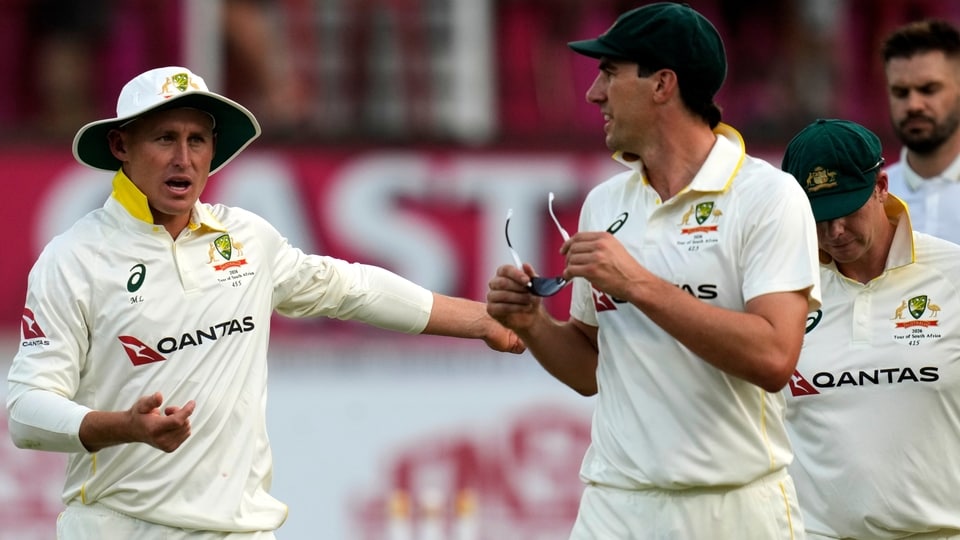
As per the new ICC ruling, the pink ball can now be used under floodlights in case of bad light during daytime games if both teams agree on it prior to the encounter. At Kingsmead, no such arrangement was agreed upon, so the pink ball wasn't used, even though bad light ended play prematurely on the first three days after 65.4, 80.4 and 75 overs respectively — a total loss of 48.4 overs.
Former South Africa captain Shaun Pollock, doing TV commentary at Kingsmead, expressed his displeasure at the whole development as he wanted both teams to shake hands on the use of the pink ball in advance in the event of bad light so as to facilitate an outright result.
"If this was a final or a game where you had to win to enter the World Test Championship final and it was 1-all in the series, and Australia was playing South Africa and you tell them, 'Let's use the pink ball because we are going to lose 100 overs to bad light,' do you think they would agree or not agree?" Pollock told Fox Sports.
Pollock had a point. Pat Cummins’ side won the game at the end of the day, but what if the match had ended in a draw, and it turned out that those lost overs got in the way of getting an outright result?
Test cricket has already lost so much of its sheen over the years, and outright results are a must to breathe life back into it. Even at Kingsmead, despite it being a high-profile series, there were not many spectators to speak of. Empty stands and open grass banks made the headlines in the global media.
During the match, Pollock also said there was no data supporting the claim that the pink ball swings significantly more than the red ball—a reason teams often hesitate to fully embrace day-night Tests.
‘It’s an experimental thing on ICC’s part’
However, according to a senior BCCI umpire who preferred to stay anonymous, the call isn't that simple.
“From what I understand, it’s [the new rule] an experimental thing on ICC’s part," said the senior umpire. "To begin with, the sighting of the ball isn’t great in the evening. The pitch has to be a certain way to facilitate sighting. The lacquer on the pink ball goes away faster compared to the other two balls. To ensure that it’s there for a longer period, the grass on the pitch has to be a certain number of millimetres, usually on the higher side, so that the lacquer can be retained for longer durations,” he told HT.
“Plus, the pink ball is very partial to fast bowlers. Spinners struggle big time. There is usually nothing for them off the pitch. The pitch has to be a little dry for the spinners to be effective, but that [if the pitch is made dry] affects the lacquer. You see, pink ball games end quickly, often inside three days. Players are not comfortable with the pink ball. That’s another truth. They are conditioned to play with red and white balls, even white balls pose problems during day games, as they are difficult to see against the bright sky when they go high up in the air.
“So, you have to understand why evenly-matched teams are unwilling to embrace the new ruling. A top team and a lesser team might say yes to it when there is nothing much at stake. With the World Test Championship points at stake, evenly-matched teams are unlikely to go for the new ruling. They can’t be entirely blamed,” he added.


