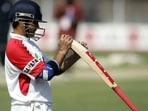
A master craftsman who infused Indian batting with artistic elegance and sportsmanship, Gundappa Ranganath Viswanath stood as one of the most beloved figures in international cricket. Born on February 12, 1949, in Bhadravathi, Mysore, the diminutively built right-handed batter captured public imagination through his wristy, aesthetic strokeplay, particularly his iconic square cut executed against high-velocity bowling.
Making his Test debut against Australia at Kanpur in November 1969, he became the first Indian cricketer to follow a first-innings duck with a century on debut by scoring a heroic second-innings 137. Across a distinguished 91-Test career spanning 14 years, he accumulated 6,080 runs at an average of 41.93, including 14 centuries and 35 half-centuries, establishing a legendary record that India never lost a Test match in which he registered a hundred.
Beyond his individual statistics, Viswanath occupied a pivotal place in Indian sports culture by delivering his greatest performances under extreme pressure on hazardous pitches. His masterclass unbeaten 97 out of India's total of 190 against a fearsome West Indian pace attack led by Andy Roberts at Chepauk in 1975 was acclaimed as one of the finest non-century Test knocks in history. Alongside his brother-in-law Sunil Gavaskar, he formed the batting backbone of the national side throughout the 1970s, playing an indispensable role in historic victories at home and abroad.
Viswanath's enduring legacy was equally defined by his unyielding commitment to the spirit of the game and fair play. Captaining India during the Golden Jubilee Test against England at Bombay in 1980, he famously recalled English batter Bob Taylor after an erroneous decision, a gesture of rare chivalry that transcended competitive outcomes.
Following his retirement from international play in 1983, he continued to shape Indian cricket as team manager, chairman of the national selection committee, and also served as an ICC match referee. Recognized with the Padma Shri in 1971 and the Col. C.K. Nayudu Lifetime Achievement Award in 2008, he remains immortalized as a true gentleman of the sport who proved that grace and greatness could coexist on the cricket field.


 Live Score
 Teams
 Players

 INDIA
 WI
 ENG
 AUS
 India
 Experience
 Very Bad
 Bad
 Ok
 Good
 Excellent