


 Live Score
 Cricket Teams
 Cricket Players
Sanju Samson's margin for failure shrinks as 15-year-old Vaibhav Sooryavanshi waits impatiently outside India's XI
Sanju Samson remains a proven match-winner, but Vaibhav Sooryavanshi's rapid rise has left him with far less room for repeated failures.

 Prefer HTon Google


Sanju Samson had already found two boundaries, and India were hardly under pressure. Chasing 157 against Afghanistan in Delhi, there was time for the opener to settle into an innings that could strengthen his hold on a position that has suddenly become fiercely contested. Instead, eight balls into his comeback, Samson attempted to pull Azmatullah Omarzai and found the fielder in the deep. Ten runs, another start gone, and another opportunity left incomplete.
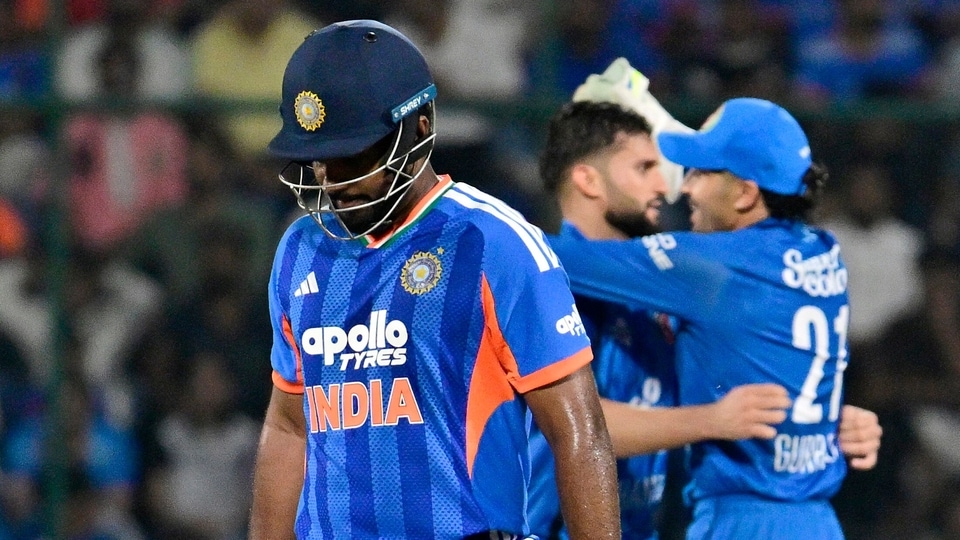
On most nights, it would have been a relatively insignificant dismissal in a chase India eventually completed with seven wickets and 38 balls to spare. Abhishek Sharma's brutal 82 off 32 balls made sure of that, while Ishan Kishan contributed 42. For Samson, however, the circumstances surrounding those 10 runs made them considerably more important.
India had chosen him ahead of Vaibhav Sooryavanshi. That decision itself represented considerable faith in Samson. Sooryavanshi had walked into the Afghanistan series after scoring 50 off 19, 20 off nine and 81 off 49 in three T20Is against Zimbabwe. The last of those innings had earned him the Player of the Match award. Yet when India picked their XI in Delhi, the 15-year-old was left out, and Samson was restored alongside Abhishek at the top.
Samson, therefore, wasn't simply being given another game. India had moved aside one of the most exciting young batters in world cricket to make room for him. That changes the value of every opportunity he gets.
Samson has earned patience, but how much?
There is an important distinction to make here. One failure should not put Samson's place in danger. Only six months ago, he produced arguably the finest tournament of his international career, scoring 321 runs in five innings as India won the 2026 T20 World Cup. His average of 80.25 and strike rate of 199.37 earned him the Player of the Tournament award. Those numbers alone provide a compelling argument for patience.
But inconsistency has repeatedly complicated Samson's India career, and even his World Cup brilliance did not entirely eliminate it. His first three T20I innings after the tournament produced 5 against Ireland, 0 in the second match and 1 against England. India then turned to Sooryavanshi before recalling Samson for the final England T20I, where he struck an aggressive 27 off 14 balls. He was subsequently absent from the Zimbabwe series.
That sequence captures the problem. Samson's ceiling has rarely been in doubt. When everything clicks, he can destroy attacks at a rate very few Indian batters can match. The uncertainty has always been about how frequently those innings arrive and how many quiet games India should tolerate while waiting for the next one. Earlier, the management could afford to answer that question by backing Samson through the failures. Now there is another name sitting outside the XI.
The Sooryavanshi-shaped shadow
Sooryavanshi's own introduction to international cricket was hardly flawless. He began with scores of 14, 13 and 15 in England. India nevertheless persisted with him, and the response arrived in Zimbabwe: 151 runs in three innings, including two half-centuries, at a strike rate well above 190 for the series. Across his first six T20Is, he has 193 runs at a strike rate of 189.21.
That patience is worth remembering when discussing Samson. The senior batter could reasonably argue that he deserves the same freedom to fail, particularly after what he achieved at the World Cup. The difference is that India are no longer deciding whether Samson deserves another opportunity in isolation. Every game given to him is now also a game not given to Sooryavanshi. Abhishek's spectacular innings against Afghanistan only tightens the equation further. One opening position increasingly appears his; Ishan remains another wicketkeeping and top-order option, while Sooryavanshi is waiting after scoring 81 in his previous international appearance.
That does not mean Samson should disappear from the XI after one score of 10. It means something more uncomfortable for him: his margin for error has shrunk. For years, Samson's inconsistency primarily tested India's patience. Now every missed opportunity carries an alternative. India know how destructive Samson can be, but they are also watching a 15-year-old whose potential is still expanding at remarkable speed.
Samson may still produce another run of innings that makes the discussion disappear. His talent has always allowed him to do that. But for perhaps the first time in his India career, waiting for that run comes with a visible cost.


