
 E-Paper



Chandni Chowk to be Delhi’s first pedestrian market
Residents of Delhi will soon be in for a smooth and hassle-free shopping experience, away from the noise and packed roads, with the launch of its first pedestrian market — Chandni Chowk in Old Delhi.


Getting stuck in a sea of traffic in an attempt to find a parking space, and then struggling to walk through the barrage of honking vehicles while trying to haggle with a street vendor for a T-shirt that caught your fancy may surely kill the excitement of shopping.
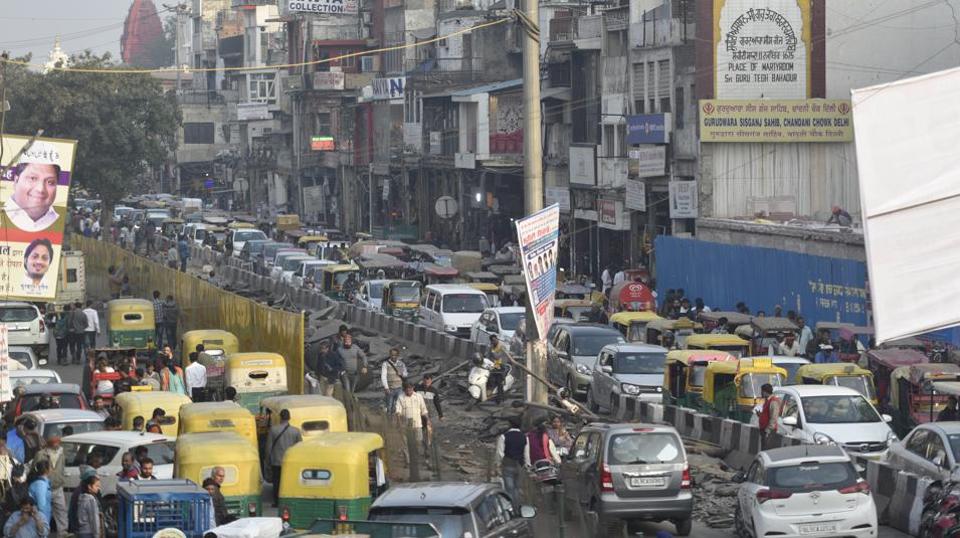
But residents of Delhi will soon be in for a smooth and hassle-free shopping experience, away from the noise and packed roads, with the launch of its first pedestrian market — Chandni Chowk in Old Delhi.
Hindustan Times looks at how the Delhi government — which is trying to achieve the mammoth feat of turning its markets into pedestrian-only spaces — is finally on course to make it a reality, even if only at one place so far.
A hopeful attempt
A month after the municipal agencies started work to convert the crowded streets of Chandni Chowk into an accessible space for pedestrians, traders — who had initially opposed the idea fearing loss of revenue— say business has started picking up.
Under its redevelopment project, the Public Works Department (PWD) has put up huge barricades to restrict traffic movement on the main Chandni Chowk-Fatehpuri Masjid road to give more space for people to walk. No motorised vehicle is allowed to ply on the stretch between 9am and 9pm.
Traders say the ease of reaching the market has made shoppers frequent the place these days.
Though he was initially apprehensive of the move, Chandni Chowk Traders’ Association president Sanjay Bhargava said pedestrianisation of Chandni Chowk was much needed and is, in fact, a very positive step.
“Now, that vehicular movement has been restricted, walking has become easy and customer footfall has increased. In the future, this model is going to be a huge success. Visitors will be able to park their vehicles at dedicated spots on arterial roads around the market and continue with their shopping,” he said.
Bhargava said Chandni Chowk was going to become a model for other markets after the redevelopment is complete and people will demand pedestrinisation of other markets.
Panna Lal, who runs a sweet shop, said if any market turns pedestrian-friendly, business is only going to boom.
“At present, there is not much difference in the footfall and the business. But once the project is complete, Chandni Chowk will become more accessible for visitors. Such models should be adopted in other crowded market places such as Lajpat Nagar and Karol Bagh,” he said.
Once completed, pedestrians say, the redevelopment project will help traders improve businesses and make shopping at a pleasant experience.
“The authorities have restricted vehicular movement, giving more space to pedestrians. Dust is a problem at present because of the construction work but that is only temporary,” a visitor, Lovkesh Kushwaha, said.
CP, a failed attempt
The sprawling Connaught Place in the heart of Delhi, which gets a footfall of thousands of shoppers and visitors every day, is an example of a failed attempt at pedestrianisation.
The New Delhi Municipal Council (NDMC) has unsuccessfully initiated multiple attempts to reserve the inner and the middle circles of the market for those on foot.
“We tried to reserve sections of the market for pedestrians but the plan did not take off because of resistance from traders who thought their business will get affected if shoppers are not allowed to come in cars,” a senior NDMC official, who did not wish to be named, said.
As a build-up towards making the market walkable, the agency had organised series of events under the ‘Raahgiri’ banner, which included blocking the market for motorised vehicles for certain hours on Sunday morning and promoted cycling and collective activities such as yoga and celebrity interactions, to increase public enthusiasm for walking. None of these could be sustained.
Mahesh Yadav, who owns a shop in CP’s inner circle, said the market is frequented by a fairly upscale crowd who wouldn’t want to come to a market where they will have to park their cars a kilometre away and walk.
“It is absolutely correct that the Metro leaves shoppers inside the market but a major section of our clientele do not use the Metro. They get their private cars, and if they face inconvenience, they would rather hang out and shop at Defence Colony or Khan Market,” Yadav said.
Urban design experts, however, believe CP has the perfect model to endorse pedetrianisation. The design of the market and the connectivity with all modes of public transport—Metro (Rajiv Chowk, Janpath and Barakhamba Road), public buses on Outer Circle and readily available auto rickshaws and cabs—will make pedestrianisation a low-investment achievement.
“If parking is restricted only to the outer circle as the NDMC design had proposed, shoppers will not even have to walk a lot to reach the centre of the market. CP is the easiest market where the plan could have been implemented,” said Raghuvendra Sinha, researcher and consultant in sustainable transportation in Delhi.
Delhi markets vs international markets
A few years ago, the municipal corporations had started pedestrianising Ajmal Khan Road in Karol Bagh but the project was left midway due to lack of support from traders and implementing bodies.
Just like Delhi, Paris has also been trying to dedicate landmarks in the city such as Notre Dame Cathedral and Central Market only for pedestrians. The only difference is the approach of the two governments.
In an interview to local media, Anne Hidalgo, the mayor of Paris, said the idea for moving ahead with the plan would be to get citizens on board with ideas on its implementation plan.
Experts back home agree that unless all stakeholders are taken into confidence, it would be difficult to launch such massive projects.
Popular markets such as Lajpat Nagar, Karol Bagh and Sarojini Nagar can be converted into pedestrian-only spaces by setting up seating arrangements, food courts and shallow fountains to attract crowds, experts said.
“In Delhi, most markets are planned to cater to the convenience of walkers. Cars have only spoilt the shape of these centres and made them crowded and less accessible. If we try to regain the face of these markets, the footfall will improve and businesses will pick up,” said Romil Dang, an independent design consultant who works with state governments to improve public spaces.
With Delhi Metro going to markets such as Lajpat Nagar and Sarojini Nagar, there is all the more reason for agencies to attempt pedestrianisation along these markets.
Residents of these areas said though the market area is easily walkable, the lack of pedestrian facilities such as continuous footpaths make the task of shopping difficult. The conversion of areas around these markets into parking spaces has also deterred people from using public transport.

Stay updated with all top Cities including, Bengaluru, Delhi, Mumbai and more across India. Stay informed on the latest happenings in World News along with Delhi Election 2025 and Delhi Election Result 2025 Live, New Delhi Election Result Live, Kalkaji Election Result Live at Hindustan Times.


