
 E-Paper



Delhi’s Covid-19 test positivity rate 15.3 %, highest in 140 days
Experts see positivity rate as a crucial metric to assess an outbreak in a community and, when this number is coupled with an increase in new cases, it can determine how fast a contagious disease is spreading.


The Capital reported 3,235 new cases of the coronavirus disease (Covid-19) on Diwali, as per Sunday’s health bulletin, a dip in infections that came on a day when testing fell to a 76-day low, even as the state battles a third wave of the pandemic that has seen deaths and hospital admissions rise sharply.
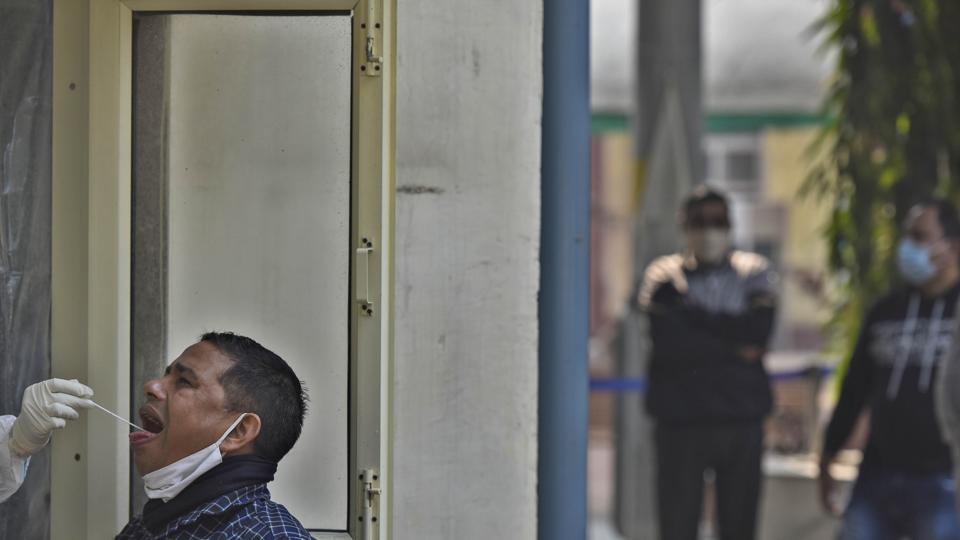
In a matter of continuing concern, the positivity rate on Saturday soared to a 140-day high.
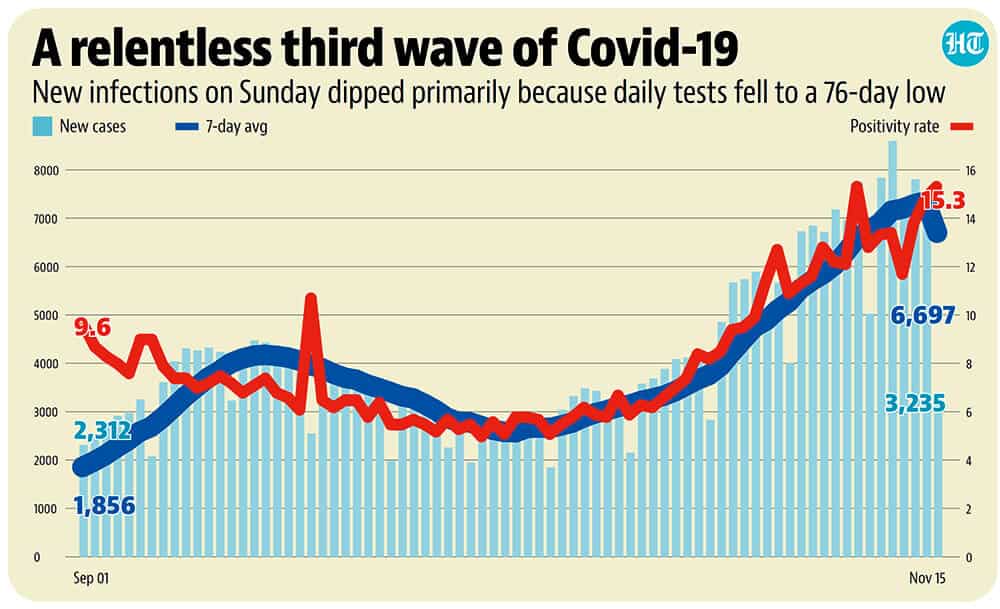
While new infections dipped to their lowest since October 26, this only happened because daily tests saw a massive drop and fell to 21,098, the lowest since August 31. In contrast, Delhi had been conducting an average of around 54,000 tests a day in the week before Diwali.
The positivity rate, meanwhile, continued to rise as it touched 15.33% on Saturday — the highest since 15.37% on June 27, indicating that if the government had maintained a regular testing number, the cases would have been significantly higher.
Further, only around 9,000 of the tests on Diwali day were conducted using the more accurate RT-PCR (reverse transcription polymerase chain reaction) method.
The positivity rate — the number of positive cases among total tests — usually goes up with increase in the number of RT PCR as it is a more sensitive test that can pick more positive cases as compared to its alternative rapid antigen test.
Experts see positivity rate as a crucial metric to assess an outbreak in a community and, when this number is coupled with an increase in new cases, it can determine how fast a contagious disease is spreading.
According to recommendations by the World Health Organization (WHO), the positivity rate from a region that has a comprehensive testing programme should be at or below 5% for at least two weeks before an outbreak is considered under control
Experts have attributed the current exponential rise in cases to the festive season, hazardous pollution levels, as well as the dip in temperatures.
“The number of cases is likely to remain high for at least two more weeks after Diwali, with people being out and about aiding the spread of the infection. It is also known that the low temperatures and high levels of pollution leads to increase in respiratory infections including Covid-19; this might lead to more infections in the coming time,” said Dr Jugal Kishore, head of the department of community medicine at Safdarjung hospital.
Concerns remain over the ability of the city’s health infrastructure to handle the severe Covid-19 caseload.
With over 8,700 people with the infection hospitalised across the city, facilities too are fast running out of intensive care unit (ICU) beds. Over 87% of the 3,542 ICU beds earmarked for the treatment of the Covid-19 patients across hospitals were occupied as on Sunday evening, as per data on the Delhi Corona app. Over 53% of all Covid-19 beds were occupied, as per the app.
The number of available ICU beds are likely to go up, however, with the Delhi high court allowing the government to reserve 80% of the total ICU capacity in 33 big private hospitals.
“Even as more are being opened up for Covid-19 patients,they are filling up fast. If the number of cases continues to go up further, there will be a problem,” said Dr Vikas Maurya, director, department of pulmonology and sleep disorders at Fortis Hospital, Shalimar Bagh.
On Sunday, the city also recorded 95 deaths due to the infection, taking the total toll to 7,614. Earlier this week,the city had seen the highest single day mortality of 104 deaths in a day, higher than the 101 recorded during the June-July surge, when protocols for treatment were still being developed.
“If the hospitals are overwhelmed and the beds get exhausted, naturally the mortality of the disease will go up. People who are in need of ICU care or oxygen support need it in a timely manner. Also, if we look at Covid-19 cases, most people are preferring to stay in home isolation. These days people also have the oxygen saturation monitors at home. So, chances are those who reach the hospitals are in need of immediate medical attention. If they do not get it, they are likely to die,” said Dr Shobha Broor, former head of the department of virology at the All India Institute of Medical Sciences (AIIMS).


Stay updated with all top Cities including, Bengaluru, Delhi, Mumbai and more across India. Stay informed on the latest happenings in World News along with Delhi Election 2025 and Delhi Election Result 2025 Live, New Delhi Election Result Live, Kalkaji Election Result Live at Hindustan Times.


