
 E-Paper


Covid-19 update: Delhi starts e-token system for liquor purchases to avoid crowding
The weblink was non-functional till Thursday night. A senior official attributed that to “high traffic within a limited time after announcement” and claimed that it would be functional in a few hours.

 Prefer HTon Google


To avoid crowding at liquor shops, the Delhi government has started issuing e-tokens, specifying the store and timings, for residents on a web link set up by the excise department. Since Monday, when the government allowed around 172 liquor shops in the city to open after more than six weeks of lockdown, people have been crowding spaces outside liquor stores, violating social distancing norms that are mandated to curb the spread of Covid-19.
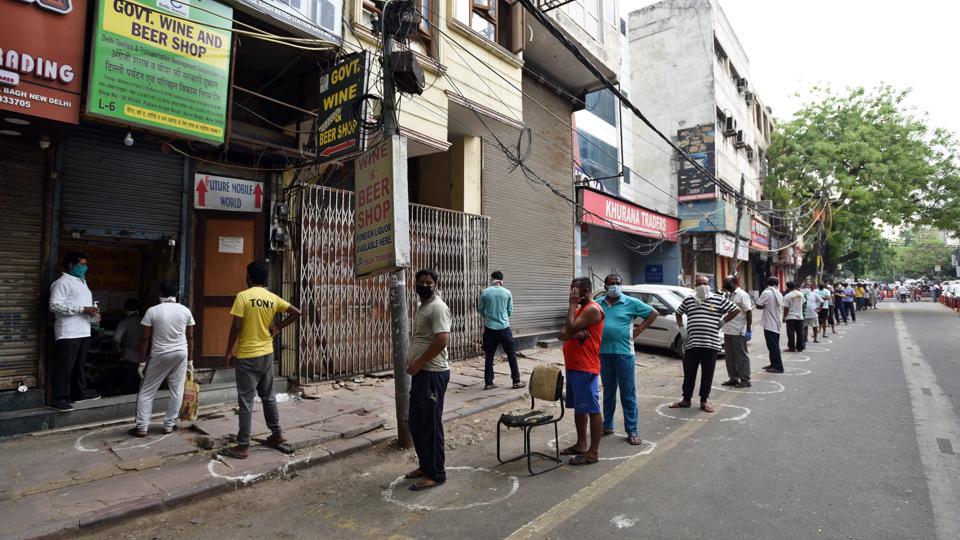
The government continued its deliberations over home delivery of liquor and a decision is likely to be taken by the weekend, a senior official said. The chief secretary has already asked the excise commissioner to chalk out a plan “at the earliest”, he said.
“In a bid to ensure social distancing and to stop overcrowding at the liquor shops, the Delhi government on Thursday launched an e-token service to buy liquor. The Delhi government took this decision to encourage people to avoid long queues by applying for an e-token with time slot at any nearby shop to buy liquor,” read a government statement issued on Thursday.
The statement read, “Any person can apply for an e-token through the link ‘https://www.qtoken.in/’. Name and phone number will be required while applying and the e-coupon will be sent to the registered mobile number. With that e-token, the person will be allowed to buy liquor from the nearby shops. This will be an additional facility to reduce overcrowding at the liquor shops.”
The weblink was non-functional till Thursday night. A senior official attributed that to “high traffic within a limited time after announcement” and claimed that it would be functional in a few hours.
While Thursday was a dry day in Delhi, liquor shops would also start issuing coupons to people standing outside in queues, as per a government order, which also directed the deployment of marshals, to ensure social distancing, and use of more barricades, for area management.
The additional tax of 70% on the maximum retail price of liquor would continue in Delhi.
The municipalities on Thursday submitted a list of 30 private liquor shops in the city that are not located in markets, malls, commercial spaces and shopping complexes, and, hence, qualify for relaxations under the Central government’s guidelines applicable to red zones a second senior government official said. “An order to implement relaxation for private shops is expected in a day or two. Meanwhile, all government shops that were allowed to operate but could not function over the last four days for a range of reasons — lack of staff, inadequate stock to law and order issues — are set to resume from Friday. Increasing the overall strength of shops to 200 would help reducing mass gatherings outside shops to a large extent,” the official said.
Delhi has 864 liquor shops, of which 475 are owned by government departments, ranging from tourism to industrial and infrastructure development. The other 389 are owned by private individuals and enterprises.
“Only 50 (of the 172) could function full day on an average between Monday and Thursday. That is one reason for massive crowds outside most shops,” the second senior government official said.
While most government shops function with L-6 and L-8 licences, which allow the sale of Indian manufactured foreign liquor and country liquor, respectively, most private shops have an L-10 licence, which allows the sale of imported liquor too.
On Thursday, representatives of the Confederation of Indian Alcoholic Beverage Companies wrote to Delhi chief minister Arvind Kejriwal, seeking a review of the 70% special corona fees and urged that private shops that are not located in containment zones be allowed to open and restaurants, bars and pubs be allowed to sell their unfinished stock by initiating a “take-away only” facility.
The Confederation also urged the government to allow home delivery of liquor. “Such a facility can reduce at least 15%-20% physical crowd from the shops… A clear announcement of the period of imposing the special cess would also help people plan their purchases and reduce crowds,” said Vinod Giri, the director-general of the Confederation.
On Thursday, the Confederation met deputy chief minister Manish Sisodia and submitted a memorandum.


