
 E-Paper



Delhiwale: An architecture in self-isolation
The only daily intrusion to the Khanqah’s solitude is the sunlight that travels through the courtyard from morning to evening, turning the whole place into a kind of sundial with its play of shifting light and shadow.

 Prefer HTon Google


A word like ‘freedom’ acquires its true meaning only to those denied it. And so do words like “quarantine’ and ‘self-isolation’, gradually getting more real to us as we experience either or both of them to some degree, due to the coronavirus.
Armed with new understandings, it is a revealing experience to enter places in the city, that one might have explored in the BC (Before Corona) era. Some of these landmarks reveal themselves to be the architectural equivalent of self-isolation. Such as the Hijron ka Khanqah, in south Delhi’s Mehrauli. The first word in the name refers to transgender people who live in closely-knit communities. The second word implies a retreat in Persian.
Believed to be a Lodhi-era graveyard, the Hijron ka Khanqah lies like a secret in the heart of a congested bazaar. Its entrance, between store fronts, is barely perceptible to the eye. On entering, however, the world changes abruptly. Gone is the chaos of the bazaar. The airy courtyard opens out like a placid sea, with wavelets rippling along its surface. The waves are, in fact, the dozens of graves spread across the courtyard. On counting, they turn out to be exactly 50.
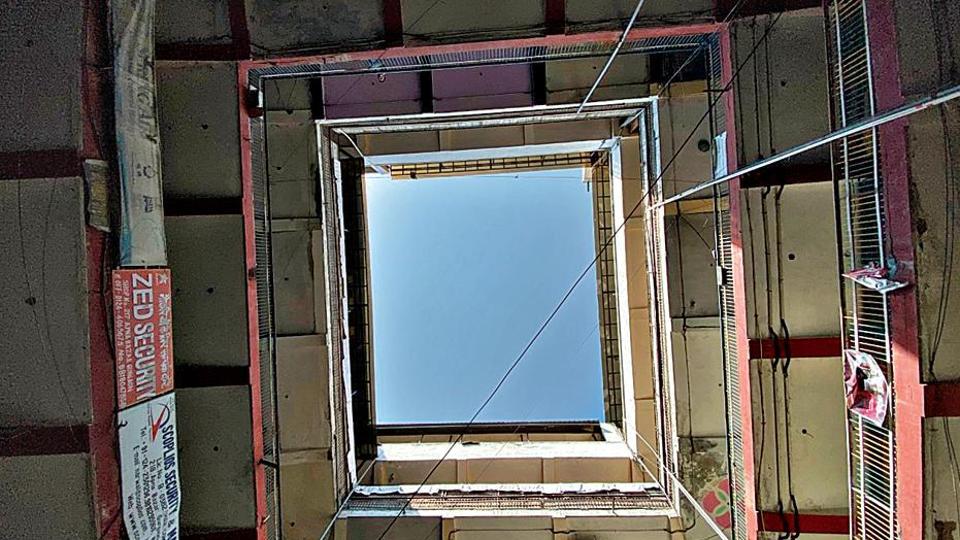
This sunny afternoon the clear sky over the Khanqah is like a blue ceiling. The place is empty except for its caretaker. He informs that the Khanqah is especially sacred to transgender people, who tend to be its only visitors, apart from rare sightseers interested in Delhi’s forgotten monuments.
The only daily intrusion to the Khanqah’s solitude is the sunlight that travels through the courtyard from morning to evening, turning the whole place into a kind of sundial with its play of shifting light and shadow.
The pigeons, too, gather in large numbers. Some probably drop dead from the sky. Two birds are discovered lying lifeless.
Pointing to the courtyard’s only grave privileged enough to have a roof of its own, the caretaker explains that it is the burial spot of the sister of a man known as Sheikh Baba. Pilgrims usually come in “tolis” (groups) on Thursday afternoons, and offer flowers at the revered grave, perched under the shade of a giant neem tree. “They sit here in the courtyard, offer prayers and sometimes cook food.”
A partially broken staircase goes up to a terrace from which one can see the entire Khanqah in a single sweep of the eye. From here, the place loses its confidentiality, as you see the neighbourhood crammed all around it. This so-called retreat now appears very much part of the world, to the point of being absorbed by it and disappearing.


