
 E-Paper



Why anti-smog guns cannot clean Delhi’s polluted air
The pollution levels, instead of dipping, spiked drastically even as gallons of water were sprayed throughout the day starting from 10am. The trial continued till 6pm.


Spraying water through ‘anti-smog guns’ will not be able to curb Delhi’s air pollution, said experts after the trial run failed to bring any improvement in the air quality at Anand Vihar ISBT on Wednesday.
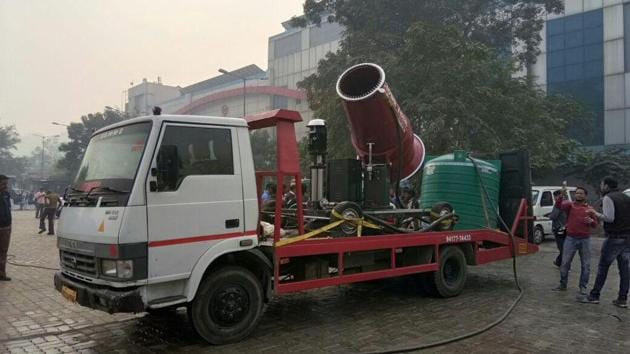
The pollution levels, instead of dipping, spiked drastically even as gallons of water were sprayed throughout the day starting from 10am. The trial continued till 6pm.
Here are some of the reasons why the device, which is usually used to curb pollution levels in coal mines, cement factories and thermal power plants, cannot be used to clean Delhi’s air.
Best suited in small areas
“Anti-smog guns are usually used to control pollution in a small place such as a stadium.They can also be used in coal mines, cement factories and thermal power plants to control dust pollution,” said a senior official of the state environment department.
They are not suitable to bring down pollution levels in a metropolises like Delhi which has multiple sources of pollution that contribute throughout the day.
Diesel generator sets required to run them
Even though the anti smog gun was run with power from the grid on Wednesday, representatives of the company which developed the machine said that it would require diesel generator (DG) sets to run the machine when it moves around the city.
This would in turn add to the pollution levels. It is because of the high rate of emissions of DG sets that it was banned in Delhi by the Supreme Court appointed panel Environment Pollution (Prevention & Control) Authority (EPCA) during the Graded Response Action Plan in force in winter.
“We always need to maintain a balance. The pollutants added to the air should not be more than what is subtracting. DG sets would add to the pollution,” said Vivek Chattopadhyay, senior program manager at Centre for Science and Environment’s air pollution control unit.
Coverage area
Each ‘fog canon’ can spray the water to a maximum distance of 50 metres. Hence the trial run was done within a few metres of the air monitoring station at Anand Vihar. When the monitoring station did not show the desired result, the water was sprayed on the air directly above the station which could have damaged the monitoring station’s instruments.
“Moreover, had the monitoring station reflected a drop in pollution levels it would have sent a wrong signal as the gun would have brought down pollution levels near the station only while other areas in Anand Vihar would have been reeling under severe pollution,” said a senior official of the environment department.
A drain of money and water
The company representatives said that the machine which was used for trial run was just a miniature form. The actual smog gun could carry 12,000 litres of water and can cost up to Rs 35-Rs 40 lakh.
“In a bid to cover the entire city several such anti-smog guns have to be used. It would be waste of money and water. And even then it might not achieve the desired targets. Hence it is advisable to spray water on the roads and construction sites instead of spending money on these costly machines,” said a senior official.

Stay updated with all top Cities including, Bengaluru, Delhi, Mumbai and more across India. Stay informed on the latest happenings in World News along with Delhi Election 2025 and Delhi Election Result 2025 Live, New Delhi Election Result Live, Kalkaji Election Result Live at Hindustan Times.


