
 E-Paper



Some of our price woes are imported, from across Atlantic
Manoj Kumar, a roadside barber, blames price rise on the government, the easier thing to do. He is just about right, although some of his inflation has to do with decisions taken on the other side of the Atlantic. Zia Haq reports


Manoj Kumar, a roadside barber, blames price rise on the government, the easier thing to do. He is just about right, although some of his inflation has to do with decisions taken on the other side of the Atlantic.

When expenses go up, the first thing people notice is food prices, the single biggest slab of their monthly expenditure, which rose 9% in August. But India's food price spiral is part homegrown and part global.
Analysts say India's inflation is tied to five, fairly entrenched factors. One of these is the US central bank Federal Reserve's decision to launch "QE3," or a third round of "quantitative easing."
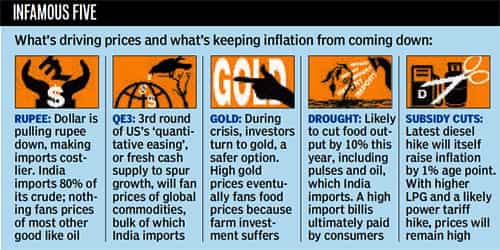
Essentially, the Fed will increase money supply to make borrowing and spending easier so that the US economic activity picks up. It will release $40 billion a month till jobs are back.
Two earlier rounds of QE — in 2008-10 and 2010-11 — did help the US economy but also fanned global inflation because of an economic home-truth: too much money chasing too few goods.
Flush with money, speculators stepped in to buy and sell oil, apart from other commodities, in the futures market without taking actual possession of these goods, spurring prices. The QEs shot up global oil prices by up to 40%, according to EuropaCom.
Overall, India imports more commodities — such as pulses and nickel — than it exports to meet domestic demand. It imports up to 80% of its crude. Nothing knocks up prices of goods more than the price of oil.
"If the world is taken to be a single economy, India is a part of it, so Indian prices rise too," former chief economic adviser Kaushik Basu said.
A falling rupee because of higher demand for dollar has also made oil imports costlier. There's evidence now that high gold prices — at their highest decadal level — eventually hit food inflation because investors concentrate on gold, not on food supply.
Among chief homegrown reasons for inflation, this year's poor monsoon is foremost. India on Sunday cut summer food output by 10%. "Lower production means pressure on inflation," Madan Sabnavis, the chief economist of inflation tracking firm, Care Ratings, said.

Stay updated with all top Cities including, Bengaluru, Delhi, Mumbai and more across India. Stay informed on the latest happenings in World News along with Delhi Election 2025 and Delhi Election Result 2025 Live, New Delhi Election Result Live, Kalkaji Election Result Live at Hindustan Times.


