
 E-Paper



Indian economy beyond the 8.2% Sept quarter growth | Number Theory
Having said that, there is good reason to look at a broader picture of the Indian economy than just the immediate numbers
Updated on: Dec 12, 2025, 08:54:33 IST

 Prefer HTon Google
Share via


Copy link

The Indian economy is in a rare Goldilocks period, RBI Governor Sanjay Malhotra said after the Monetary Policy Committee (MPC) meeting on December 5. An 8% plus growth and lowest ever inflation in the month of October is indeed a good place to be for any economy. Having said that, there is good reason to look at a broader picture of the Indian economy than just the immediate numbers.

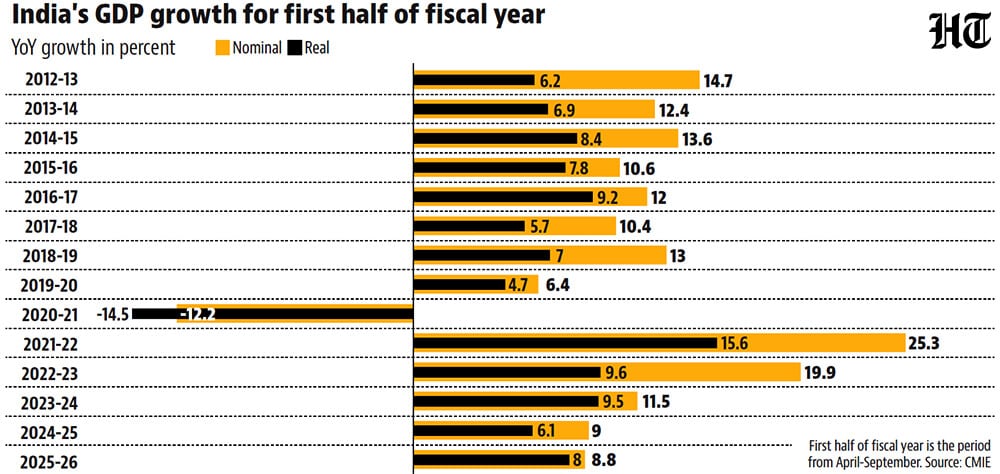
 While real growth is impressive, nominal growth is lower than average in the first half of the fiscal yearWhen read together, real GDP growth in the first half of the current fiscal year (April-September 2025) is 8%. If one were to exclude GDP growth in the corresponding period for 2020-21 and 2021-22 – the former saw a pandemic induced contraction and the latter was contaminated by base effect and persisting disruption because of the second wave of the pandemic – median GDP growth between 2012-13 and 2025-26 for H1 is 7.4%. This means that the 2025-26 H1 performance is clearly above median. However, this is not the case when it comes to nominal growth where the 2025-26 H1 number (8.8%) is significantly lower than the median (11.75%). While real GDP growth is what is widely used for measuring growth, the nominal number is not without significance, especially for fiscal matters as well as business and labour incomes (more on this later). See Chart 1: H1 real and nominal growth
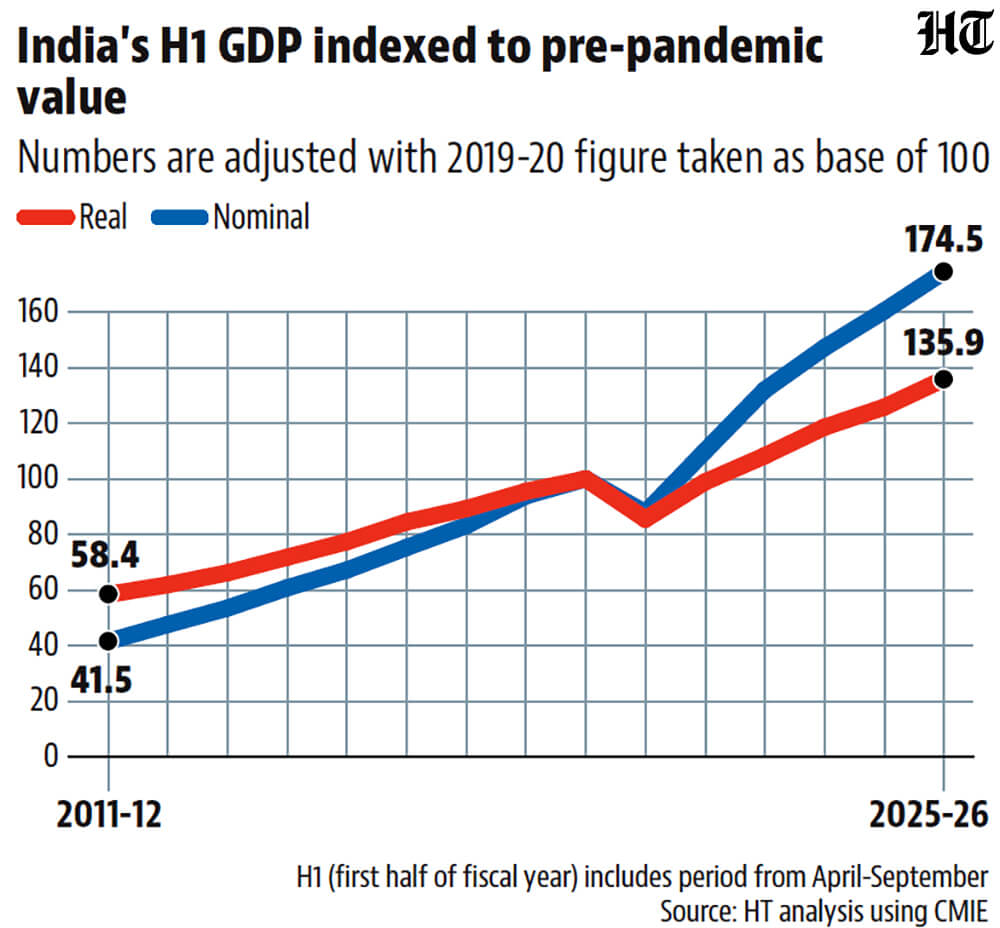
- To be sure, this does not take away from India’s impressive post-pandemic growthIndia has retained its position as the fastest growing major economy in the world for many years now. This has also given a decent post-pandemic trajectory for the Indian economy. The slowdown in nominal GDP growth in the more recent period notwithstanding, both nominal and real GDP have grown well if one were to take the pre-pandemic GDP (2019-20) as the base. See Chart 2: Absolute GDP based to pre-pandemic levels
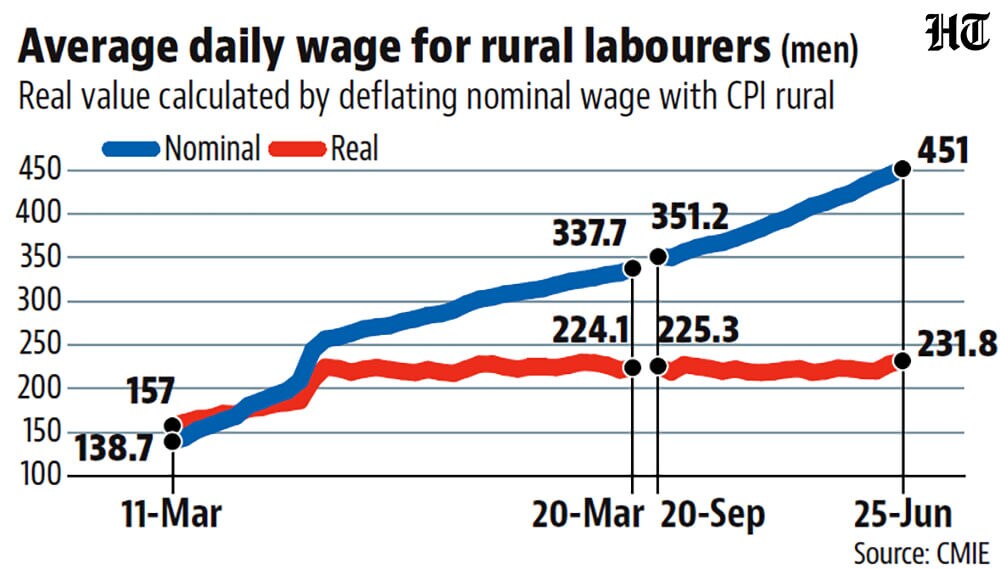
- The real poor have built some sort of inflation immunity in IndiaCounter-intuitive as it sounds, an important labour market statistic suggests this for the Indian economy. Labour Bureau’s daily rural wage data can be considered the lowest base of blue-collar wage in India. Rural labour markets are also the glacial source of blue-collar workers in Indian cities as well. A long-term trajectory of rural wages shows that the real wage has almost perfectly adjusted to inflation leading to a constant real rural wage in India over the past many years. This suggests that the most basic blue-collar earning has found a stable anchor or sorts in India. This could partly be a result of welfare measures, especially subsidised food and also cyclical adjustments to migrant flows of rural workers to urban areas. This, in a way, also explains, the larger political stability amidst cyclical fluctuations in India’s economic performance. See Chart 3: real and nominal rural wage in India
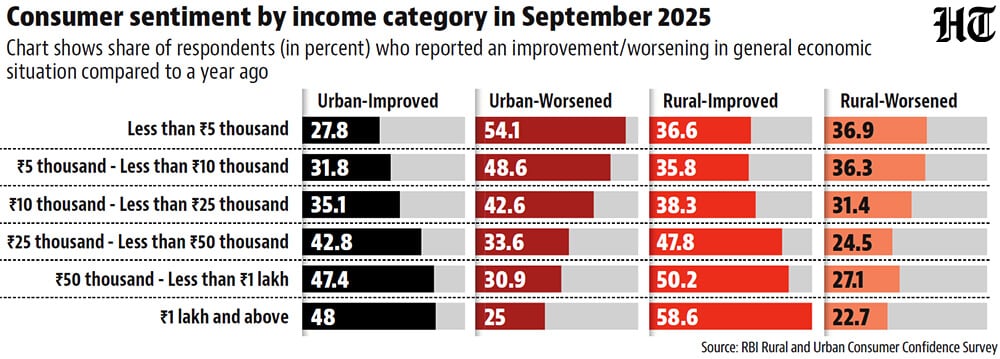
- But a comparison of latest consumer sentiment data suggests that urban poor could do with a boostWhile statistics and indices matter, fortunes of the economy are as dependent on animal spirits as past data. This is where consumer sentiment also comes into play. RBI’s Consumer Confidence Survey (CCS) is the consumer sentiment metric which is used by India’s central bank for its policy making purposes. Because CCS now has both rural and urban versions and also provides unit-level data which allows classifying sentiment according to income cohorts. That lower income cohorts show a weaker consumer sentiment than their richer counterparts have been a trend in CCS data for some time now. However, the latest unit level CCS data for September 2025 – it coincides with the latest available GDP data – shows that the consumer sentiment asymmetry between rich and poor in urban areas is greater than in the rural areas. Is this a reflection of the fact that lower nominal growth in the economy has eaten into some of its dynamism, thereby weakening sentiment to a larger extent for the urban poor than the rural poor (as the latter have established some sort of basic minimum in terms of real over the years)? If this is indeed the case, then the economy could indeed do with some degree of higher inflation compared to what prevails today. The real challenge, however, is not in answering this question in principle but how to go about achieving this in praxis. See Chart 4: rural-urban consumer sentiment

Unlock a world of Benefits with HT! From insightful newsletters to real-time news alerts and a personalized news feed – it's all here, just a click away! -Login Now!


